



New Jersey’s real estate market is entering a defining moment, one shaped not by lack of demand, but by a structural imbalance that is fundamentally altering how—and when—young adults are able to live independently. Across the state, a convergence of elevated mortgage rates, persistent student debt burdens, and a critically constrained supply of entry-level housing is reshaping the traditional path to homeownership. The result is a measurable and accelerating shift: more young adults are staying at home longer, not as a fallback, but as a calculated financial strategy.
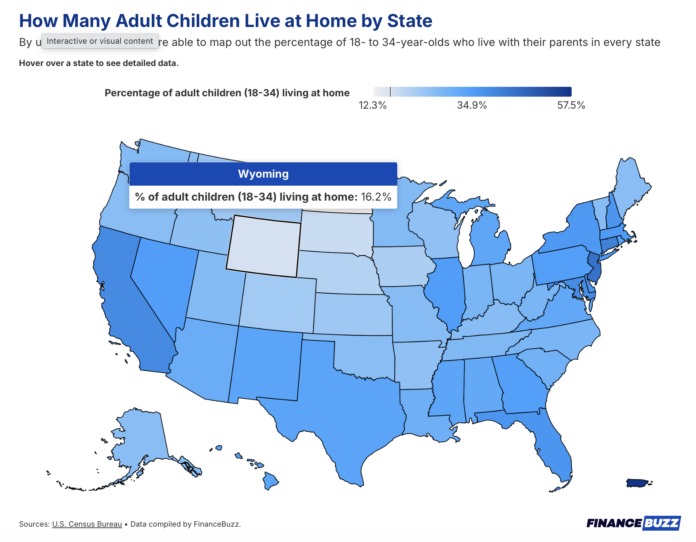
The latest U.S. Census data underscores the magnitude of this transformation. Approximately 33% of individuals between the ages of 18 and 34 are currently living with their parents, a figure approaching levels last seen during the peak of the COVID-19 era. In New Jersey, however, the trend is even more pronounced. At 44.1%, the state leads the nation, signaling a localized housing pressure that extends well beyond national averages and into the structural realities of one of the country’s most competitive residential markets.
This is not a temporary anomaly. It is a reflection of systemic conditions that have been building for years and are now fully manifesting across the state’s housing ecosystem. In high-cost regions like North Jersey, Hudson County, and parts of Central New Jersey, the pathway from renting to owning—or even from dependent to independent living—has become increasingly complex. What was once a linear progression is now a multi-stage financial strategy that often includes extended periods of saving, debt management, and delayed household formation.
Real estate professionals across the state are observing this shift in real time. In markets like Jersey City, where demand remains strong but affordability continues to tighten, nearly half of prospective first-time buyers are currently living at home or have recently returned after an initial attempt at independent living. This is not simply a matter of preference. It is a response to a market that requires more capital, more planning, and greater financial resilience than at any point in recent memory.
The drivers behind this trend are both immediate and deeply embedded. Student loan debt remains a significant barrier, particularly in New Jersey, where borrowers carry an average balance exceeding $37,000. Monthly obligations in the range of $300 to $450 may appear manageable in isolation, but when integrated into mortgage qualification frameworks, they have a profound impact on purchasing power. These recurring liabilities can reduce borrowing capacity by tens of thousands of dollars, effectively shifting entire segments of the housing market out of reach for younger buyers.
At the same time, interest rates have fundamentally altered the economics of homeownership. The difference between historically low rates and current market conditions is not incremental; it is transformational. A buyer who could previously afford a $400,000 home at a 3% rate is now, under higher-rate conditions, constrained to a significantly lower price point. This compression of purchasing power is not theoretical—it is directly influencing buyer behavior, inventory absorption, and overall market velocity.
Compounding these financial pressures is a shortage of what the industry refers to as “starter homes.” In many parts of New Jersey, the inventory of entry-level properties has been steadily declining, driven by a combination of factors including redevelopment trends, investor activity, and the economics of new construction, which often favor higher-margin, larger-scale builds. The absence of accessible inventory at the lower end of the market creates a bottleneck effect, where first-time buyers are unable to enter the market, which in turn slows movement across all tiers of housing.
This dynamic is particularly visible in suburban markets that have traditionally served as entry points for younger buyers. Towns that once offered a range of affordable options are now seeing increased competition, limited supply, and rising price floors that exceed what many first-time buyers can reasonably afford. As a result, the decision to remain at home is no longer viewed as a delay—it is increasingly framed as a strategic move designed to preserve financial stability and accelerate long-term goals.
From a broader economic perspective, this shift carries significant implications. Delayed household formation affects everything from rental demand and consumer spending to long-term wealth accumulation and generational equity. When young adults postpone homeownership, they also delay participation in one of the primary mechanisms for building wealth in the United States. Over time, this can widen existing disparities and reshape the demographic composition of homeownership across the state.
At the same time, the trend is not uniform across the country. States with lower housing costs and more abundant inventory are experiencing significantly lower rates of young adults living at home. In places where affordability aligns more closely with income levels, the traditional progression toward independence remains more intact. This contrast highlights the extent to which New Jersey’s housing challenges are tied to its unique combination of demand, geography, and economic positioning within the broader Northeast corridor.
Within the context of New Jersey’s real estate sector, the current environment is forcing a recalibration of expectations. Buyers are adjusting timelines, sellers are navigating a more complex demand landscape, and developers are increasingly tasked with balancing profitability against the need for accessible housing. Policymakers, too, are facing mounting pressure to address supply constraints and explore solutions that can expand entry-level inventory without compromising the character or infrastructure of existing communities.
What is emerging is a market that is both resilient and constrained. Demand remains strong, driven by population density, employment opportunities, and the state’s proximity to major metropolitan centers. Yet the ability of that demand to translate into transactions—particularly at the entry level—is being limited by structural factors that cannot be resolved through short-term market adjustments alone.
For Sunset Daily News New Jersey readers tracking the evolution of the state’s housing landscape, this moment represents a critical inflection point. The decisions made now—by developers, lenders, policymakers, and buyers themselves—will shape the accessibility and functionality of the market for years to come. Understanding the forces at play is essential, not only for those directly involved in real estate, but for anyone invested in the broader economic health of the state.
To explore how these trends are unfolding across different markets and to stay informed on the developments shaping New Jersey’s housing future, visit the real estate section, where ongoing coverage continues to map the intersection of affordability, demand, and long-term growth.
As more young adults in New Jersey navigate the realities of high costs, constrained inventory, and evolving financial priorities, one thing is becoming increasingly clear: the path to independence is not disappearing, but it is being redefined. And in that redefinition lies the future of the state’s real estate market.