


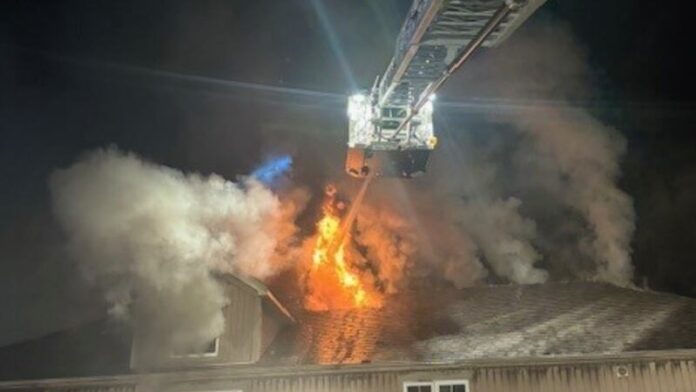

An early morning house fire in Collingswood has become more than a single-incident response story—it is now a defining case study in the mounting operational pressures facing local fire departments across New Jersey. What began as an urgent residential emergency quickly evolved into a broader test of municipal readiness, inter-agency coordination, and the structural limits of a department already navigating staffing constraints.
The incident unfolded in the early hours of the weekend, when firefighters were dispatched to a residential blaze that had already escalated by the time crews arrived on scene. Initial response units were immediately forced into a dual-priority scenario: suppressing an active fire threatening property and life, while also managing the urgent medical needs of an injured resident. Under ideal conditions, these responsibilities would be handled simultaneously by a fully staffed department equipped with dedicated personnel for both fire suppression and emergency medical operations. In this case, however, Collingswood’s available resources were stretched thin.
With firefighters fully engaged in controlling the blaze and preventing further structural damage, the department faced a critical limitation—there were not enough available personnel to safely transport the injured individual to medical care. Mutual aid was quickly requested, bringing in support from neighboring jurisdictions to assist with emergency transport while Collingswood crews remained focused on extinguishing the fire. The coordination worked, but the necessity of that call for help has become the central issue now under scrutiny.
Commissioner Amy Henderson Riley did not downplay the implications. In the immediate aftermath, she pointed directly to the incident as a clear and urgent illustration of the borough’s ongoing staffing challenges. Her assessment reflects a growing concern not just within Collingswood, but across municipalities statewide, where fire departments are increasingly being asked to do more with fewer personnel, often under conditions where seconds carry life-altering consequences.
This particular fire response underscores a critical vulnerability in emergency operations: the inability to fully compartmentalize responsibilities during high-risk incidents. Fire suppression, victim rescue, medical stabilization, and transport are distinct functions that require dedicated staffing to be executed effectively and safely. When those roles begin to overlap due to personnel shortages, the margin for error narrows dramatically. In Collingswood’s case, the reliance on mutual aid ensured that the injured resident received care, but it also highlighted a dependency that cannot always be guaranteed in more complex or widespread emergencies.
Across New Jersey, this scenario is becoming increasingly familiar. Departments are balancing rising call volumes, evolving emergency response expectations, and workforce limitations that are not being resolved at the same pace as demand. The challenges extend beyond recruitment; retention, training capacity, and budget allocations all factor into the equation. The result is a system that, while still highly capable, is operating closer to its limits than at any point in recent memory.
Coverage within the state’s law and order reporting has consistently pointed to these structural pressures, particularly as municipalities confront the realities of modern emergency response. Fire departments are no longer tasked solely with extinguishing fires. They are integral components of a broader public safety network that includes medical response, disaster preparedness, and community risk reduction. That expanded role requires a level of staffing and resource allocation that many towns are still working to achieve.
In Collingswood, the weekend fire has accelerated that conversation. The incident is now being viewed not just as an isolated emergency, but as a catalyst for policy discussion and operational review. Local officials are expected to revisit staffing models, funding strategies, and inter-agency agreements in an effort to ensure that future responses are not constrained by the same limitations.
At the same time, the performance of the firefighters on scene cannot be overlooked. Operating under pressure, they executed a coordinated response that ultimately contained the fire and facilitated medical assistance for the injured resident. Their ability to adapt in real time, prioritize effectively, and integrate mutual aid resources reflects a level of professionalism that remains a cornerstone of New Jersey’s emergency services. The issue at hand is not capability—it is capacity.
The broader implication is clear. As communities continue to grow and the demands placed on emergency services evolve, the infrastructure supporting those services must keep pace. Staffing levels that may have been sufficient a decade ago are now being tested by more complex incident profiles and higher expectations for rapid, multi-faceted response.
For Collingswood, this fire may ultimately serve as a turning point. It has brought visibility to an issue that can no longer be addressed incrementally. The need for sustainable staffing solutions, reinforced mutual aid frameworks, and forward-looking investment in public safety is no longer theoretical—it is immediate.
In a state where local departments form the backbone of emergency response, the lessons from this incident will resonate well beyond a single borough. They will inform how municipalities prepare, how they allocate resources, and how they ensure that when the next call comes in—whether it is a fire, a medical emergency, or something more complex—the system in place is not just responsive, but resilient.