

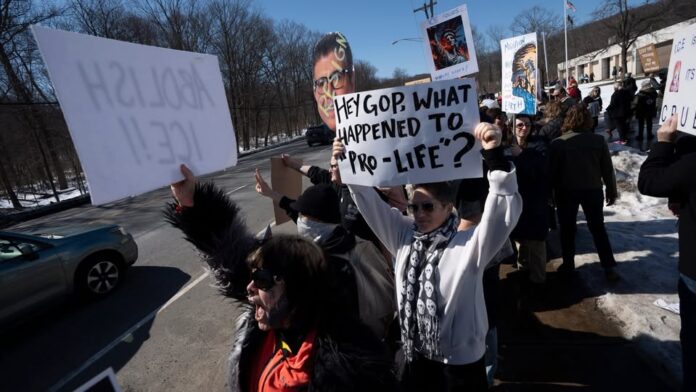

NEWARK, NJ — In a forceful and highly charged demonstration that underscored New Jersey’s growing role as a national political battleground, longtime civil rights leader Lawrence Hamm delivered a sweeping rebuke of former President Donald Trump while standing before a large and energized crowd gathered at the Lincoln Statue in Newark. The rally, organized under the banner of the “No Kings” movement, was not framed as a symbolic protest—it was presented as a direct, coordinated response to what organizers described as escalating threats to democracy, civil liberties, and electoral integrity ahead of the upcoming midterm elections.
Hamm, who serves as chairman of the People’s Organization for Progress, set the tone early with a message that was as expansive as it was uncompromising. Addressing a coalition of activists, labor leaders, elected officials, and community organizers, he outlined a sweeping indictment of Trump’s political agenda, his administration’s legacy, and what he characterized as a broader institutional alignment involving Congress and the Supreme Court. The rally, he emphasized, was rooted in opposition to what he described as “racist, fascist, and unjust policies” both domestically and internationally, positioning the gathering as part of a larger national resistance movement.
The Newark event was not an isolated demonstration but a coordinated mobilization backed by a broad coalition of organizations spanning labor unions, civil rights groups, political advocacy networks, and grassroots community organizations. More than 40 groups endorsed the rally, signaling a level of organizational density and political alignment that reflects a deeply interconnected progressive infrastructure across New Jersey. This included major labor entities, education associations, civil liberties advocates, and long-standing community organizations, all converging under a unified message centered on voting rights, economic justice, and systemic reform.
The presence of Newark Mayor Ras Baraka further elevated the political significance of the event, reinforcing the city’s role as both a symbolic and operational hub for progressive activism in the state. Alongside him were key voices from the American Civil Liberties Union, the Newark NAACP, and organized labor leadership, each contributing to a program that blended policy demands with ideological framing. The rally’s structure was deliberate—less a spontaneous protest and more a strategic demonstration designed to amplify specific legislative and political objectives.
At the core of Hamm’s address was a detailed list of demands that extended far beyond electoral concerns. While the headline message centered on a call for Trump to cease any attempts to interfere with midterm elections, the broader platform touched nearly every major fault line in contemporary American politics. From immigration enforcement and federal policing to economic inequality, labor rights, and healthcare access, the rally functioned as a comprehensive articulation of progressive priorities heading into a critical election cycle.
One of the most urgent themes was the protection of voting rights and the integrity of the electoral process. Hamm accused Trump and his allies of attempting to undermine democratic systems through policy proposals and administrative actions, specifically calling for an immediate halt to any efforts that could impede voter participation. He also demanded the return of ballots allegedly seized in Georgia, framing the issue as part of a broader pattern of interference. The call for legislative action was equally clear, with support voiced for expanded voter access measures, same-day registration, and the overturning of campaign finance rulings that have allowed significant financial influence in elections.
Economic issues were also front and center, with Hamm advocating for a $20 minimum wage, the restoration of federal budget cuts, and stronger protections for workers. The rally’s alignment with organized labor was evident not just in attendance but in messaging, as speakers emphasized the need for pro-union legislation and the rebuilding of workforce stability following widespread layoffs and policy shifts. The economic argument was framed not only in terms of wages but also cost-of-living pressures, with criticism directed at tariff policies and broader fiscal strategies.
Immigration policy emerged as another focal point, with particularly strong language directed at federal enforcement agencies. Hamm called for the abolition of Immigration and Customs Enforcement, the closure of detention facilities, and accountability for alleged abuses. Specific cases were cited to underscore claims of systemic harm, and demands were made for the removal of federal enforcement presence from local communities and transportation hubs. These positions reflect an increasingly assertive stance among progressive organizations in New Jersey, where immigration remains a deeply contested issue with both local and national implications.
Healthcare, education, and taxation rounded out the platform, with calls for universal healthcare, the elimination of student debt, and increased tax contributions from high-income individuals. These proposals were presented not as aspirational goals but as necessary corrections to what speakers described as systemic inequities exacerbated by federal policy decisions.
Perhaps the most politically explosive element of the rally was the explicit call for impeachment—not only of Trump but also members of his administration and sitting Supreme Court justices. This demand, while unlikely to materialize in the immediate term, signals the intensity of opposition and the willingness of organizers to push beyond conventional political boundaries. It also reflects a broader trend in progressive activism toward more aggressive institutional challenges.
The Newark rally illustrates a critical shift in how political movements are organizing at the state level. New Jersey, often viewed as a reliably blue state, is increasingly positioning itself as a staging ground for national political narratives, particularly as the country approaches another high-stakes election cycle. Events like the “No Kings” rally are not just expressions of dissent—they are strategic interventions aimed at shaping public discourse, influencing policy, and mobilizing voters.
What emerged in Newark was not a fragmented protest but a highly coordinated demonstration of political intent. The convergence of labor, civil rights organizations, elected officials, and grassroots activists signals a level of alignment that could have significant implications in the months ahead. As midterm tensions escalate nationwide, New Jersey is making it clear that it will not remain on the sidelines—and voices like Lawrence Hamm are ensuring that message resonates far beyond the city limits.