


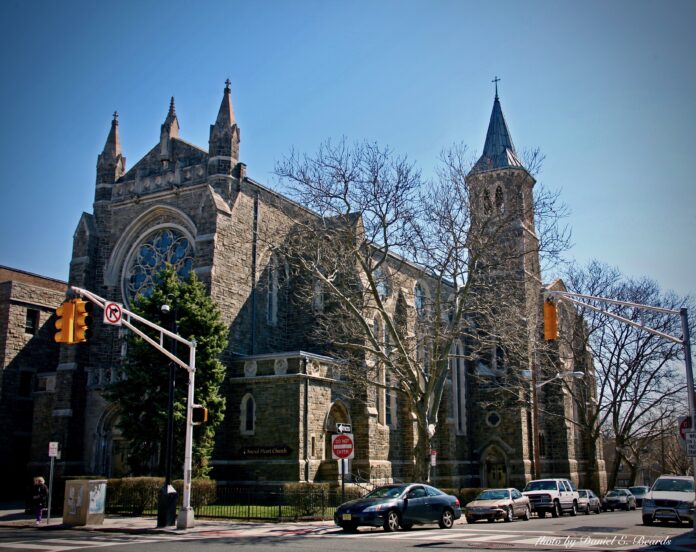

A long-dormant religious landmark in Jersey City’s Greenville section is officially entering a new era after city officials approved the first major phase of an ambitious adaptive reuse project designed to transform the former Sacred Heart of Jesus campus into a large-scale mixed-use residential community while preserving one of the neighborhood’s most historically recognizable properties. The newly approved phase marks the first tangible construction movement in a redevelopment effort that has been discussed for years and could ultimately reshape a significant portion of Bayview Avenue through a combination of historic preservation, residential expansion, educational investment, and community-centered redevelopment.
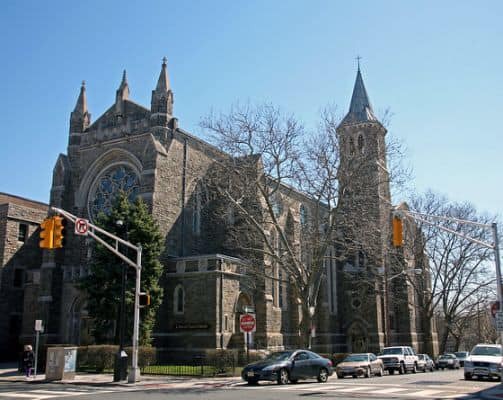
The approval by the Jersey City Planning Board signals the beginning of a broader revitalization effort known as The Enclave at Sacred Heart of Jesus, a sweeping redevelopment proposal centered around the former church campus located at 183 Bayview Avenue. The property has remained largely inactive since Sacred Heart closed in 2005, although portions of the campus have continued operating through a private school that remains active on-site. For nearly two decades, the complex stood as one of Greenville’s most visible symbols of institutional decline, with its historic structures largely shuttered despite their architectural significance and longstanding role within the community.
Now, after years of planning, zoning modifications, redevelopment negotiations, and conceptual redesigns, the first component of the campus overhaul has officially secured approval, pushing the project from vision into implementation. The initial redevelopment phase focuses on the former Priory building, a historic structure that once functioned as a religious dormitory connected to the church complex. Under the approved plan, the building will be transformed into a 14-unit multifamily residential development while preserving much of its original architectural character.
The redevelopment strategy reflects a growing trend across Jersey City and the broader Northeast corridor where historic religious institutions, many struggling with declining congregations and aging infrastructure, are being reimagined through adaptive reuse projects that blend preservation with urgently needed housing development. In the case of Sacred Heart, the approach attempts to balance neighborhood history with modern residential demand while avoiding wholesale demolition of the campus’ most architecturally important structures.
Designed by Weckenmann Architecture, the approved first phase intentionally limits exterior alterations to preserve the Priory’s historic identity. Rather than dramatically altering the building footprint or adding modern additions that could compromise the original design, the redevelopment plan focuses on restoration, modernization, and interior repurposing. Existing openings will receive updated windows while the structure itself undergoes preservation work intended to maintain its historic appearance within the surrounding streetscape.
One of the project’s most distinctive features involves the adaptive reuse of the Priory’s double-height chapel space, which developers intend to convert into a shared amenity area for future residents. The decision reflects a broader architectural philosophy increasingly common in adaptive religious reuse projects where sacred gathering spaces are preserved architecturally even as their functions evolve to support contemporary residential lifestyles.
The approved residential mix includes ten one-bedroom apartments alongside four two-bedroom residences, slightly reducing the original proposal from 16 units to 14. While relatively modest in size compared to the broader redevelopment vision for the campus, the first phase serves as a critical proof of concept for the larger Sacred Heart transformation now gradually taking shape in Greenville.
The project notably excludes vehicle parking during this initial phase, a planning decision that aligns with Jersey City’s increasing emphasis on transit-oriented urban development and reduced automobile dependency in dense residential corridors. Instead, the development includes bicycle parking accommodations, pedestrian improvements, refreshed landscaping, restored fencing, and upgraded sidewalk infrastructure intended to integrate the property more effectively into the surrounding neighborhood fabric.
Beyond the immediate residential conversion, the Sacred Heart redevelopment carries far larger long-term implications for Greenville’s future growth trajectory. The broader master plan envisions the campus evolving into a multi-component mixed-use complex featuring residential housing, educational facilities, event space, community infrastructure, and modernized public-facing amenities. If fully realized, the redevelopment could become one of the most substantial preservation-driven neighborhood transformations currently underway in Jersey City.
Future phases outlined in the larger redevelopment proposal include the conversion of the main church structure into a multi-use event venue, potentially giving the historic sanctuary a second life as a gathering destination capable of hosting community functions, cultural programming, and private events. Additional plans include transforming the still-active school building into a separate 12-unit residential property while constructing a new 96-unit residential building on the site currently occupied by the gymnasium parking lot.
The larger proposal also previously included plans for a newly constructed multi-story Sacred Heart School facility totaling approximately 34,000 square feet, demonstrating that educational infrastructure remains intertwined with the broader redevelopment vision despite the campus’ transition toward mixed residential use.
The scale of the redevelopment highlights how aggressively Jersey City continues evolving amid sustained development pressure, population growth, and rising housing demand throughout Hudson County. While waterfront luxury towers and downtown high-rise construction often dominate headlines, projects like Sacred Heart represent a different category of urban transformation — one centered on reinvestment into historically overlooked neighborhoods through adaptive preservation instead of wholesale redevelopment.
Greenville, in particular, has increasingly become a focal point for redevelopment conversations as city officials, developers, and community stakeholders seek ways to channel investment into sections of Jersey City that historically received less development attention than the booming waterfront districts. Projects involving historic institutional properties carry added sensitivity because they often involve deeply embedded neighborhood landmarks tied to generations of community identity and cultural memory.
Sacred Heart itself occupies a significant place within that local history. Portions of the campus date back to 1924, making the property one of the more historically established institutional sites within the neighborhood. Even after the church’s closure, the complex remained visually prominent due to its size, architecture, and longstanding role within Greenville’s civic landscape. Its revival therefore carries symbolic weight extending beyond the housing units themselves.
The redevelopment also reflects the increasing complexity of modern urban preservation economics. Maintaining aging religious campuses in dense urban areas often becomes financially unsustainable without introducing revenue-generating residential or mixed-use components capable of supporting restoration costs. Adaptive reuse projects like Sacred Heart attempt to solve that equation by allowing historic preservation and economic redevelopment to coexist within the same framework.
Jersey City officials have increasingly embraced that redevelopment philosophy in recent years as the city navigates simultaneous pressures surrounding housing shortages, affordability concerns, historic preservation battles, and infrastructure modernization. The Sacred Heart redevelopment sits directly at the intersection of those debates, combining historic reuse, increased housing density, neighborhood revitalization, and long-term land use transformation inside one highly visible project.
Although no official groundbreaking date has yet been announced for the first construction phase, Planning Board approval represents the most significant milestone yet for a redevelopment effort years in the making. For Greenville residents who have watched the campus sit mostly dormant since the mid-2000s, the approval signals that one of the neighborhood’s most recognizable properties may finally be entering a new chapter rather than fading further into deterioration.
As Jersey City continues redefining itself through waves of redevelopment and population growth, the Sacred Heart project illustrates a broader evolution occurring across urban New Jersey — one where preservation, housing demand, infrastructure modernization, and adaptive reuse are increasingly intertwined. Rather than erasing the past entirely, projects like The Enclave at Sacred Heart of Jesus attempt to fold historic architecture into the next generation of city growth, creating developments that preserve neighborhood memory while introducing new residential life into aging institutional spaces long left behind by changing urban realities.



