


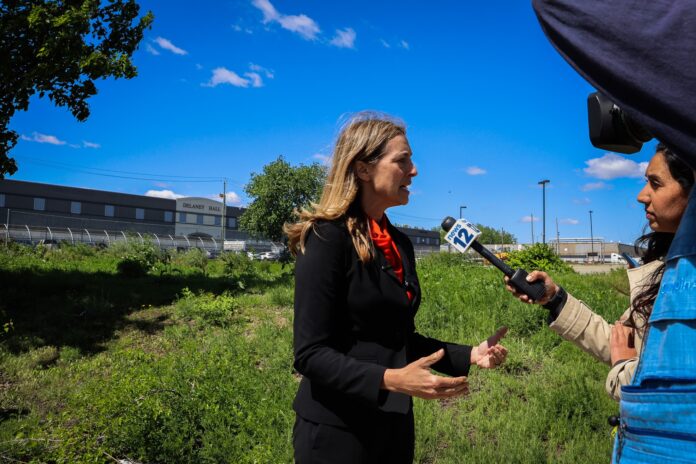

The growing political and legal confrontation surrounding Delaney Hall in Newark escalated dramatically this week after New Jersey Attorney General Jennifer Davenport publicly condemned the treatment of demonstrators and questioned the federal government’s actions outside the controversial detention facility, deepening what has rapidly become one of the most explosive civil liberties flashpoints in the state’s political landscape.
What began as an immigration enforcement dispute has now evolved into a broader collision involving state sovereignty, constitutional protections, federal authority, public accountability, protest rights, immigration policy, and the increasingly volatile relationship between New Jersey officials and federal immigration operations tied to ICE enforcement activities under the Trump administration.
At the center of the latest controversy are allegations that heavily armed federal immigration agents operating outside Delaney Hall used masks to conceal their identities while engaging in aggressive crowd-control tactics against protesters gathered outside the Newark detention facility. Witness accounts, activist organizations, elected officials, and state leaders described scenes involving pepper spray, forceful confrontations, blocked access, and escalating tensions between demonstrators and federal personnel operating around the facility perimeter.
The political implications immediately reverberated throughout New Jersey.
Attorney General Davenport issued one of the strongest statements yet from a senior state official regarding the ongoing Delaney Hall controversy, saying she was “deeply troubled” both by reported conditions inside the facility and by the treatment of protesters and public officials attempting to monitor the situation.
Her remarks came only hours after Governor Mikie Sherrill reportedly was denied access to the facility while attempting to conduct oversight activities tied to mounting allegations regarding detention conditions and federal operational conduct.
The denial intensified an already combustible political environment.
“This follows on the heels of the facility’s refusal to allow Governor Sherrill to access Delaney Hall this morning,” Davenport stated. “We will continue to work alongside Governor Sherrill and her administration to protect the rights of New Jerseyans and ensure that everyone in our state is treated with the basic dignity the law requires.”
That language matters politically.
The statement represented not simply criticism of a single law enforcement operation, but an unmistakable signal that New Jersey’s highest-ranking legal officials are increasingly framing the Delaney Hall situation as part of a broader constitutional and civil liberties conflict involving federal overreach, accountability, transparency, and state authority.
The confrontation also revived national attention surrounding New Jersey’s controversial anti-mask legislation signed earlier this year by Governor Sherrill.
The legislation, championed by the administration as a public accountability measure, specifically targeted anonymous law enforcement activity and sought to prohibit federal immigration agents operating in New Jersey from concealing their identities while conducting enforcement operations. The Governor argued at the time that masked federal agents operating without visible identification undermined constitutional norms, public trust, and democratic accountability.
“We’re not going to allow masked fed agents to terrorize our state,” Sherrill declared during the March signing ceremony for the legislation. “We’ve all seen them in videos — unknown, unnamed, unaccountable, chasing after citizens. Again — not here in the United States of America.”
At the time, critics dismissed the rhetoric as politically charged messaging aimed at energizing progressive voters ahead of a contentious political cycle.
Now, however, the Delaney Hall confrontation has thrust those warnings directly into the center of a real-world political and legal battle unfolding in real time.
Activists and protesters outside the facility alleged that federal agents arrived heavily armed and masked while aggressively controlling demonstrators gathered near the detention center gates. Videos and eyewitness reports circulating online fueled outrage among immigrant rights organizations and civil liberties advocates, many of whom accused federal authorities of escalating tensions unnecessarily while intentionally concealing agent identities from public scrutiny.
The visual symbolism itself became politically explosive.
Masked officers confronting protesters outside a detention facility in New Jersey created precisely the kind of imagery state officials had warned about earlier in the year when arguing for expanded oversight and restrictions on anonymous federal enforcement operations.
For Governor Sherrill’s administration, the Delaney Hall incident now represents a defining test of whether the state is willing — or able — to meaningfully challenge federal immigration operations it considers unconstitutional or dangerous.
For federal authorities and ICE officials, the situation underscores the increasingly hostile political environment facing immigration enforcement agencies operating in progressive states that have openly resisted Trump-era deportation policies and detention practices.
The dispute also reflects a much larger national political struggle unfolding far beyond Newark.
Across the country, immigration enforcement facilities have increasingly become flashpoints for broader debates surrounding federal authority, civil liberties, due process, detention conditions, protest rights, and executive power. Progressive states and cities continue pushing back against aggressive federal immigration operations, while federal officials argue that immigration enforcement falls squarely under national jurisdiction regardless of local political resistance.
New Jersey has emerged as one of the central battlegrounds in that larger fight.
Under Governor Sherrill, the state has aggressively expanded its opposition to private detention facilities, increased scrutiny of ICE cooperation agreements, strengthened immigrant protections, and positioned itself as one of the most outspoken state governments challenging federal immigration enforcement practices.
That posture has made facilities like Delaney Hall highly symbolic.
To supporters of the administration, Delaney Hall represents the dangers of privatized detention systems operating with insufficient oversight and accountability. To critics, state officials are interfering with legitimate federal enforcement responsibilities while politicizing immigration operations for ideological gain.
The intensity of the rhetoric on both sides continues escalating.
Civil rights groups, immigrant advocacy organizations, and progressive activists increasingly describe federal immigration operations using language associated with authoritarian enforcement tactics, citing masked agents, unidentified personnel, aggressive detentions, and restricted oversight access.
Meanwhile, federal officials and conservative critics argue that state-level resistance undermines immigration law enforcement while placing officers and operational security at risk.
The legal questions surrounding the anti-mask legislation itself remain deeply unsettled.
Constitutional scholars continue debating whether states possess authority to regulate how federal officers present themselves while performing federal duties. Questions involving federal supremacy, state police powers, officer safety protections, and constitutional jurisdiction are likely to produce significant litigation if New Jersey attempts to directly enforce provisions restricting federal agent conduct.
The Delaney Hall confrontation may accelerate those legal challenges dramatically.
At the same time, the political consequences are already unfolding.
The issue arrives during a highly charged election cycle where immigration, federal authority, civil liberties, and public safety remain dominant political issues both nationally and across New Jersey. Democratic leaders throughout the state increasingly view aggressive opposition to ICE enforcement tactics as central to energizing progressive coalitions, immigrant communities, younger voters, and civil rights activists.
Republicans, meanwhile, continue framing Democratic resistance as dangerous interference with federal law enforcement and border security efforts.
That polarization ensures Delaney Hall will not fade quietly from public attention.
Instead, the facility is rapidly becoming symbolic of a much larger ideological struggle over what kind of relationship states can maintain with federal enforcement agencies during periods of intense political division.
For Newark specifically, the controversy places the city once again at the center of national debates involving immigration, policing, protest rights, and federal power. The city’s longstanding role as both an immigrant hub and progressive political stronghold has made it a recurring focal point for major immigration battles spanning multiple presidential administrations.
And for New Jersey overall, the Delaney Hall confrontation underscores how deeply national political conflicts now penetrate local governance, law enforcement operations, and state-level policymaking.
What might once have been viewed as a localized detention dispute has instead evolved into a constitutional, political, and symbolic struggle involving competing visions of law enforcement, state sovereignty, civil liberties, and democratic accountability.
The images emerging from Delaney Hall — masked agents, angry protesters, denied oversight access, pepper spray allegations, and escalating rhetoric from top officials — now stand as some of the most politically charged visuals yet in New Jersey’s increasingly confrontational relationship with federal immigration enforcement.
Whether the confrontation ultimately produces litigation, legislative escalation, federal-state standoffs, or broader political fallout remains uncertain.
What is already clear, however, is that Delaney Hall has become far more than a detention facility debate.
It has become a defining political battleground in New Jersey’s ongoing fight over immigration policy, constitutional authority, public accountability, and the limits of federal power inside the Garden State.



