


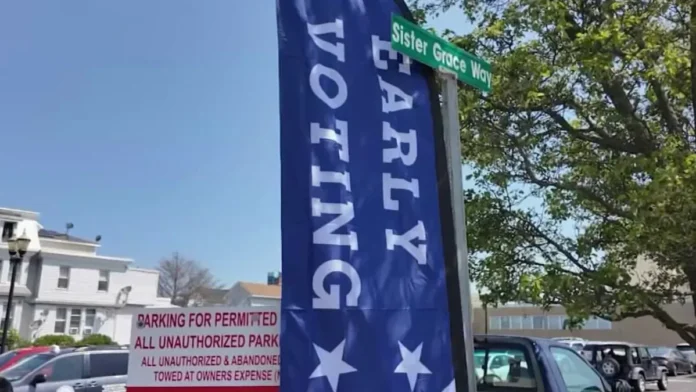

New Jersey’s 2026 congressional primary season officially entered a critical new phase today as early in-person voting locations opened statewide, launching what is expected to become one of the most closely watched and politically consequential midterm election cycles the state has experienced in years. Voters across New Jersey can now begin casting ballots ahead of the June primary elections that will ultimately determine which Democratic and Republican nominees advance into the high-stakes November congressional contests.
The opening of early voting marks far more than a procedural milestone in the election calendar. It represents the beginning of an intense final stretch in a political cycle already defined by aggressive campaigning, ideological battles, rapidly escalating advertising wars, competitive district-level races, and mounting national attention focused squarely on New Jersey’s congressional map.
With control of the U.S. House continuing to hang on a razor-thin margin nationally, several New Jersey congressional districts are now viewed as major battlegrounds capable of influencing the broader balance of power in Washington. Political strategists from both parties are pouring enormous financial and organizational resources into the state as primary voters prepare to shape the general election landscape that will unfold later this fall.
The start of early voting also reflects the continuing transformation of how New Jersey residents participate in elections. What was once a system overwhelmingly centered around traditional Election Day turnout has evolved into a far more extended voting process involving early in-person voting, vote-by-mail participation, expanded ballot access, and prolonged campaign mobilization strategies. Campaigns now operate under entirely different timelines, with candidates increasingly treating the opening of early voting as the functional beginning of the final election push rather than merely a preliminary administrative step.
Across New Jersey, county election officials have spent weeks preparing polling locations, staffing operations, processing mail ballots, updating voter systems, and coordinating security measures ahead of what many expect to be unusually strong turnout for a midterm primary cycle. Political organizations on both sides have simultaneously intensified outreach operations aimed at persuading undecided voters and maximizing turnout among reliable supporters before Election Day arrives.
This year’s congressional primary environment is unfolding against an especially volatile political backdrop. National debates over immigration, inflation, reproductive rights, federal spending, public safety, healthcare costs, education policy, energy development, and the future direction of both major political parties are all feeding directly into local New Jersey races. Candidates throughout the state are attempting to balance district-specific issues with broader national political messaging as they compete for increasingly polarized electorates.
Several districts are already attracting substantial statewide and national attention due to the competitiveness of their primaries. Democratic contests in multiple congressional districts have become especially intense, featuring ideological divisions between progressive and moderate factions, disputes over electability, clashes regarding immigration policy and federal enforcement, and growing tensions surrounding campaign financing and outside political spending. Republican primaries meanwhile continue reflecting broader national debates over party identity, populism, institutional conservatism, and alignment with national leadership figures.
The opening of early voting effectively shifts these campaigns from persuasion-heavy messaging toward turnout-focused operations. Campaigns now face the reality that ballots are actively being cast, meaning every day between now and primary day carries heightened urgency. Advertising, endorsements, public appearances, grassroots organizing, social media messaging, and voter outreach efforts are all expected to accelerate dramatically over the coming days.
The increasingly nationalized nature of congressional politics has also elevated the importance of New Jersey’s primary contests well beyond state borders. National political committees, advocacy organizations, labor unions, business groups, ideological PACs, and independent expenditure organizations are closely monitoring races throughout the state, particularly in districts considered vulnerable or potentially competitive in November. Outside spending is expected to intensify further as early voting progresses and polling data sharpens.
For voters themselves, the expansion of early voting continues reshaping civic participation habits statewide. Supporters of early voting argue that the system improves accessibility, reduces scheduling barriers, increases flexibility for working families, and allows broader participation among residents who may struggle to vote on a single designated Election Day. Critics, however, continue raising concerns nationally regarding prolonged election calendars, campaign misinformation cycles, and the operational complexity associated with extended voting periods.
Regardless of those debates, early voting has now become a firmly established component of New Jersey’s electoral infrastructure. Campaigns increasingly build entire operational strategies around banking votes early, identifying turnout patterns in real time, and adjusting messaging dynamically as ballots are cast throughout the voting window.
This year’s congressional races are also unfolding during a period of major political transition inside New Jersey itself. Redistricting changes, demographic shifts, suburban political realignment, evolving voter coalitions, and changing turnout dynamics continue reshaping the state’s political landscape. Once reliably predictable districts are becoming more competitive, while some historically contested regions are hardening politically in new directions.
Suburban voters remain especially central to many of the state’s most competitive races. Concerns surrounding affordability, taxes, housing costs, transportation infrastructure, healthcare access, public education, and economic stability are likely to play enormous roles in determining turnout patterns and candidate performance across multiple congressional districts. At the same time, younger voters, immigrant communities, urban turnout blocs, and independent voters are expected to significantly influence several closely watched primary outcomes.
The broader atmosphere surrounding the 2026 midterm cycle has also become increasingly charged nationally as both parties frame the election as a referendum on the country’s direction. That intensity is spilling directly into New Jersey’s congressional contests, where candidates are frequently tying local campaigns to larger national narratives regarding democracy, economic policy, immigration enforcement, institutional trust, public accountability, and federal governance.
Election officials throughout the state are encouraging voters to confirm polling locations, review voting procedures, and familiarize themselves with ballot options as turnout activity begins increasing. Campaigns meanwhile are entering what is traditionally considered the most operationally important period of the election cycle, where organization, turnout execution, voter contact operations, and ground-game effectiveness often become decisive.
As early in-person voting officially begins, New Jersey’s congressional primaries now move from speculation into active electoral reality. Ballots are being cast, campaigns are intensifying, outside groups are escalating involvement, and the state’s political future is beginning to take shape in real time. Over the coming days and weeks, New Jersey voters will help determine not only the nominees who advance into November’s general elections, but potentially the broader balance of power in Congress itself as one of the nation’s most politically watched states moves deeper into a pivotal midterm season.