


The confrontation surrounding Delaney Hall in Newark escalated into one of the most politically explosive and emotionally charged scenes New Jersey has witnessed in years as protesters, federal immigration authorities, elected officials, and activists collided outside the privately operated ICE detention facility during a chaotic Memorial Day demonstration that continued well into the evening hours.
What began as an organized protest tied to allegations of deteriorating detention conditions inside the facility rapidly evolved into a volatile standoff involving barricades, crowd-control deployments, chemical agents, armored vehicles, blocked transportation routes, and a growing constitutional showdown between New Jersey political leaders and federal immigration enforcement authorities.
By late Monday night and into Tuesday morning, Delaney Hall had become far more than a local protest site.
It had transformed into a symbol of the widening national divide surrounding immigration enforcement, federal detention operations, protest rights, state oversight authority, and the increasingly combustible political atmosphere surrounding ICE facilities across the country.
Throughout the day, demonstrators gathered outside the Newark detention center demanding improved treatment for detainees and calling for the permanent closure of the facility. Protest organizers accused ICE and private facility operators of maintaining unsafe living conditions while retaliating against detainees who had reportedly launched hunger and labor strikes inside the complex.
Activists claimed approximately 300 detainees had participated in various forms of protest over healthcare access, air conditioning failures, sanitation concerns, and alleged due process violations.
Federal officials disputed multiple aspects of those claims.
But tensions intensified dramatically after reports emerged that ICE tactical teams were preparing to transfer detainee organizer Martin Alonso Soto Hernandez from Delaney Hall to another detention location. Demonstrators attempted to physically block the transfer operation by forming barricades and human chains outside the facility entrances.
As the confrontation escalated, scenes outside the facility grew increasingly chaotic.
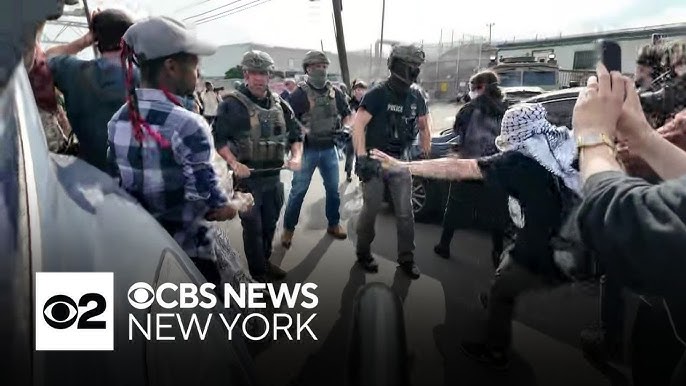
Federal agents reportedly deployed less-lethal crowd-control tactics, including pepper ball projectiles and chemical irritants, as protesters attempted to obstruct vehicle movement around the facility perimeter. Videos circulating across social media showed pushing, shouting, running confrontations, and heavily armed federal personnel attempting to secure transport corridors amid swelling crowds.
The optics immediately fueled political outrage throughout New Jersey.
The situation escalated even further after U.S. Senator Andy Kim became caught in chemical spray deployed during the confrontation while attempting to intervene between demonstrators and federal officers. Images of volunteers flushing the senator’s eyes with water bottles spread rapidly online, transforming the Newark protest into a nationally watched political incident almost instantly.
“It’s sad, it’s a sad day,” Kim reportedly told reporters while receiving treatment outside the facility.
The remarks reflected the increasingly emotional and politically charged atmosphere surrounding Delaney Hall.
At the same time, competing narratives surrounding the confrontation emerged almost immediately.
Federal officials and supporters of the enforcement operation characterized portions of the protest as unlawful obstruction efforts aimed at interfering with legitimate immigration enforcement activity. DHS officials defended federal personnel, arguing that officers repeatedly issued lawful orders for demonstrators to clear operational areas before crowd-control measures were deployed.
Some critics went further, describing the blockade attempts and crowd tactics as dangerous efforts to undermine federal law enforcement authority.
Meanwhile, immigrant advocacy groups, civil liberties organizations, and Democratic lawmakers described the scene very differently.
To them, Delaney Hall represented a disturbing escalation of militarized immigration enforcement tactics occurring within New Jersey communities under increasingly secretive and aggressive operational conditions. The use of armored vehicles, masked officers, chemical agents, and crowd-control munitions outside a detention facility in Newark became politically explosive imagery throughout progressive political circles.
The controversy deepened after Governor Mikie Sherrill was reportedly denied access to the facility earlier in the day while attempting to conduct oversight activities connected to the growing detainee protest movement.
That denial further inflamed tensions between state leaders and federal authorities.
For New Jersey Democrats, the incident reinforced longstanding concerns regarding transparency, accountability, and federal operational conduct inside privately run immigration detention facilities. For federal authorities, however, the growing protest activity represented increasingly dangerous interference with active law enforcement operations.
The clash exposed how rapidly immigration enforcement disputes can evolve into broader constitutional and political confrontations.
Delaney Hall now sits directly at the center of one of New Jersey’s most consequential modern battles over federal power, civil liberties, immigration policy, and state sovereignty.
The political timing could hardly be more volatile.
Governor Sherrill’s administration has already spent months aggressively positioning New Jersey against what state officials describe as unaccountable federal immigration overreach. Earlier this year, the administration signed legislation aimed at restricting masked federal enforcement activity inside the state while strengthening protections tied to constitutional accountability and public transparency.
At the time, critics accused the administration of inflammatory rhetoric.
Now, however, the scenes unfolding outside Delaney Hall appear to have intensified the Governor’s position considerably.
The visual symbolism surrounding the confrontation became impossible to ignore.
Masked federal agents.
Pepper spray clouds.
Barricaded streets.
Armored transport vehicles.
Protesters screaming outside detention fences.
Elected officials demanding access.
And federal tactical personnel attempting to maintain operational control while crowds surged around the facility.
Those images now define the Delaney Hall controversy politically.
At the same time, the incident reflects a broader transformation occurring nationally regarding immigration enforcement protests and federal-state confrontations. Across the country, ICE facilities increasingly serve as flashpoints where local activism, national immigration policy, constitutional law, public safety concerns, and political polarization intersect in highly visible and emotionally charged ways.
New Jersey has rapidly emerged as one of the most aggressive states challenging federal immigration operational tactics.
That reality virtually guarantees Delaney Hall will remain a focal point for both activism and political escalation moving forward.
Calls for investigations are already intensifying.
Democratic lawmakers are demanding answers regarding the use of chemical agents, detainee treatment, access denials, and crowd-control tactics deployed outside the facility. Civil rights organizations are calling for expanded federal oversight and possible litigation tied to protest response measures.
Meanwhile, federal authorities continue defending their actions while warning against interference with immigration operations.
The legal and political questions surrounding the confrontation remain enormous.
Can state officials compel access to federal detention operations?
What authority do states possess over masked federal officers operating inside state borders?
At what point does protest activity become unlawful obstruction?
How should private detention facilities be regulated when operating within politically hostile jurisdictions?
And perhaps most importantly, how sustainable is the current trajectory of increasingly militarized political confrontations surrounding immigration enforcement operations?
Those questions now loom over New Jersey politics in a major way.
For Newark specifically, the Delaney Hall standoff underscores the city’s continued role as a central battleground in national debates over immigration, policing, protest rights, detention policy, and federal authority. Long recognized as both an immigrant hub and progressive political stronghold, Newark once again finds itself at the epicenter of a national ideological struggle far larger than any single protest.
What happened outside Delaney Hall during Memorial Day weekend will likely reverberate politically for months.
The confrontation touched nearly every major political nerve currently shaping American public life: immigration, state power, federal enforcement, protest rights, civil liberties, police tactics, public accountability, executive authority, and constitutional interpretation.
And unlike many political controversies that dissipate quickly, this one appears only to be intensifying.
As lawmakers return to the facility, activists continue mobilizing, and federal officials dig in defensively, Delaney Hall is rapidly becoming one of the defining political and legal flashpoints in New Jersey.
What began as a detention protest has now become something much larger.
A struggle over who controls enforcement power.
A battle over transparency and constitutional authority.
And increasingly, a defining test of how far state leaders are willing to go in confronting federal immigration operations they believe violate both public trust and fundamental democratic principles.