


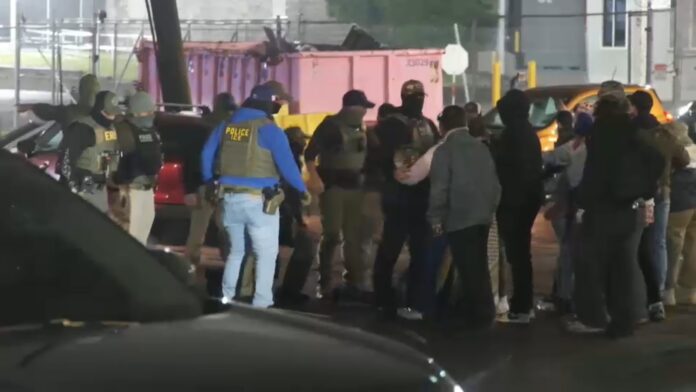

What began as a localized demonstration outside a privately operated immigration detention facility in Newark has now exploded into one of the most politically volatile confrontations in New Jersey this year, drawing in the Governor’s Office, members of Congress, federal immigration authorities, civil rights activists, and an increasingly furious coalition of Democratic lawmakers demanding answers, oversight, and potentially the permanent closure of Delaney Hall itself.
The confrontation outside Delaney Hall on Monday, May 25, transformed rapidly from a protest into a dramatic and nationally watched standoff involving chemical agents, armored vehicles, federal tactical teams, hunger-striking detainees, blocked government access, and one of New Jersey’s sitting United States senators caught directly in the middle of the chaos.
By Tuesday morning, the political fallout was accelerating across every level of government.
At the center of the escalating controversy is U.S. Senator Andy Kim, who was struck by chemical irritants and pepper spray deployed by federal ICE officers during a tense confrontation between demonstrators and federal agents outside the Newark detention facility. Video footage from the scene quickly circulated online, showing volunteers and protesters pouring water over the senator’s face as he attempted to recover from exposure to the chemical agents.
“It’s sad, it’s a sad day,” Kim reportedly told reporters while receiving first aid outside the facility.
The images immediately ignited outrage throughout New Jersey’s political establishment.
The clash itself unfolded against the backdrop of growing unrest inside Delaney Hall, where an estimated 300 detainees have reportedly launched hunger and labor strikes protesting conditions inside the privately run detention center. Demonstrators and immigrant advocacy organizations have alleged severe problems involving poor healthcare access, inadequate ventilation, lack of air conditioning, due process concerns, and deteriorating living conditions inside the facility.
Federal officials have disputed several of those allegations.
But the situation escalated dramatically Monday when federal tactical teams reportedly arrived with armored vehicles to transfer detainee organizer Martin Alonso Soto Hernandez — described by activists as one of the central organizers behind the hunger strike movement — to another detention facility.
Protesters quickly attempted to block the transfer operation.
Demonstrators formed human chains outside the facility gates while chanting against ICE and demanding greater transparency regarding detainee conditions. Tensions rose rapidly as federal agents moved to clear access routes surrounding the armored vehicles.
According to multiple accounts emerging from the scene, ICE officers deployed batons, chemical irritants, and less-lethal pepper ball projectiles as the confrontation intensified.
It was during that escalating moment that Senator Kim reportedly stepped between federal officers and demonstrators in what witnesses described as an attempt to calm the situation and reduce the possibility of further violence.
Instead, the confrontation deteriorated further.
The deployment of chemical agents against a sitting United States senator immediately transformed the protest into a national political crisis.
Within hours, lawmakers throughout New Jersey were condemning federal authorities while demanding investigations into ICE tactics, detainee treatment, operational transparency, and the denial of oversight access to elected officials attempting to inspect the facility.
The political pressure intensified even further after reports emerged that Governor Mikie Sherrill herself had been denied entry into Delaney Hall earlier Monday during efforts to inspect conditions inside the facility.
That development infuriated Democratic officials throughout the state.
Governor Sherrill, who has built much of her administration’s immigration posture around opposing private detention systems and expanding state-level protections for immigrants, has repeatedly criticized Delaney Hall and other detention operations tied to aggressive federal enforcement policies.
Her administration earlier this year signed legislation aimed at restricting masked federal enforcement activity and strengthening state-level accountability measures surrounding immigration operations.
Now, Delaney Hall has become the defining battleground for that broader political fight.
The denial of gubernatorial access immediately raised larger constitutional and legal questions about federal authority, state oversight powers, and the operational secrecy surrounding privately managed detention facilities operating within New Jersey.
Senator Kim was reportedly only able to gain entry into the facility after personally contacting DHS Secretary Markwayne Mullin to intervene directly with federal officials.
That detail alone intensified the political optics surrounding the incident.
To critics of the detention center, the situation reinforced concerns that meaningful oversight of federal detention operations is increasingly obstructed even when elected officials attempt direct inspections. To supporters of federal enforcement efforts, however, the protests represented unlawful interference with ongoing immigration operations requiring tactical response measures.
The Department of Homeland Security quickly issued a statement defending federal actions.
DHS officials denied claims that a formal hunger strike was occurring inside the facility and rejected accusations regarding improper detainee treatment. The department also defended the tactical response outside Delaney Hall, arguing that officers issued repeated lawful orders to disperse crowds obstructing federal law enforcement operations.
Federal officials described portions of the crowd as “rioters” interfering with lawful detention procedures.
But those explanations did little to calm the political firestorm unfolding across New Jersey.
Representative Rob Menendez quickly announced plans to return to Delaney Hall to demand further answers regarding the use of chemical agents, the handling of protesters, and broader allegations involving detainee conditions.
Meanwhile, a growing coalition of Democratic lawmakers began openly demanding the permanent closure of the facility.
What makes the Delaney Hall conflict especially politically explosive is how many major national issues have now converged into a single location.
Immigration enforcement.
Federal-state power struggles.
Private detention facilities.
Civil liberties.
Police tactics.
Protest rights.
Executive authority.
Transparency.
Oversight.
And increasingly, the role of militarized federal operations inside densely populated civilian communities.
For New Jersey Democrats, Delaney Hall is rapidly becoming symbolic of broader concerns surrounding federal immigration policy under Donald Trump’s administration. Progressive lawmakers throughout the state increasingly portray the facility as evidence of unchecked federal overreach operating without sufficient accountability or humanitarian oversight.
Governor Sherrill’s administration has already framed the confrontation in explicitly constitutional language.
Earlier this year, when signing legislation aimed at restricting masked federal enforcement activity, Sherrill argued that anonymous federal agents operating in public spaces undermine democratic accountability and public trust.
The images emerging from Delaney Hall over the past 24 hours have only intensified that argument politically.
Masked officers.
Armored vehicles.
Chemical agents.
Blocked inspections.
Federal tactical teams confronting protesters and elected officials.
The visuals themselves have become politically radioactive.
At the same time, federal authorities and immigration enforcement supporters argue that increasingly confrontational protest tactics create dangerous operational environments requiring crowd-control responses and enhanced officer protection measures.
That divide now sits squarely at the center of New Jersey’s political landscape.
And the implications extend well beyond Newark.
The Delaney Hall confrontation arrives during a period of rising national tensions surrounding immigration enforcement, sanctuary policies, detention practices, and state resistance to federal immigration operations. Progressive states like New Jersey continue attempting to expand protections for immigrants while limiting cooperation with aggressive federal enforcement initiatives.
Federal agencies, meanwhile, continue asserting broad operational authority under immigration law regardless of local political opposition.
The result is a constitutional collision course increasingly visible across the country.
And now nowhere more dramatically than outside Delaney Hall.
What may have once remained a localized protest outside a detention facility has instead evolved into a defining political confrontation involving some of New Jersey’s highest-ranking elected officials, federal enforcement agencies, and increasingly energized activist networks.
The next phase of the conflict may prove even more consequential.
Calls for investigations are growing louder.
Demands for federal accountability continue expanding.
Pressure for facility closure is intensifying.
And questions surrounding the legality of federal operational tactics, state oversight rights, and detainee treatment are unlikely to disappear anytime soon.
For New Jersey, Delaney Hall has become far more than an immigration facility controversy.
It is now a live political battlefield where questions involving constitutional authority, public accountability, federal power, protest rights, immigration policy, and state sovereignty are colliding in real time under national scrutiny.
And after the events of Monday, the political temperature surrounding that battle has risen dramatically.