


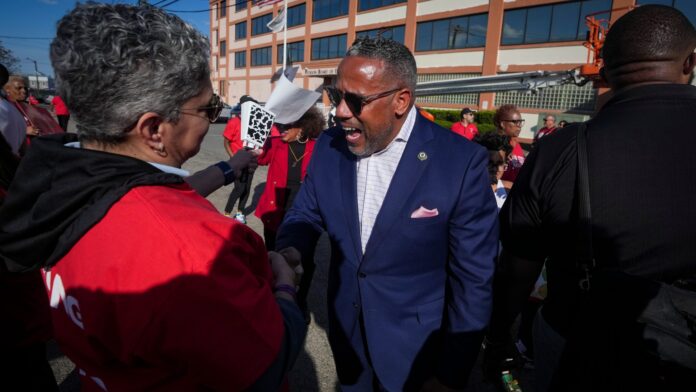

The political temperature inside Paterson’s mayoral race continues to rise as mayoral candidate Alex Mendez secured a significant endorsement this week from the Paterson Fire Officers Association Local 202, a move that immediately injects new momentum into one of New Jersey’s most closely watched municipal elections. The endorsement arrives at a pivotal moment for the city, where public safety, fiscal stability, municipal leadership, and resident confidence have become defining issues shaping both the campaign narrative and the broader future of Paterson itself.
For Mendez, the backing from Local 202 is more than a symbolic political endorsement. It represents organized support from senior public safety leadership operating on the front lines of one of New Jersey’s largest and most complex urban environments. In a city where emergency response systems, staffing levels, municipal spending, and public trust are increasingly intertwined, endorsements from first responder organizations carry substantial weight with voters evaluating the next phase of leadership at City Hall.
The Paterson Fire Officers Association Local 202 made clear that its endorsement stems from mounting concerns over the direction of the city during the past eight years. According to the organization, ongoing staffing shortages, escalating grievances, unresolved labor disputes, and operational challenges affecting fire personnel have created growing pressure across the department. Union leadership also pointed toward the city’s request for approximately $78 million in state transitional aid, a dramatic increase from the $33 million figure associated with 2025, as a reflection of broader structural and financial concerns facing Paterson government.
That financial backdrop is expected to become one of the defining issues of the election cycle. Across New Jersey, municipalities are facing rising operational costs tied to infrastructure, emergency services, labor agreements, insurance expenses, and public works obligations. In Paterson, however, the debate carries additional urgency because of the city’s size, economic disparities, and longstanding dependence on state assistance. The conversation surrounding transitional aid has therefore become larger than a simple budget line item. It has evolved into a referendum on management, accountability, and whether residents believe City Hall is effectively stewarding taxpayer resources while maintaining core city services.
Mendez has increasingly positioned himself as a candidate focused on operational accountability and restoring confidence in municipal leadership. The endorsement from Local 202 reinforces that messaging because it comes directly from individuals responsible for emergency response coordination and public safety supervision throughout the city. Fire officers are uniquely positioned within municipal government to witness the impact of staffing shortages, equipment concerns, overtime pressures, and administrative delays. Their endorsement signals that segments of the city’s public safety leadership believe change is necessary.
In announcing its support, Local 202 emphasized Mendez’s willingness to engage directly with first responders and address issues affecting frontline personnel. Among the concerns cited were staffing deficiencies, fair contract negotiations, and the need for stronger operational support systems within the fire department. Those issues resonate beyond labor politics because they intersect directly with emergency response times, firefighter readiness, public protection standards, and the city’s overall emergency management capacity.
Public safety has become one of the most politically sensitive subjects in urban New Jersey communities, particularly in cities balancing aging infrastructure, budget limitations, rising service demands, and workforce retention challenges. Paterson is no exception. As one of the state’s largest municipalities, the city faces constant pressure to maintain effective emergency services while managing fiscal realities that continue to strain local government operations. That dynamic has created a political environment where endorsements from police, fire, and emergency personnel organizations can significantly shape voter perception.
Mendez acknowledged the significance of the endorsement by framing it as validation from those who directly understand the challenges facing Paterson residents and emergency personnel alike. He described the support from Local 202 as especially meaningful because of the union members’ firsthand experience operating within the city every day.
“I am honored to receive the endorsement of the Paterson Fire Officers Association Local 202,” Mendez said. “Their support is especially meaningful because these are the men and women who serve on the front lines every day and understand firsthand the challenges facing our city. I thank them for their trust and support, and I remain committed to leadership that strengthens public safety, supports first responders, and delivers the accountability Paterson residents deserve.”
The endorsement also reflects the increasingly central role labor organizations continue to play in local New Jersey politics. Public sector unions remain among the most influential political forces in municipal elections because of their deep community ties, volunteer networks, voter mobilization capabilities, and visibility among residents. In cities like Paterson, where local government operations directly affect everyday quality of life, endorsements from first responder organizations often carry credibility beyond traditional political circles.
Paterson’s mayoral race is unfolding against a larger statewide backdrop in which urban governance, public safety funding, economic development, and fiscal oversight have become dominant political themes. Cities throughout New Jersey continue to wrestle with balancing redevelopment ambitions against service demands and budget realities. Paterson, with its historic industrial identity, diverse population, and complex economic challenges, stands at the center of many of those statewide conversations.
The city itself remains one of New Jersey’s most politically consequential urban centers. Long viewed as both a symbol of resilience and a case study in municipal challenges, Paterson occupies a unique place in the state’s political landscape. Its elections frequently attract regional attention because the issues debated there often mirror broader concerns affecting other major municipalities throughout New Jersey. Questions surrounding economic recovery, neighborhood investment, public safety modernization, and government transparency are no longer isolated local matters. They have become statewide political priorities.
For Mendez, building momentum through endorsements like this may prove critical as Election Day approaches. Campaigns in cities the size of Paterson are rarely won through a single issue. Success typically depends on assembling broad coalitions that include labor support, neighborhood organizations, business stakeholders, public safety advocates, and voters seeking institutional reform or leadership stability. The endorsement from Local 202 strengthens Mendez’s standing within one of the most influential sectors of municipal government while simultaneously reinforcing his broader campaign message centered on accountability and operational change.
The endorsement may also intensify scrutiny surrounding the current administration’s handling of city operations, labor relations, and fiscal management. Political campaigns often become defined not only by what challengers promise, but by how effectively they capitalize on public frustration with existing conditions. By specifically citing staffing shortages, unresolved grievances, and the city’s escalating reliance on transitional aid, Local 202 effectively elevated those concerns into central campaign issues.
As the race advances, Paterson voters are expected to hear increasingly detailed debates regarding municipal spending priorities, emergency service funding, staffing strategies, economic redevelopment, and the future direction of city leadership. Public safety will almost certainly remain near the center of those conversations, particularly as residents evaluate which candidate they believe can most effectively stabilize operations while restoring confidence in city government.
The endorsement from the Paterson Fire Officers Association Local 202 underscores how consequential this election has become for both city employees and residents alike. What is unfolding in Paterson is not simply another local political contest. It is a broader debate over governance, accountability, fiscal direction, and whether city leadership can effectively respond to the mounting pressures facing one of New Jersey’s most important urban communities.
With support continuing to build among public safety advocates and community stakeholders, Mendez’s campaign now enters a new phase where momentum, messaging, and voter turnout could ultimately determine the next chapter in Paterson politics. As Election Day moves closer, the battle over the city’s future is becoming increasingly defined by one central question: which candidate can convince residents that they are prepared to restore operational stability, strengthen public trust, and deliver a stronger future for Paterson and its neighborhoods.
For more New Jersey political coverage and statewide public affairs reporting, visit Sunset Daily News Politics