


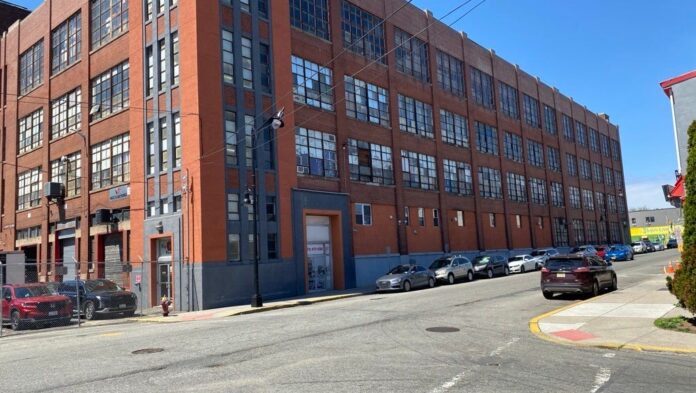

One of Passaic’s most historically significant industrial corridors could soon undergo a dramatic transformation as city officials explore a redevelopment proposal that would replace portions of the former Uniroyal industrial complex with nearly 500 apartments, structured parking, and new mixed-use commercial space. The proposal, now emerging as one of the most ambitious residential redevelopment discussions in Passaic in recent years, reflects the broader reshaping of North Jersey’s aging industrial landscape as municipalities continue searching for new housing opportunities, tax ratables, and economic reinvestment projects tied to long-underutilized properties.
The project centers around the Big Apple West warehouse complex located at 177 and 187 Passaic Street, a sprawling industrial property situated near one of the city’s busiest commercial corridors. During an April 14 city council meeting, officials introduced an ordinance that would amend Passaic’s Eastside Redevelopment Plan to allow residential use at the six-acre industrial site. If ultimately approved and developed, the proposal could yield as many as 490 residential units alongside a parking garage capable of accommodating up to 640 vehicles.
While city officials have stressed that discussions remain in the early planning stages, the proposal immediately signals a potentially major turning point for a property that has remained deeply tied to Passaic’s industrial identity for more than a century. The redevelopment concept reportedly being considered by property owners Jordan and Michael Plachter would involve demolishing six existing industrial structures and replacing them with three new residential-oriented buildings designed to reposition the corridor toward a more mixed-use future.
According to preliminary plans under discussion, one of the proposed buildings would rise approximately five or six stories and consist entirely of residential apartments. Two additional mixed-use buildings would include street-level retail or commercial space designed to activate the surrounding streetscape while introducing new housing density into a section of the city historically dominated by industrial activity and warehouse operations.
The location itself makes the proposal especially significant from both a planning and economic development standpoint. The site sits less than a block from U.S. Route 21 and directly within one of Passaic’s major commercial arteries. Across the street stands the approximately 400,000-square-foot Contempo Plaza shopping center, while nearby industrial and warehouse properties continue shaping the surrounding corridor’s urban character. The former Ethan Allen furniture warehouse and office property at 1 Market Street, another site previously targeted for residential redevelopment, further underscores how this section of Passaic is increasingly becoming part of a larger transformation conversation involving adaptive reuse, mixed-use planning, and residential growth.
For Passaic, the redevelopment proposal arrives at a critical moment in the city’s broader evolution. Like many older industrial cities throughout North Jersey, Passaic has spent years balancing economic redevelopment pressures against aging infrastructure, legacy industrial properties, housing demand, and changing regional economic patterns. The city’s location within the densely interconnected North Jersey transportation network places it squarely within the path of continued residential expansion fueled by proximity to New York City, regional transit infrastructure, and growing demand for urban housing alternatives outside Manhattan and Brooklyn.
That broader regional housing pressure continues reshaping communities throughout Bergen County, Essex County, Hudson County, Union County, and Passaic County alike. Developers increasingly view older industrial corridors as opportunities for adaptive redevelopment projects capable of introducing housing density while repurposing underutilized or obsolete industrial facilities. Municipal leaders, meanwhile, are often tasked with balancing redevelopment opportunities against concerns involving traffic, infrastructure strain, school capacity, parking, affordability, and neighborhood identity.
The proposed redevelopment of the former Uniroyal complex embodies many of those same tensions while simultaneously reflecting the changing economic realities of North Jersey itself. For decades, the property functioned as part of Passaic’s manufacturing backbone, contributing to the industrial economy that once defined much of the region. The site’s history stretches back to the nineteenth century, offering a direct window into the industrial evolution of the city itself.
Historical records indicate the property housed Reid and Barry commercial dryers as early as 1869 before eventually transitioning into a rubber manufacturing operation operated by U.S. Rubber around the turn of the twentieth century. That transition reflected the larger industrial expansion reshaping northern New Jersey during the era when manufacturing, textiles, rubber production, and heavy industry drove regional economic growth.
Uniroyal, which emerged as the successor to U.S. Rubber, continued operating at the site until 1973, when the factory closed its doors and approximately 1,100 workers lost their jobs. That closure represented more than the loss of a single industrial facility. It symbolized the beginning of a much broader economic transformation that would fundamentally alter urban industrial communities across New Jersey and the Northeast for decades to come.
Like many former manufacturing properties throughout the region, the complex entered a long and uncertain transition period after industrial operations ceased. In 1977, Uniroyal sold the property to Truck Industries, continuing the site’s industrial trajectory even as the manufacturing economy itself continued evolving. Years later, the property again entered the spotlight when New York real estate developer Alex Parker acquired the complex in a highly publicized transaction reported by The New York Times in 1984.
Parker’s vision for the property reflected the kind of ambitious redevelopment experimentation often associated with post-industrial urban reinvention during the 1980s. His plans reportedly included warehouse renovations, office conversions, a riverboat restaurant and lounge positioned along a nearby canal, and even a proposed “songwriters’ hall of fame” paired with a commercial station concept. While many of those ideas never materialized as originally envisioned, they revealed how long developers and investors have viewed the site as possessing untapped redevelopment potential.
Now, decades later, the property once again stands at the center of a major redevelopment conversation. Records from the Passaic County Tax Board indicate that the two parcels involved in the current proposal include both warehouse structures and parking areas. The industrial buildings currently standing on the site were erected in 1934 and were ultimately sold to the current ownership group in 2000 for approximately $595,000. The combined assessed value of the parcels today reportedly stands near $5.9 million, notably lower than the property’s assessed valuation more than two decades ago.
That valuation history reflects the broader economic complexities surrounding aging industrial properties throughout urban New Jersey. While many sites possess substantial redevelopment potential because of their location, scale, and infrastructure access, redevelopment itself often requires major capital investment, zoning adjustments, environmental review, demolition costs, and long-term planning coordination.
The Passaic proposal therefore represents more than a straightforward apartment development. It reflects a broader recalibration of land use priorities occurring throughout the region as municipalities attempt to reposition aging industrial corridors toward housing, retail activity, and mixed-use redevelopment capable of generating new economic activity and long-term tax growth.
At the same time, the proposal also highlights the continuing debate surrounding residential density and redevelopment strategy across North Jersey. Projects involving several hundred apartments inevitably trigger discussions surrounding traffic management, parking demand, public transportation access, infrastructure modernization, and the long-term sustainability of urban growth patterns. Structured parking proposals, such as the planned 640-space garage tied to this project, increasingly become central elements in redevelopment planning as cities attempt to balance density with practical infrastructure concerns.
Passaic itself has not seen many developments of this scale in recent years, making the proposal particularly notable within the city’s current development landscape. If approved and completed, the project would significantly reshape one of the city’s most visible industrial corridors while potentially serving as a catalyst for additional redevelopment activity nearby.
The surrounding area has already attracted redevelopment attention in recent years. In 2020, Jersey Digs reported that a separate developer had explored plans to convert the nearby former Ethan Allen warehouse at 1 Market Street into a 251-unit residential project featuring 257 parking spaces. That proposal, combined with the current Big Apple West redevelopment discussion, suggests developers increasingly view this section of Passaic as a viable residential growth corridor positioned near major transportation routes and commercial amenities.
The larger economic forces driving these projects are unlikely to slow anytime soon. North Jersey continues experiencing intense housing demand, particularly in communities offering relative affordability compared to neighboring urban centers while still maintaining regional connectivity. Industrial-to-residential redevelopment projects are becoming increasingly common as developers seek opportunities within land-constrained urban environments where large undeveloped parcels remain scarce.
For Passaic, the outcome of the redevelopment proposal could ultimately shape not only the future of one historic industrial site, but the direction of the city’s broader redevelopment identity moving forward. The transformation of the former Uniroyal complex from manufacturing center to residential mixed-use community would represent a profound shift in both land use and economic function, symbolizing the continuing reinvention of one of North Jersey’s historic industrial cities.
As discussions continue and redevelopment plans evolve, the project is likely to remain closely watched by city officials, developers, residents, and regional planners alike. The proposal sits at the intersection of housing demand, economic redevelopment, urban planning, and industrial history — all issues increasingly defining the future of communities throughout New Jersey’s rapidly changing real estate landscape.
For more New Jersey redevelopment, housing, and commercial real estate coverage, visit Sunset Daily News Real Estate