


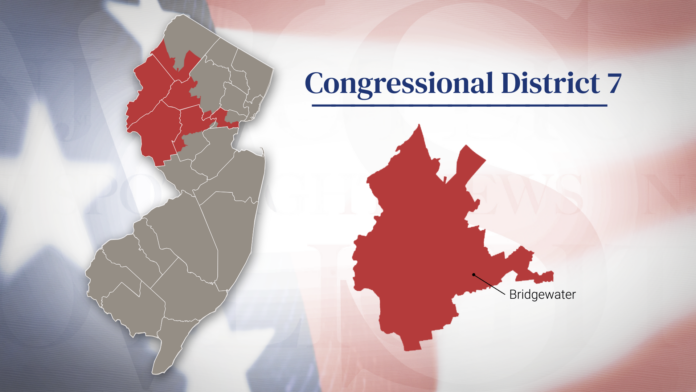

New Jersey’s 7th Congressional District is once again becoming one of the most closely monitored political battlegrounds in the country, setting the stage for what is expected to be one of the most expensive, competitive, and nationally significant races of the 2026 election cycle. Stretching across portions of Union, Somerset, Morris, Sussex, Warren, and Hunterdon counties, the district has evolved into a defining test case for both parties as Democrats attempt to reclaim ground in suburban New Jersey while Republicans fight to maintain one of their most critical congressional footholds in the Northeast.
At the center of the political storm stands two-term Republican Congressman Tom Kean Jr., whose seat has officially been labeled a “Toss Up” by national election analysts as both parties intensify preparations for the June 2 primary and the November general election. What once appeared to be a district leaning toward stable Republican control has rapidly transformed into a volatile political battlefield fueled by changing demographics, economic anxiety, national political polarization, and mounting scrutiny surrounding Kean’s recent absence from Capitol Hill.
The district itself represents a uniquely complicated political landscape. CD-7 is simultaneously affluent and economically anxious, suburban yet partially rural, highly educated but politically divided. Voters here often prioritize taxes, affordability, infrastructure, healthcare access, transportation, and economic stability over ideological extremes. It is precisely that blend that has turned the district into one of the most closely studied congressional races in America heading into 2026.
For Republicans, the district remains critical because it represents one of the party’s strongest opportunities to maintain influence in a traditionally blue state increasingly shaped by suburban political realignment. For Democrats, flipping CD-7 would represent not merely a symbolic victory, but a strategic breakthrough capable of influencing the broader balance of power in Congress.
Much of the current political attention surrounding the race has focused on Congressman Kean himself. While the Republican incumbent is running unopposed in the Republican primary, his campaign enters the general election cycle under growing scrutiny following an extended absence from congressional voting activity. As of early May 2026, Kean had not cast a vote in nearly two months, with his office publicly citing a “personal health matter” while offering few additional details.
That absence has created political openings Democrats are aggressively attempting to exploit. National Democratic organizations have officially designated the district as one of their premier pickup opportunities for the 2026 cycle, placing CD-7 squarely in the national political spotlight months before the general election campaign fully begins.
Yet the Democratic side of the race remains far from settled. Four candidates are competing intensely for the party’s nomination, each attempting to position themselves as the candidate most capable of unseating Kean in November while simultaneously navigating the district’s politically moderate tendencies.
Among the candidates drawing significant attention is Rebecca Bennett, whose campaign has increasingly gained traction through a message centered on military service, leadership, and political pragmatism. Bennett, a former Navy helicopter pilot and healthcare business executive, has secured endorsements from four of the district’s six county Democratic organizations, positioning her as a leading contender heading into the final stretch of the primary campaign.
Bennett’s candidacy reflects a broader Democratic strategy emerging nationally in competitive suburban districts. Rather than leaning heavily into ideological messaging, her campaign has emphasized patriotism, competence, affordability, and crossover appeal aimed at independent voters and moderate Republicans uneasy with the current direction of national Republican politics.
During a recent meet-and-greet event attended by district voters, Bennett addressed one of the most persistent questions surrounding her candidacy: her former Republican affiliation. Rather than avoiding the topic, she confronted it directly, explaining that she grew up in Texas in a Republican household and initially registered with the same party as her parents while still a teenager.
According to Bennett, her political evolution accelerated during the rise of Donald Trump’s first presidential campaign in 2015. She described that period as politically transformative, ultimately leading her to formally identify as a Democrat and become politically active.
The exchange reflected one of the underlying dynamics shaping the district’s politics in 2026. CD-7 remains filled with voters who once identified with older generations of moderate Northeastern Republicanism but who now find themselves politically displaced by the increasingly nationalized and polarized nature of modern party politics.
Bennett has repeatedly argued that many moderate Republicans and independent voters within the district feel politically homeless. Her campaign has sought to directly appeal to those voters, particularly individuals who once aligned themselves with the late Tom Kean Sr. brand of Republican politics associated with moderation, bipartisanship, and suburban governance.
That argument has become central to Democratic messaging throughout the district. Rather than framing the race solely as a national ideological battle, candidates are increasingly attempting to localize the election around questions of responsiveness, independence, and constituent advocacy.
Bennett has specifically criticized Kean for what she characterizes as insufficient independence from the national Republican leadership and the Trump political apparatus. She has argued that Kean failed to assert meaningful opposition during attempts to reduce federal support connected to the Gateway Tunnel project, one of the region’s most important infrastructure initiatives. She has also pointed to local frustrations in Roxbury Township regarding a proposed ICE detention facility as another example of perceived congressional inaction.
The Gateway Tunnel issue in particular continues to resonate deeply throughout North Jersey political conversations. Infrastructure investment remains a defining issue for suburban commuters, businesses, and local governments throughout the region, especially as aging transportation systems continue facing mounting strain.
Bennett’s military background has also become a defining part of her campaign strategy. Democratic strategists increasingly believe military service can neutralize longstanding Republican messaging advantages surrounding patriotism and national security, particularly in suburban swing districts where voters often prioritize stability and institutional credibility over partisan rhetoric.
The Democratic field, however, remains highly competitive.
Michael Roth, a former Small Business Administration official during the Biden administration, has focused much of his campaign on middle-class affordability and tax reform. His message centers heavily on economic pressure facing suburban families, particularly in one of the nation’s most expensive states.
Tina Shah, an ICU physician and former advisor to the U.S. Surgeon General, has built her campaign around healthcare accessibility, public health policy, and independent fundraising strength. Her medical background has positioned healthcare as a central issue within the Democratic primary conversation.
Meanwhile, Brian Varela has emerged as the field’s more progressive candidate, earning support from Democratic organizations in Sussex and Warren counties while advocating for Medicare for All, campaign finance reform, and broader structural political change.
Despite their differences, all four Democratic candidates have increasingly converged around one central theme: affordability.
That focus reflects broader political realities not only within CD-7 but across New Jersey as a whole. Even in affluent communities, rising property taxes, housing costs, transportation expenses, healthcare prices, and overall cost-of-living concerns continue dominating voter conversations. Democrats believe economic messaging centered on affordability may provide their clearest path toward persuading moderate voters who previously supported Kean.
The district’s political makeup, however, remains structurally difficult for Democrats. Following post-2020 census redistricting changes, CD-7 became slightly more Republican-leaning after losing Democratic-heavy portions of Middlesex County while adding more conservative territory in Hunterdon County and surrounding areas. Current voter registration statistics continue giving Republicans a modest edge, with approximately 34 percent registered Republican compared to 31 percent Democratic registration.
That reality means Democrats likely cannot rely solely on turnout advantages. Success in November would almost certainly require meaningful crossover support from independents and moderate Republicans dissatisfied with national Republican politics or concerned about local representation.
The financial stakes surrounding the race are also rapidly escalating. Political observers expect the contest to become one of the most expensive congressional campaigns in New Jersey history, with millions of dollars already flowing into both parties’ operations months before the general election officially begins.
National political organizations view the district as too strategically important to ignore. Outside spending from party committees, political action groups, and independent expenditures is expected to intensify dramatically after the June primary concludes.
At the same time, the race reflects broader national questions about the future direction of suburban American politics. Districts like CD-7 increasingly serve as indicators of shifting voter coalitions that could shape congressional control for years to come. The district’s voters are highly educated, politically engaged, and often resistant to ideological extremes from either party. That creates an environment where candidate quality, local issues, economic credibility, and voter trust may ultimately matter more than national partisan branding alone.
For New Jersey, the significance extends beyond congressional mathematics. The race represents another chapter in the state’s ongoing political evolution, where suburban communities continue redefining their political identity amid rapid national polarization.
As the June 2 Democratic primary approaches, candidates are intensifying outreach efforts across the district, hoping to consolidate support before the contest enters what is expected to become a bruising and extraordinarily expensive general election battle. By November, New Jersey’s 7th Congressional District may once again stand at the center of the national political conversation, serving as one of the clearest indicators of where suburban American politics is heading next.
For more political coverage and New Jersey election news, visit Sunset Daily News Politics