


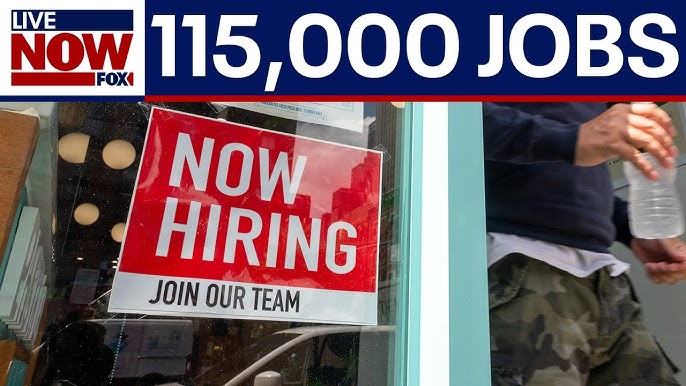

The April 2026 jobs report delivered something the American economy has increasingly struggled to produce over the past year: a result that was not catastrophic. In another era, adding 115,000 jobs nationwide would have been viewed as a major warning sign for a weakening labor market and potentially the early stages of recessionary contraction. Today, however, the economic landscape has fundamentally changed. Expectations have fallen, labor force growth has slowed, hiring momentum has cooled across multiple sectors, and both Wall Street and the Federal Reserve are recalibrating what now qualifies as “stable.”
Against that backdrop, the latest employment report from the Bureau of Labor Statistics landed with cautious relief across financial markets and policy circles. Economists had widely expected payroll growth to come in somewhere between 55,000 and 65,000 jobs for April. Instead, the economy added 115,000 positions, significantly outperforming forecasts while keeping the national unemployment rate steady at 4.3%.
That number alone does not suggest a booming economy. Far from it. Compared to the explosive post-pandemic hiring surges that once delivered monthly gains of several hundred thousand jobs, April’s report reflects an economy operating at a much slower and more fragile pace. Yet within the context of 2026’s economic environment, the report represented something increasingly valuable: stability.
The modern labor market no longer requires massive monthly hiring gains to maintain equilibrium. Population growth has moderated, labor participation remains constrained, and employers across many industries have already completed the aggressive hiring cycles that followed the pandemic recovery years. In practical terms, economists now estimate that the U.S. economy may only need payroll growth near or slightly above 100,000 jobs per month to keep unemployment relatively stable.
That reality helps explain why April’s 115,000-job gain was ultimately interpreted as modestly encouraging despite historically appearing underwhelming. The labor market is undeniably cooling, but it has not collapsed. Employers are hiring more cautiously, but they are not engaging in broad-based layoffs at recessionary levels either. The economy appears increasingly stuck in a middle phase where momentum is slowing without fully breaking.
For New Jersey, however, the national picture only tells part of the story.
The Garden State enters the second quarter of 2026 facing a more volatile employment environment than many other parts of the country. While national unemployment remains at 4.3%, New Jersey’s most recently reported unemployment rate stood significantly higher at 4.9% in March, after earlier peaking at 5.2% during the first part of the year.
That difference matters because New Jersey’s economy remains uniquely exposed to several industries currently undergoing structural transitions, including finance, technology, logistics, pharmaceuticals, transportation, and professional services. At the same time, the state’s exceptionally high cost of living continues placing enormous pressure on households even when employment levels remain relatively stable.
In many ways, New Jersey has become a case study for the complicated economic conditions emerging nationwide. Official unemployment numbers alone no longer fully capture the stress many workers and families are experiencing. Employment may technically exist, but affordability continues deteriorating across housing, healthcare, transportation, insurance, taxes, and everyday expenses.
That disconnect is becoming increasingly central to national economic conversations.
April’s report reflected several warning signs beneath the surface headlines that suggest the labor market may be weaker than topline payroll numbers initially indicate. Perhaps most concerning was a sharp surge in involuntary part-time employment. The number of workers forced into part-time jobs because they could not secure full-time hours jumped by approximately 445,000 during the month.
That statistic often functions as an early indicator of economic softening. Employers frequently reduce hours before conducting broader layoffs, allowing companies to control labor costs while avoiding large-scale workforce reductions. For workers, however, involuntary part-time status can create major financial strain even when they technically remain employed.
In high-cost states like New Jersey, that dynamic becomes especially severe. Many households already struggle balancing mortgage payments, rent, childcare, transportation, and healthcare expenses even with full-time employment. Reduced hours or inconsistent schedules can quickly destabilize middle-class finances in a state where the cost of living consistently ranks among the highest in the nation.
At the sector level, the April report reinforced several economic trends that have increasingly defined the post-pandemic labor market.
Healthcare once again led national hiring growth, adding approximately 37,000 jobs. Transportation and warehousing followed closely with gains of around 30,000 jobs, reflecting continued consumer demand, supply chain activity, and logistics expansion.
Those industries remain critically important to New Jersey’s economy as well. The state’s strategic location between New York City and Philadelphia, combined with its extensive port infrastructure, warehouse corridors, and pharmaceutical presence, has helped logistics and healthcare remain relatively resilient even as other sectors slow.
Yet beneath those stronger industries, deeper concerns continue building.
The federal government shed another 9,000 jobs in April, extending a broader contraction trend affecting public sector employment. Meanwhile, layoffs within the technology sector accelerated sharply nationwide, including among companies with significant New Jersey footprints.
Artificial intelligence is increasingly emerging as a central factor reshaping employment discussions across white-collar industries. Companies throughout the technology, finance, customer service, software, and administrative sectors are aggressively implementing AI-driven systems aimed at reducing operational costs and automating functions previously handled by human employees.
For New Jersey, the implications are particularly important because of the state’s concentration of highly educated white-collar workers employed across technology, healthcare administration, financial services, pharmaceuticals, telecommunications, and corporate operations.
The concern is no longer limited to factory automation or low-skill labor displacement. Increasingly, mid-level professional positions are being reevaluated through the lens of AI efficiency and operational streamlining. That shift is quietly altering hiring patterns throughout industries once viewed as stable career pathways for suburban middle-class workers.
At the same time, wage growth appears to be moderating. Average hourly earnings increased by only 0.2 percent month-over-month in April, with annual wage growth slowing to 3.6 percent. While lower wage inflation may help ease pressure on the Federal Reserve’s long-running inflation battle, it also creates new concerns regarding consumer purchasing power.
For many New Jersey residents, wages simply are not keeping pace with overall living costs. Property taxes, utility bills, insurance premiums, commuter expenses, and housing prices continue climbing even as salary growth cools. That growing imbalance helps explain why affordability has become one of the defining political and economic themes throughout the state in 2026.
The labor force participation rate also slipped slightly to 61.8 percent in April, another subtle but important indicator that parts of the workforce remain disengaged or discouraged. Participation rates often reveal broader confidence levels within the labor market. When participation weakens, it can indicate that workers are abandoning job searches altogether or delaying reentry into the workforce due to limited opportunities or personal economic pressures.
Despite those warning signs, financial markets largely viewed April’s jobs report positively because it reduced fears of an immediate economic downturn while simultaneously lowering pressure on the Federal Reserve to maintain aggressively restrictive interest rate policies.
That balancing act now defines much of the national economic conversation. Policymakers are attempting to engineer a “soft landing” where inflation continues cooling without triggering widespread unemployment or recession. April’s numbers suggest the economy may still be narrowly threading that needle, though the margin for error appears increasingly thin.
For New Jersey businesses, the current environment creates both opportunity and uncertainty. Companies in healthcare, logistics, warehousing, and infrastructure continue seeing relatively stable demand, while sectors tied to discretionary spending, technology expansion, and speculative investment face growing caution.
Small businesses throughout the state remain especially vulnerable. Elevated borrowing costs, labor expenses, commercial rents, insurance rates, and supply costs continue squeezing margins even as consumer spending shows signs of moderation. Many employers are not necessarily eliminating jobs outright, but they are slowing hiring, freezing expansion plans, or shifting toward more temporary and flexible staffing models.
The broader question now facing economists, policymakers, and workers alike is whether the current slowdown represents a controlled normalization phase or the early stages of something more serious.
For the moment, April’s report suggests the labor market still possesses underlying resilience. Payroll growth exceeded expectations. Unemployment remained stable. Major layoffs have not yet spread across the broader economy. But the details beneath the headline numbers reveal an economy increasingly operating with less momentum, narrower margins, and growing structural pressure.
In states like New Jersey, where costs remain exceptionally high and economic expectations have historically been elevated, even modest labor market weakening can produce outsized effects on households and communities.
The American economy may not be in crisis. But it is clearly entering a period where simply remaining stable increasingly counts as a victory.
For more business, labor market, and economic coverage from across New Jersey and beyond, visit Sunset Daily News Business



