



What began months ago as a competitive but relatively policy-centered Democratic primary in New Jersey’s 7th Congressional District has now escalated into a bruising political fight defined by attack mailers, ideological accusations, outside spending, electability arguments, and increasingly personal attempts to reshape the narrative surrounding the candidates vying to challenge Republican Congressman Tom Kean Jr. this November.
At the center of that political storm now stands Rebecca Bennett.
During a Friday evening meet-and-greet event in Warren County, Bennett directly confronted the growing wave of attacks aimed at her candidacy, using the gathering not simply to reassure supporters, but to frame the escalating negativity as evidence that both Republicans and Democratic rivals increasingly view her as the frontrunner capable of flipping one of New Jersey’s most closely watched congressional districts.
The moment that crystallized the atmosphere came almost immediately after Bennett completed her remarks before supporters gathered inside a private home.
“What about all that crap I’m getting in the mail?” one attendee asked.
The question captured precisely where the Democratic primary now stands.
With the June 2 election approaching rapidly, the four-way race in CD-7 has transformed from a traditional Democratic contest into a politically charged battle over ideology, electability, authenticity, immigration politics, and control of one of the most strategically important congressional seats in New Jersey.
Bennett did not dodge the question.
Instead, she leaned directly into it.
Calling the attacks “ridiculous” and “not true,” Bennett argued that the growing volume of political assaults against her campaign reflects mounting concern among opponents and outside organizations that she has emerged as the candidate most capable of defeating Kean in the general election.
The attacks themselves have arrived from multiple directions simultaneously.
One mail campaign tied to Democratic opponent Tina Shah attempts to connect Bennett to conservative Texas politics by emphasizing that Bennett originally registered as a Republican while living in Texas earlier in her life. Another set of attacks from a group known as Real Change PAC alleges Bennett “stands with ICE,” seeking to paint her as politically out of step with progressive Democratic voters increasingly focused on immigration enforcement reform and opposition to aggressive federal detention policies.
For Bennett, however, the attacks themselves serve as political validation.
She told supporters that both Shah and outside Republican-aligned organizations are converging on her campaign because polling and internal momentum increasingly suggest she has consolidated significant support across the district’s Democratic electorate.
“They are terrified of me being the general election candidate running against Tom Kean Jr. in November,” Bennett told attendees. “Because they know I’m going to kick his ass.”
The bluntness of the statement reflects the broader political mood surrounding New Jersey’s 7th District, where Democratic voters remain intensely focused not simply on ideological alignment, but on selecting a nominee they believe can realistically defeat Kean in a district that has become one of the most important congressional battlegrounds in the Northeast.
That electability question now appears to be dominating the race.
Unlike some Democratic primaries elsewhere in the country that have centered heavily on ideological litmus tests or activist coalition-building, the CD-7 race increasingly revolves around a single core calculation among many voters: who has the strongest path to unseating a Republican incumbent in a high-stakes general election environment likely to attract national attention and substantial outside spending.
That dynamic explains why Bennett’s opponents have intensified scrutiny surrounding her political background, biography, and messaging.
It also explains why Bennett herself continues emphasizing pragmatism, broad coalition-building, and general election viability.
The Texas issue in particular illustrates how modern political identities are increasingly weaponized inside primary campaigns.
Bennett’s earlier Republican voter registration has become a focal point for critics attempting to question her Democratic credentials. Yet Bennett and her supporters argue the attacks intentionally oversimplify personal political evolution while ignoring the reality that many Americans — particularly suburban professionals and moderates — have shifted politically over the past decade amid rising polarization, changing party dynamics, and the transformation of national Republican politics during the Trump era.
In many ways, Bennett’s candidacy itself reflects those broader suburban political realignments reshaping districts across the country.
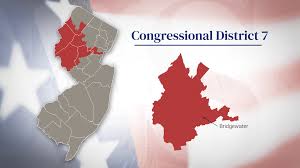
New Jersey’s 7th Congressional District includes affluent suburban communities, highly educated voters, moderate Democrats, independents, and anti-Trump Republicans whose voting behavior has shifted dramatically over recent election cycles. The district has become emblematic of the national suburban political battleground where Democrats attempt to balance progressive energy with broader crossover appeal necessary for general election victories.
That balancing act remains delicate.
Too progressive, and candidates risk alienating moderates and independents.
Too centrist, and they risk backlash from energized activist wings within the Democratic base.
Bennett now finds herself navigating that precise political terrain.
The ICE-related attacks highlight another major fault line inside Democratic politics nationally.
Immigration enforcement, border policy, detention practices, and the future role of agencies like ICE continue dividing Democratic factions ranging from progressive abolition advocates to more moderate institutional reformers. Accusations that a candidate is insufficiently progressive on immigration have become increasingly common tactical weapons inside Democratic primaries, particularly in races where progressive organizations seek to shape ideological narratives before general elections begin.
Bennett’s response has been to aggressively reject the accusations while simultaneously attempting to re-center the race around defeating Kean rather than ideological purity battles.
Her campaign has reportedly launched a “check the facts” section online specifically designed to rebut claims made in attack mailers and political advertising.
Importantly, the two other Democratic candidates in the race — Michael Roth and Brian Varela — have largely avoided direct personal attacks thus far, creating an unusual split-screen dynamic inside the primary where some candidates continue emphasizing policy and coalition-building while others escalate contrast messaging.
The broader significance of the race extends well beyond district borders.
National Democrats continue targeting districts like NJ-7 as critical components of any future effort to reclaim congressional majorities. Tom Kean Jr., while carrying one of New Jersey’s most recognizable Republican political names, remains vulnerable inside a district where demographic shifts, suburban political evolution, and anti-MAGA sentiment continue reshaping electoral dynamics.
That reality explains why outside organizations have become increasingly active.
It also explains why emotions inside the race continue intensifying.
Warren County itself provided an especially symbolic backdrop for Bennett’s latest remarks. Long considered more conservative territory within the district, the county nevertheless reflects the broader political fluidity now shaping New Jersey suburban politics. Democratic organizations there continue working aggressively to expand turnout operations, recruit moderates disillusioned with national Republican politics, and build coalitions capable of competing in historically difficult territory.
Attendees at the event included Warren County Democratic Chair Charles Boddy, underscoring the degree to which local party infrastructure increasingly recognizes the race’s broader importance.
For many Democratic voters inside the district, however, the escalating negativity also raises concerns about potential damage heading into the general election.
Primary fights can energize voters, sharpen campaign operations, and generate media attention. But prolonged intraparty warfare also risks alienating moderates, depressing enthusiasm, and creating divisions difficult to heal before facing a well-funded incumbent.
That tension now hangs over the final stretch of the race.
At the same time, Bennett’s increasingly forceful posture may actually reflect what many Democratic primary voters currently want: confrontation, confidence, and visible willingness to directly engage Republican opposition without hesitation.
The modern Democratic electorate — particularly in competitive suburban districts — increasingly rewards candidates perceived as politically resilient under attack.
That perception may ultimately become as important as policy positioning itself.
As the June 2 primary approaches, the contest for New Jersey’s 7th Congressional District is rapidly evolving into one of the state’s most closely watched Democratic battles, not only because of who may emerge victorious, but because the race itself reflects broader national tensions reshaping modern Democratic politics: electability versus ideology, pragmatism versus purity, coalition-building versus factional warfare, and the increasingly aggressive role of outside spending in shaping voter perception before ballots are even cast.
For now, Bennett is making clear she believes the attacks validate one central reality.
Her opponents, she argues, would not be coming this hard if they did not believe she was becoming the candidate to beat.