


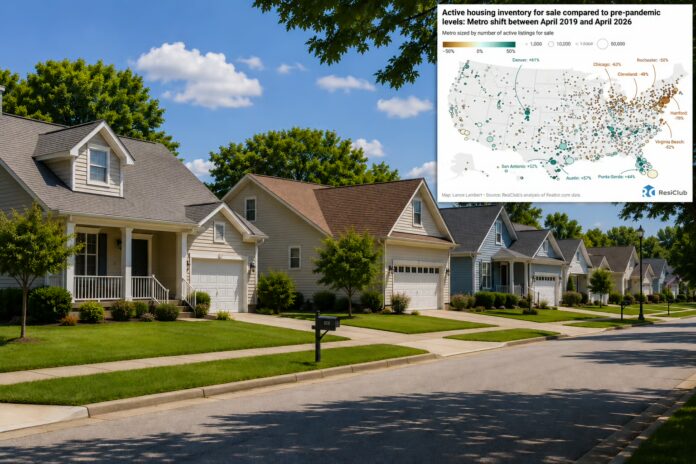

As much of the country’s once-explosive pandemic housing boom continues deflating across major Sun Belt metros and formerly overheated migration hotspots, the Northeast — including New Jersey — is heading into the summer 2026 real estate season with a dramatically different problem: there are still not nearly enough homes available to satisfy demand.
The divide now reshaping the American housing market is becoming increasingly stark.
In many Southern and Mountain West regions that dominated the pandemic-era migration frenzy, buyers are finally regaining leverage after years of runaway pricing, speculative competition, and aggressive investor activity. But across New Jersey and much of the Northeast and Midwest, inventory remains historically constrained, prices remain elevated, and the structural imbalance between supply and demand continues exerting enormous pressure on buyers entering the market this summer.
The contrast highlights how uneven the national housing correction has become.
Markets like Austin, Texas, Punta Gorda, Florida, Phoenix, Nashville, and parts of the broader Sun Belt experienced extraordinary pandemic-era appreciation as remote workers, investors, and relocating households flooded into lower-tax and lower-density regions between 2020 and 2023. Those migration surges sent prices skyrocketing far beyond what many local wage structures could sustainably support.
Now, however, the economic dynamics underpinning those booms have shifted significantly.
Domestic migration has slowed. Mortgage rates remain elevated. Affordability has deteriorated nationally. Investor enthusiasm has cooled. And critically, many Southern markets now have far more new housing inventory entering the system than Northeastern states like New Jersey.
That inventory surge is fundamentally changing buyer leverage in many Sun Belt regions.
Builders throughout the South and Mountain West increasingly offer incentives, mortgage rate buy-downs, price cuts, closing assistance, and upgrade packages to maintain sales velocity. New construction pipelines that expanded aggressively during the pandemic boom are now colliding with softer demand conditions, placing downward pressure on both new-build pricing and surrounding resale markets.
The Northeast, however, exists inside an entirely different housing reality.
New Jersey in particular remains trapped inside one of the tightest inventory environments in the United States.
Unlike many fast-growth Sun Belt metros, New Jersey never experienced the same scale of speculative overbuilding during the pandemic years. The state also did not rely nearly as heavily on inbound migration waves to sustain demand. Instead, New Jersey’s housing market remains supported by deeply entrenched structural drivers that continue limiting supply while maintaining buyer competition.
Land scarcity remains a defining issue.
Dense development patterns, longstanding suburban zoning structures, environmental protections, infrastructure limitations, and political resistance to higher-density construction all continue constraining large-scale housing expansion throughout much of the state.
At the same time, demand remains remarkably durable.
New Jersey’s strategic location between New York City and Philadelphia, its transportation infrastructure, high-income employment base, established suburban communities, public school systems, healthcare access, and proximity to major economic corridors continue making the state one of the country’s most consistently desirable housing markets despite affordability pressures.
That dynamic has become increasingly evident entering the summer 2026 market.
Across much of New Jersey, buyers continue competing aggressively for relatively limited inventory while sellers maintain substantial pricing power. Even as mortgage rates remain far higher than pandemic-era lows, demand has not collapsed the way many analysts once predicted.
Instead, the market has shifted into what many housing economists now describe as a “frozen inventory” environment.
Millions of homeowners nationwide locked into ultra-low mortgage rates during the pandemic years and now remain reluctant to sell because moving would require financing replacement homes at significantly higher borrowing costs. That phenomenon has become especially pronounced throughout the Northeast, where long-term homeownership patterns, aging housing stock, and limited new construction already constrained turnover before rates increased.
The result is a market where many potential sellers simply stay put.
That further restricts available supply.
And in New Jersey, restricted supply continues reinforcing upward pricing pressure despite broader national housing uncertainty.
The numbers increasingly reflect that reality.
Median home values across large portions of the state continue climbing, particularly for single-family housing. Inventory gains remain modest compared to many Southern regions. And unlike some Sun Belt markets now experiencing noticeable price softness, New Jersey home values remain relatively resilient because supply remains fundamentally inadequate relative to demand.
The Midwest faces similar conditions for many of the same reasons.
Many Northeastern and Midwestern markets never experienced the same speculative migration bubble that reshaped parts of Florida, Texas, Arizona, Nevada, and the Carolinas. As a result, those regions avoided some of the extreme pandemic-era overbuilding now contributing to inventory corrections elsewhere.
Ironically, the absence of massive construction booms may now be protecting home values in the Northeast and Midwest even while simultaneously worsening affordability challenges.
New Jersey’s situation is especially complex because the state faces multiple overlapping housing pressures simultaneously.
Affluent suburban counties continue attracting high-income buyers priced out of New York City. Urban redevelopment continues expanding throughout Jersey City, Newark, Hoboken, New Brunswick, and other transit-oriented hubs. Shore communities remain intensely competitive. Retirement migration inside South Jersey and Ocean County continues fueling adult-community demand. And younger households still seek entry-level ownership opportunities despite rising costs.
Meanwhile, construction pipelines remain insufficient to meaningfully close the supply gap.
The state’s broader affordability crisis therefore continues deepening even as inventory rises slightly.
For first-time buyers, the situation remains particularly punishing.
Starter homes remain scarce. Mortgage rates continue straining purchasing power. Property taxes remain among the highest in the country. Insurance costs continue rising in many regions. And wage growth has not remotely kept pace with cumulative home appreciation over the past several years.
Many younger New Jersey residents increasingly find themselves confronting difficult choices: remain renters indefinitely, leave the state entirely, move farther from employment centers, rely on family support for home purchases, or dramatically stretch household finances to secure ownership opportunities before prices climb even higher.
Those pressures increasingly affect employers as well.
Housing affordability now directly influences workforce recruitment, retention, commuting patterns, healthcare staffing, education systems, municipal planning, and long-term economic competitiveness throughout the region.
Yet despite those challenges, the underlying strength of Northeast housing markets also reflects broader confidence in the region’s long-term stability.
While pandemic migration patterns created dramatic short-term booms across parts of the South, many Northeastern housing markets remain supported by slower-moving but more deeply rooted economic fundamentals: established infrastructure, institutional employment, finance, healthcare, higher education, transportation networks, and dense regional connectivity.
That stability continues insulating many Northeastern markets from the sharper corrections now emerging elsewhere.
The national housing market entering summer 2026 therefore no longer behaves as a single unified system.
Instead, America increasingly resembles two separate real estate economies operating simultaneously.
One consists of formerly overheated Sun Belt boomtowns where inventory has expanded rapidly and buyers now possess growing leverage.
The other includes regions like New Jersey, where inventory remains constrained, construction remains limited, and demand continues significantly outpacing available supply despite elevated borrowing costs.
For buyers hoping that falling national headlines automatically translate into cheaper New Jersey housing, the reality remains frustratingly different.
The Northeast’s housing shortage is not primarily cyclical.
It is structural.
And structural shortages do not disappear quickly.
As summer 2026 begins, that reality continues defining nearly every aspect of New Jersey’s housing landscape — from pricing pressure and affordability challenges to inventory competition, construction debates, suburban redevelopment battles, and the growing urgency surrounding long-term housing policy solutions.
The pandemic housing boom may be over nationally.
In New Jersey, however, the fight over limited housing supply is still very much alive.