


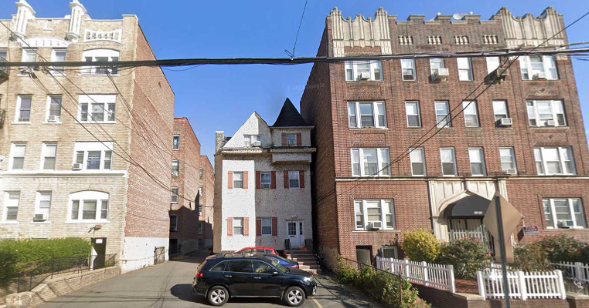

In a state where rising housing demand, escalating land values, redevelopment pressure, and rapid urban expansion continue reshaping entire neighborhoods block by block, one restored property in Jersey City’s Heights section is emerging as something larger than a successful construction project.
It is becoming a symbol of a growing debate over what the future of New Jersey development should actually look like.
For longtime Heights resident Norrice Raymaker, the aging three-story home on Beacon Avenue represented both a piece of neighborhood history and a familiar source of anxiety.
Like many residents deeply connected to Jersey City’s historic fabric, Raymaker had watched wave after wave of older residential properties disappear throughout the neighborhood during the last decade. Elegant Second Empire homes, historic multifamily residences, porched Victorian structures, and century-old streetscapes increasingly gave way to fast-built replacement projects designed primarily around maximizing lot efficiency and parking capacity.
In many cases, the result was the now-infamous “Bayonne Box.”
The term — often used critically by preservationists, urban planners, architects, and longtime residents — refers to a repetitive style of modern multifamily construction that spread rapidly across Hudson County and especially neighboring Bayonne following World War II development patterns. These structures are typically characterized by elevated living spaces positioned above garages, highly vertical massing, flat façades, limited ornamentation, and designs critics argue prioritize development efficiency over architectural identity or neighborhood continuity.
For many communities across North Jersey, the Bayonne Box became a visual symbol of larger anxieties surrounding redevelopment itself.
Residents worried not only about density, parking, and infrastructure pressure, but also about the gradual erosion of neighborhood character and historic streetscapes that helped define older urban communities throughout Hudson County for generations.
That is why the Beacon Avenue property attracted so much attention.
Instead of demolishing the existing structure entirely, developers pursued a dramatically different strategy — one attempting to blend historic preservation, adaptive redevelopment, additional housing creation, and modern urban density into a single integrated project.
The redevelopment effort led by Behrang Behin and collaborator Alan Feld ultimately transformed what preservation advocates feared could become another demolition casualty into a hybrid restoration-and-expansion project now increasingly viewed as a possible blueprint for future neighborhood-sensitive development.
Rather than leveling the historic structure outright, the project preserved and restored the existing home while incorporating additional townhouse units at the rear of the property.
That design decision became central to winning zoning approvals.
According to zoning board findings tied to the project, preserving the original structure while adding carefully positioned townhomes helped maintain neighborhood integrity and preserve the surrounding streetscape — a critical concern in a rapidly transforming section of Jersey City where many residents increasingly fear architectural homogenization and speculative redevelopment.
The design itself intentionally attempted to soften the impact of added density.
Instead of conventional rear-yard configurations, the townhouses were designed with enclosed front-yard spaces separated by fencing, helping create greater privacy and visual buffering between the restored historic structure and the newly constructed residential units.
The approach represented something increasingly rare in high-pressure redevelopment markets: compromise.
The project added housing inventory without erasing the architectural identity already embedded within the block.
That balance is becoming one of the defining urban development debates not only in Jersey City, but throughout New Jersey itself.
Across the state, municipalities continue wrestling with extraordinarily difficult questions surrounding housing production, historic preservation, affordability, infrastructure capacity, environmental sustainability, zoning reform, and neighborhood identity.
New Jersey remains one of the nation’s most densely populated states while simultaneously facing major housing shortages and affordability pressures. That dynamic places enormous pressure on older urban and suburban neighborhoods where redevelopment opportunities often collide directly with preservation concerns.
The Heights section of Jersey City has become one of the clearest examples of that collision.
Once viewed as a quieter, more working-class counterpart to Jersey City’s rapidly transforming waterfront, the Heights has increasingly become one of the region’s most competitive residential markets. Rising demand, proximity to Manhattan, transit accessibility, and changing demographic patterns have accelerated redevelopment activity throughout the neighborhood.
Older properties now frequently sit at the center of intense economic calculations.
Developers see opportunity in underutilized lots and aging structures positioned inside one of the country’s hottest regional housing markets. Residents and preservationists, meanwhile, often fear that unchecked redevelopment risks destroying the architectural and cultural identity that made these neighborhoods desirable in the first place.
The Beacon Avenue project stands out because it attempted to navigate both realities simultaneously.
The effort was not without obstacles.
The COVID-19 pandemic delayed construction timelines substantially, complicating financing, labor coordination, permitting schedules, and broader development logistics across the industry. Yet the project ultimately reached completion last year with a reported development cost of approximately $2.3 million.
Importantly, the project also reflected a deeply personal dimension of development increasingly common among smaller-scale urban builders.
Rather than functioning solely as a large institutional investment operation, the redevelopment effort carried strong family involvement throughout the process. Behin’s mother reportedly handled apartment listings and applicant qualification reviews, while family participation extended into leasing and tenant coordination as well.
That kind of family-centered development model contrasts sharply with the corporate-scale institutional redevelopment reshaping many urban markets nationally.
The completed project now generates approximately $14,600 per month in combined rental income, illustrating another major reality driving redevelopment pressure across Hudson County: the extraordinary economic value of housing demand in Northern New Jersey.
High rents, constrained inventory, and intense regional demand continue fueling redevelopment interest throughout Jersey City, Hoboken, Union City, Weehawken, Bayonne, and surrounding municipalities.
Yet the Beacon Avenue story resonates beyond economics alone.
It highlights a growing shift in urban planning philosophy increasingly visible in portions of New Jersey redevelopment policy.
For decades, preservation and housing development were often framed as opposing forces. Historic advocates frequently battled developers in zero-sum political fights where either preservation won or redevelopment prevailed.
Now, however, a more integrated conversation is beginning to emerge.
Cities increasingly recognize that adaptive reuse, historically sensitive infill development, mixed-density planning, and contextual architectural approaches may offer more sustainable long-term solutions than purely demolition-driven redevelopment cycles.
The Beacon Avenue project fits squarely inside that evolving framework.
Rather than maximizing every square foot through standardized high-density construction, the project attempted to preserve streetscape continuity while still increasing housing capacity and economic viability.
That balancing act may become increasingly important statewide.
New Jersey’s housing crisis continues intensifying. Demand remains extraordinarily high. Land scarcity continues worsening. Infrastructure systems face mounting pressure. Communities remain divided over zoning reform and density expansion. Historic neighborhoods face accelerating redevelopment interest.
Against that backdrop, projects capable of integrating preservation with modern housing production may attract growing attention from planners, architects, local officials, and residents alike.
For longtime neighborhood advocates like Raymaker, the successful preservation of the Beacon Avenue structure represents more than simply saving one historic home.
It reflects a larger argument that growth and preservation do not necessarily have to function as enemies.
And in Jersey City — where redevelopment pressure continues reshaping entire neighborhoods at remarkable speed — that idea may ultimately prove as important as the project itself.