


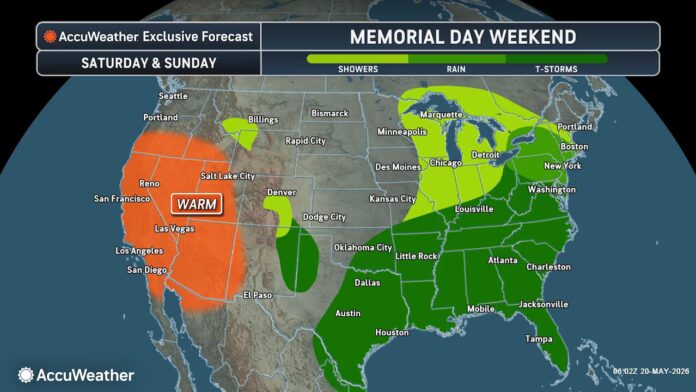

What was supposed to be the unofficial launch of Summer 2026 across New Jersey is instead shaping up to become one of the coldest, wettest, and most frustrating Memorial Day weekends the state has seen in years.
New Jersey 3-Day Forecast (Cherry Hill) – The holiday weekend will remain unsettled with steady, soaking rains on Saturday followed by persistent showers on Sunday.
| Day | Sky Condition | Temperature | Chance of Rain |
|---|---|---|---|
| Fri, May 22 | 64°F / 52°F | 17% (Day) / 45% (Night) | |
| Sat, May 23 | 53°F / 51°F | 75% | |
| Sun, May 24 | 61°F / 54°F | 75% |
Saturday Battle of the Big Bands Impact (Manhattan)
If you head up to the Intrepid Museum tomorrow, New York City’s forecast mirrors New Jersey’s chill, dropping highs to 56°F with a 45% to 75% chance of steady rain. []
| Hour | Sky Condition | Temperature | Chance of Rain |
|---|---|---|---|
| 5 PM – 7 PM | 53°F – 52°F | 45% | |
| 7 PM – 9 PM | 52°F | 45% – 65% | |
| 9 PM – 11 PM | 52°F | 45% – 65% |
After days of waiting for forecast models to shift toward a more optimistic solution, meteorologists are now increasingly aligned on a bleak outcome for nearly the entire holiday corridor stretching from Friday afternoon through at least Monday afternoon. For millions of residents planning beach trips, boardwalk weekends, concerts, shore rentals, barbecues, campground excursions, fleet week events, and early summer tourism activity, the timing could hardly be worse.
New Jersey is preparing for a prolonged stretch of chilly rain, dense cloud cover, gusty onshore winds, raw marine air, and temperatures that will feel dramatically more like early March than late May.
The forecast is not pointing toward a short-lived thunderstorm pattern or intermittent passing showers. Instead, the state appears trapped beneath a broad, slow-moving coastal rain regime capable of producing two to three inches of rainfall across many communities over the course of the holiday weekend. In some localized regions, totals could push even higher.
Fortunately, forecasters do not currently expect widespread flash flooding because the precipitation is projected to unfold gradually over multiple days rather than through rapid tropical-style downpours. But the extended duration of the event will likely create an entirely different kind of disruption — one centered on economic activity, outdoor recreation, travel logistics, and coastal tourism.
For Jersey Shore businesses, restaurants, hotels, rental operators, boardwalk vendors, breweries, beach towns, and seasonal employers, Memorial Day weekend is traditionally one of the most important revenue periods of the entire year. It marks the psychological and economic transition into the summer tourism season.
Instead, businesses may find themselves confronting empty boardwalks, soaked beach towns, wind-driven rain, gray skies, and temperatures struggling to escape the 50s and lower 60s.
In practical terms, this is not “beach weather.”
It is soup weather.
The atmosphere responsible for this unusually raw late-May pattern is particularly fascinating because the storm setup does not resemble a classic nor’easter at first glance. Upper-level atmospheric maps alone would not immediately suggest such a cold and miserable outcome for the Mid-Atlantic.
In fact, at higher atmospheric levels, conditions initially appear relatively benign.
Meteorologists examining the 250mb jet stream and 500mb height anomalies see a weak ridge extending across portions of the Northeast and Mid-Atlantic. Normally, such a pattern might support milder temperatures and more stable conditions.
The true story, however, is unfolding lower in the atmosphere.
At approximately 850mb — a critical layer for analyzing lower atmospheric dynamics and temperature transport — two major pressure systems are creating a prolonged zone of atmospheric conflict directly impacting the Northeast corridor.
One high-pressure system positioned near Bermuda is attempting to push warmer, moisture-rich Atlantic air northward. Simultaneously, another sprawling area of high pressure tracking from New England toward the southeast is forcing cooler marine air southwestward along the coast.
The collision zone between these opposing circulations is generating a large-scale convergence field stretching from the Mid-Atlantic coastline deep into portions of the Great Lakes and potentially southern Canada.
When air masses converge horizontally and cannot move through one another, they are forced upward.
That lifting process is the engine driving the widespread cloud formation and persistent rainfall now expected across New Jersey through much of the holiday weekend.
Because New Jersey sits on the northern side of this convergence boundary, the state will remain locked beneath a persistent easterly to east-northeasterly wind flow coming directly off the Atlantic Ocean.
That marine influence is critical.
Ocean temperatures off the New Jersey coast remain primarily in the 50s, meaning every sustained onshore wind effectively acts like a refrigeration system feeding chilly, damp air inland. The result is a sprawling coastal marine layer capable of suppressing daytime temperatures statewide while simultaneously fueling low clouds, mist, drizzle, and periods of steady rain.
Even inland communities far from the immediate shoreline will struggle to escape the effects.
Friday begins the transition phase into the worst of the pattern.
Northwestern New Jersey may briefly approach 70 degrees before conditions deteriorate more aggressively later in the day. Elsewhere across the state, especially closer to the coast, temperatures will likely remain trapped near 60 degrees beneath increasingly thick cloud cover.
Light sprinkles may develop during daytime hours Friday, but the steadier, more organized rainfall is expected to intensify Friday afternoon and continue through Friday night as easterly winds strengthen.
By Saturday, the full impact of the marine pattern settles across the state.
Most of New Jersey will likely remain stuck between 55 and 60 degrees for daytime highs — temperatures astonishingly cold for Memorial Day weekend standards. Persistent rain, gusty coastal winds, and overcast skies are expected statewide, with many forecasters describing Saturday as essentially a complete washout.
Along Eastern and Southern New Jersey coastal communities, easterly wind gusts may become especially noticeable, creating an even colder and more unpleasant feel.
Boardwalk conditions could become particularly miserable.
Sunday offers only modest improvement.
Temperatures may creep slightly higher into the lower 60s for portions of the state, but periods of steady rainfall are still expected through at least the first half of the day, with lingering scattered showers continuing afterward into Sunday night.
The second half of Sunday may gradually improve somewhat away from the coast, but skies are expected to remain mostly cloudy and unstable.
Monday — Memorial Day itself — appears somewhat better but still far from ideal.
Temperatures may recover toward 70 degrees in some inland areas while isolated showers continue lingering beneath stubborn cloud cover. Some partial sunshine may finally begin breaking through in spots, but coastal communities will likely remain cooler due to continued marine flow.
Ironically, immediately after the holiday weekend concludes, the broader weather pattern appears poised to improve rapidly.
Forecast guidance strongly suggests a return to sunshine, warmer temperatures, and far more seasonable conditions beginning Tuesday and continuing through much of the final week of May.
Highs should rebound into the 70s and even 80s next week as the competing pressure systems finally shift offshore, allowing warmer return flow to surge back up the East Coast.
That timing, of course, is likely to intensify frustration for many New Jersey residents.
The weather pattern is particularly unfortunate for major regional events scheduled throughout the weekend, including outdoor concerts, Fleet Week activities, shore festivals, and tourism-driven gatherings across both New Jersey and New York City.
One highly anticipated casualty may be the “Battle of the Big Bands” event aboard the historic Intrepid Museum in Manhattan.
Current forecasts for New York City mirror New Jersey’s dreary setup, with temperatures hovering near 52 to 56 degrees during evening event hours alongside steady rain showers and persistent easterly winds.
Given those conditions, many attendees now expect activities originally planned for the outdoor flight deck to be relocated inside the museum’s indoor Hangar Deck facilities.
Travelers planning vintage-themed attire, especially 1940s-inspired fashion associated with the event, are increasingly being advised to incorporate heavier outerwear, trench coats, knit layers, and weather-resistant clothing for comfort during transit throughout the city.
Despite the disappointment surrounding the holiday weekend itself, the rainfall does offer one major long-term benefit for the region.
New Jersey’s reservoirs, aquifers, vegetation systems, and drought-sensitive landscapes badly needed a prolonged soaking event. The gradual nature of the rainfall should allow substantial water absorption into soil systems rather than rapid runoff associated with severe thunderstorm events.
So while the timing could hardly be worse economically for tourism communities and outdoor businesses, the precipitation itself may prove critically important environmentally as the state heads toward the hotter summer months ahead.
Still, for millions of residents hoping Memorial Day weekend would deliver sunshine, beach weather, rooftop dining, concerts, fireworks, and summer energy, the reality is likely to feel very different.
Cold rain.
Gray skies.
Wind-driven mist.
Empty beaches.
And a Memorial Day weekend across New Jersey that may ultimately be remembered less for summer’s arrival and more for the strange late-season marine storm pattern that temporarily brought autumn back to the Garden State.



