


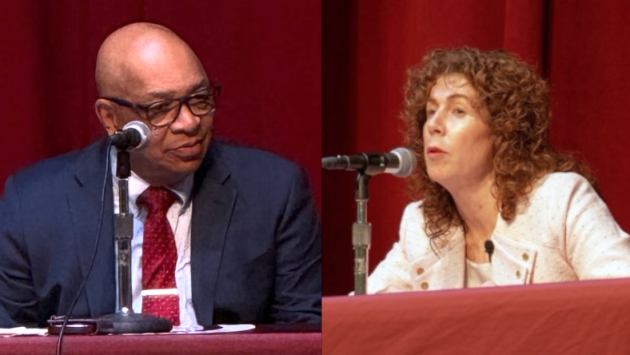

Bayonne’s mayoral race has entered its closing days with campaigns accelerating turnout operations, candidates intensifying direct voter outreach, and residents preparing to decide who will lead one of Hudson County’s fastest-evolving municipalities into its next chapter. In a political environment often defined by entrenched incumbency and established power structures, Bayonne now finds itself confronting something increasingly rare in local Hudson County politics: a truly open race with competing visions, competing personalities, and competing interpretations of what “change” actually means for the city.
The atmosphere surrounding the election reflects both urgency and transition. Longtime Mayor Jimmy Davis has moved on to become Hudson County sheriff, while interim Mayor Robert Kubert opted against seeking a full term, leaving the office without a traditional incumbent defending it. The result has created a three-way battle between Councilman Loyad Booker, former mayoral challenger Sharon Ashe-Nadrowski, and Bayonne Business Administrator Mary Jane Desmond, each presenting voters with sharply different styles of leadership and contrasting arguments about the city’s direction.
With Election Day approaching rapidly, campaign activity across Bayonne has intensified block by block, neighborhood by neighborhood, and voter by voter.
At a “Get Out The Vote” breakfast gathering Saturday morning inside the Chandelier Catering Hall, the atmosphere reflected the kind of operational focus campaigns embrace during the final hours before ballots are cast. The room was packed with supporters, organizers, volunteers, and campaign workers preparing for what may become one of the city’s most closely watched municipal elections in years.
But this was not designed as a ceremonial political gathering.
After supporters grabbed breakfast sandwiches and campaign materials, Booker delivered a message focused less on speeches and more on action. He urged supporters to vote early, mobilize neighbors, distribute literature, and maximize turnout efforts immediately.
“Get out of here,” he told the crowd, emphasizing the urgency of the moment.
The message captured the reality facing every campaign in Bayonne right now. With only days remaining before voting concludes, persuasion efforts increasingly give way to turnout strategy. Municipal elections often hinge less on broad ideological shifts and more on organization, neighborhood operations, and which campaign can physically move supporters to the polls.
That dynamic may prove especially important in a nonpartisan local election where personality, trust, familiarity, and visibility frequently matter more than formal party alignment.
Booker has attempted to frame his candidacy as the campaign of momentum and generational transition. As a sitting city council member, he enters the race with municipal experience while also attempting to position himself as part of a changing political landscape within Bayonne. His campaign operation has focused heavily on direct engagement, field organization, and voter mobilization, particularly during the final stretch.
Meanwhile, Sharon Ashe-Nadrowski has continued building on the infrastructure and recognition she developed during her previous mayoral challenge against Davis in 2022. Her campaign has blended traditional grassroots campaigning with modern digital outreach efforts, utilizing mailers, canvassing operations, automated calls, and social media engagement as it pushes to consolidate voters seeking a different direction for City Hall.
Inside Nadrowski campaign headquarters on Broadway, optimism remains measured but visible. Campaign officials described themselves as “cautiously optimistic,” a phrase commonly used in politics but one that also reflects the uncertainty surrounding open-seat local races where turnout patterns can dramatically alter outcomes.
Early voting numbers immediately became a point of interpretation between competing campaigns.
Friday marked the beginning of early voting, with approximately 800 residents casting ballots. Nadrowski supporters viewed that participation as a positive sign, arguing that higher enthusiasm levels often indicate voters motivated by dissatisfaction with the status quo and interested in political change.
But in Bayonne, the concept of “change” itself has become one of the central debates of the race.
Each candidate has attempted to claim that mantle in different ways.
Booker’s campaign argues that his leadership represents a new phase for the city capable of building forward while maintaining stability. Nadrowski’s supporters frame her candidacy as a direct opportunity to reshape local leadership after years of established political structures. Desmond’s campaign, meanwhile, has approached the election from a different angle entirely, emphasizing continuity, administrative experience, and institutional steadiness during a period of significant development and growth.
That contrast may ultimately define the election more than any single issue.
Desmond’s messaging has centered heavily on governance experience, public service, neighborhood preservation, and municipal stability. Campaign communications have emphasized her years of involvement within city operations and her focus on maintaining quality-of-life priorities while navigating Bayonne’s continuing redevelopment pressures.
The debate unfolding across Bayonne reflects broader conversations happening throughout Hudson County and many parts of New Jersey where cities balancing redevelopment, population growth, infrastructure strain, and economic transition are increasingly confronting difficult questions about identity and long-term planning.
Among the issues drawing significant attention during the campaign has been the growing controversy surrounding data centers.
What may once have sounded like an obscure zoning discussion has evolved into a politically sensitive issue carrying implications tied to development, land use, infrastructure, energy consumption, and neighborhood character. Bayonne’s city council previously approved a zoning change that would permit a data center project along New Hook Road, although any actual development proposal would still require additional approvals from local land-use authorities.
Since then, the issue has become politically charged.
The council later adopted resolutions opposing data centers, though critics questioned the practical significance of those measures. During a recent debate, Nadrowski argued the resolutions lacked substantive legal force, while opponents of large-scale data infrastructure projects continue voicing concerns about industrial expansion and future development patterns throughout the city.
The controversy reflects a larger statewide and national trend. As technology infrastructure expands rapidly across the country, municipalities increasingly face pressure to balance economic development opportunities with concerns surrounding environmental impact, electrical demand, traffic, industrialization, and local quality of life.
In Bayonne, where redevelopment has transformed significant portions of the city over the last two decades, those tensions carry particular political weight.
Development politics have also surfaced elsewhere throughout the campaign, particularly regarding fundraising and relationships with developers. Accusations that candidates are becoming too closely aligned with development interests remain a familiar theme in local New Jersey politics, especially in fast-changing urban and waterfront communities where real estate investment continues accelerating.
Still, compared to the volatility often associated with Hudson County political contests, this campaign has remained notably restrained.
That relative calm has not gone unnoticed among voters or campaign observers.
Booker himself recently emphasized the tone of the race, saying, “We’ve been respectful.”
In many ways, that statement reflects the broader mood surrounding the election. While disagreements over development, governance, zoning, and leadership style remain very real, the campaign has largely unfolded without the level of public hostility or internal party warfare sometimes associated with competitive local races in the region.
That does not mean the stakes are low.
Far from it.
Bayonne now sits at an important crossroads within Hudson County’s evolving political and economic landscape. Positioned between Jersey City and Staten Island, with growing residential demand, continuing redevelopment activity, expanding transportation relevance, and increasing regional visibility, the city is confronting decisions that will shape its long-term trajectory for decades.
Questions surrounding infrastructure, affordability, neighborhood preservation, public safety, economic growth, and development intensity are no longer abstract policy conversations. They directly affect residents navigating rising costs, shifting demographics, and rapid physical transformation throughout portions of the city.
That is why turnout may ultimately determine more than simply who occupies the mayor’s office.
It may determine how residents want Bayonne itself to evolve.
Municipal elections often receive less attention than statewide or federal races, yet they frequently have the most immediate impact on daily life. Decisions regarding zoning, development approvals, taxes, policing, recreation, traffic patterns, public works, and neighborhood planning originate at the local level. In cities experiencing active redevelopment pressure, mayoral leadership can dramatically influence both the pace and character of transformation.
Across Hudson County, political observers continue watching Bayonne closely because the race also represents a broader test of how voters are responding to changing political dynamics throughout urban New Jersey communities. Established political structures across the region have faced increasing pressure in recent years from challengers emphasizing reform, transparency, modernization, or alternative visions for growth.
At the same time, many voters remain cautious about instability or abrupt change during periods of economic uncertainty and rapid urban development.
That tension is visible throughout this race.
One campaign speaks heavily about momentum and future possibility.
Another emphasizes transformation and political change.
Another focuses on stability, experience, and continuity.
Bayonne voters now must decide which vision feels most aligned with the city they want moving forward.
Explore New Jersey continues following major political developments, municipal elections, policy debates, redevelopment battles, and statewide governance issues shaping communities throughout the region. Additional political coverage and analysis can be found through the publication’s ongoing politics coverage section, which continues tracking the evolving political landscape across New Jersey and beyond.
As Election Day approaches, the final hours of campaigning in Bayonne are likely to intensify even further. Volunteers will continue knocking on doors. Campaign literature will continue arriving in mailboxes. Phone calls, text messages, and digital outreach efforts will continue targeting undecided voters and turnout operations.
But beneath the mechanics of campaign strategy lies a broader reality.
This election is not only about choosing Bayonne’s next mayor.
It is about defining what kind of city Bayonne wants to become during one of the most consequential periods of transition it has faced in modern decades.