


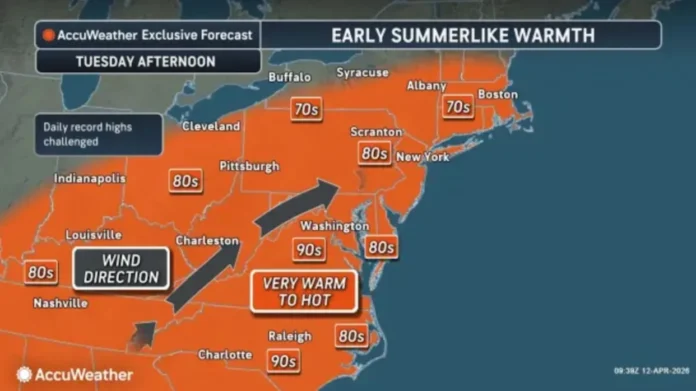

New Jersey is entering one of its most dynamic early-season weather stretches of the year, as a powerful ridge anchored across the eastern United States—reinforced by high pressure just north of Bermuda—pushes a sustained surge of warm, southwest flow into the region. The result is a multi-day period of unseasonably high temperatures, limited widespread rainfall, and atmospheric instability that could trigger isolated, highly localized storm activity across the state. As outlined across the evolving Weather Report coverage, this pattern is not just a short-lived warm spell—it is a structurally significant setup with implications for drought development, wildfire risk, and the broader transition into late April.
The defining feature of this week is heat, and not just typical spring warmth. Temperatures are accelerating well beyond seasonal norms, with much of inland New Jersey pushing into the 80s and even flirting with 90 degrees in select areas, particularly along the Interstate 95 corridor. This is the kind of anomalous warmth that begins to challenge daily records, compressing the seasonal timeline and creating conditions more consistent with early summer than mid-April.
Hourly Forecast for Today (April 14)
| Hour | Sky Condition | Temperature | Chance of Precipitation |
|---|---|---|---|
| 11 AM | 79°F | 0% | |
| 1 PM | 83°F | 0% | |
| 3 PM | 85°F | 5% | |
| 5 PM | 84°F | 0% | |
| 7 PM | 79°F | 0% | |
| 9 PM | 74°F | 0% | |
| 11 PM | 71°F | 10% |
7-Day Outlook
A summer-like surge is bringing near-record heat to the state through mid-week before a cooling trend begins over the weekend. [1, 2]
| Day | Sky Condition | Temperature (High/Low) | Chance of Rain |
|---|---|---|---|
| Tue, Apr 14 | 85°F / 61°F | 5% | |
| Wed, Apr 15 | 87°F / 64°F | 10% | |
| Thu, Apr 16 | 89°F / 64°F | 10% | |
| Fri, Apr 17 | 78°F / 55°F | 35% | |
| Sat, Apr 18 | 68°F / 53°F | 10% | |
| Sun, Apr 19 | 76°F / 38°F | 40% | |
| Mon, Apr 20 | 50°F / 36°F | 10% |
Monday established the baseline for this shift, with temperatures climbing into the 70s across most of the state and even approaching 80 degrees in interior Central and South Jersey. Coastal regions, influenced by cooler marine air, remained more tempered, with barrier island communities holding in the 50s and 60s. The atmosphere remained relatively stable, with a mix of clouds and sun and only the potential for brief, non-impactful showers. Overnight conditions reinforced the warming trend, with temperatures holding well above 50 degrees statewide, signaling a pattern that would not reset overnight but instead build momentum into the following days.
By Tuesday, the pattern fully asserts itself. Inland areas surge into the low-to-mid 80s, with some of the warmest locations potentially approaching 90 degrees under drier air conditions. Coastal regions also warm significantly, climbing into the 70s before the likely development of a sea breeze introduces cooler air later in the day. This sea breeze dynamic becomes a critical variable throughout the week, creating sharp temperature contrasts between inland and coastal zones while also acting as a potential trigger for isolated convective activity. The overall environment remains mostly dry, but the combination of heat and localized lift introduces the possibility of scattered afternoon or evening showers and thunderstorms, particularly in areas where atmospheric boundaries interact.
Wednesday stands out as the peak of this heat event. Temperatures are expected to push well into the 80s across nearly the entire state, with some inland corridors reaching into the low-to-mid 90s. Even coastal areas, often shielded from extreme heat, have the potential to exceed 80 degrees before any marine influence moderates conditions. The atmosphere becomes increasingly unstable under this level of heating, and while no organized storm systems are present, the potential for isolated convective development increases. These would be highly localized events—brief, scattered, and unevenly distributed—but capable of producing quick downpours or isolated thunder.
Thursday continues the pattern, though with a slight moderation in peak temperatures. Highs remain firmly in the 85 to 90 degree range inland, while coastal areas settle into the 70s. The persistence of southwest flow maintains the warm air mass, but subtle atmospheric changes begin to signal an approaching transition. As with the previous days, the lack of a structured weather system limits widespread rainfall, but isolated afternoon and evening storms remain possible, driven by localized lift mechanisms such as sea breezes or terrain influences along northern New Jersey’s higher elevations.
While this stretch of weather may be appealing on the surface—sun-filled skies, warm temperatures, and minimal rain—it introduces a more concerning underlying trend. The absence of sustained, synoptic rainfall is contributing to the early stages of drought development across parts of the state. Soil moisture levels are beginning to decline, and vegetation is entering a period of increased vulnerability. Combined with rising temperatures and periodic gusty conditions, this creates an elevated risk environment for brush and forest fires, particularly in areas with dense natural cover.
The pattern begins to shift on Friday as a weak upper-level disturbance moves through the region. This feature introduces a modest chance for more organized precipitation, particularly across northern New Jersey, while also breaking the intensity of the heat. Temperatures retreat to more seasonable levels, with highs around 80 degrees inland and mid-70s along the coast. Winds begin to shift, transitioning from southwest to a more west-northwest orientation, signaling the arrival of a different air mass. While not a dramatic cooldown, the change is noticeable, bringing relief from the earlier heat while maintaining generally favorable outdoor conditions.
The weekend outlook reflects this more balanced pattern. Saturday and Sunday are expected to deliver temperatures in the 70s with a mix of sun and clouds and largely dry conditions. While there remains a possibility of isolated showers, particularly as residual atmospheric energy lingers, the overall setup supports stable and comfortable weather across most of the state. This period offers a temporary reset, both in terms of temperature and atmospheric dynamics.
Looking ahead, however, the broader pattern suggests that this stability may be short-lived. Forecast models continue to indicate the development of a trough across the eastern United States beginning early the following week, introducing a colder and wetter regime between April 20 and April 25. This transition is expected to begin with a frontal system capable of delivering more widespread rainfall, followed by additional opportunities for precipitation as the trough settles in. For a state currently experiencing early signs of dryness, this shift could provide much-needed relief, replenishing soil moisture and reducing fire risk.
In the immediate term, New Jersey remains firmly in the grip of this warm, largely dry pattern. Current conditions reflect the broader trend, with temperatures already climbing into the upper 70s under partly sunny skies, moderate humidity levels, and light west winds. As the day progresses, highs are expected to peak in the mid-80s, reinforcing the early arrival of summer-like conditions.
This week’s weather narrative is defined by contrast—heat without widespread storms, dryness punctuated by isolated activity, and a rapid shift from near-record warmth to more moderate and eventually cooler conditions. For residents, businesses, and those monitoring environmental conditions, the message is clear: this is not a typical April pattern. It is a compressed sequence of seasonal signals, each carrying its own implications for safety, planning, and the broader trajectory of spring across New Jersey.



