



As the partial shutdown of the Department of Homeland Security enters its 41st day on March 26, 2026, the political battle consuming Washington has moved far beyond a conventional funding dispute. What began as a budget impasse has now escalated into a high-stakes ideological confrontation linking national security operations, election law, and social policy into a single legislative flashpoint. At the center of the crisis is President Donald Trump, who has drawn a hard line by conditioning the restoration of pay for tens of thousands of federal workers on the passage of sweeping new voting restrictions and broader policy demands that are reshaping the contours of the debate.
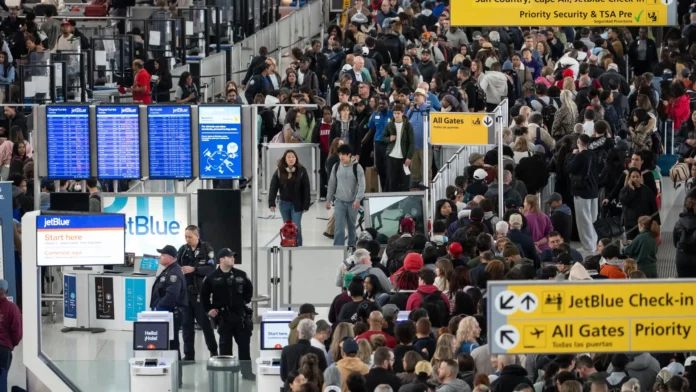
The immediate human impact of the shutdown is being felt most acutely by approximately 50,000 Transportation Security Administration employees, many of whom have now missed multiple paychecks. As frontline personnel responsible for maintaining aviation security across the United States, these workers occupy a critical role in the nation’s infrastructure. Yet the prolonged absence of compensation has triggered widespread absenteeism, with callout rates at major airports reportedly reaching as high as 40 to 50 percent. The operational consequences have been severe. At key travel hubs, including those serving the New York metropolitan region, passengers are encountering unprecedented wait times, in some cases stretching beyond four hours, fundamentally disrupting both business travel and everyday mobility.
The administration has responded to the staffing shortfall with an extraordinary measure: the deployment of Immigration and Customs Enforcement personnel to assist with airport operations. While framed as a stopgap solution to maintain order and throughput at security checkpoints, the move has generated significant concern among aviation professionals and policymakers. ICE agents are not trained to perform TSA screening functions, and their presence has raised questions about both the effectiveness and the optics of blending immigration enforcement with domestic transportation security. For critics, the decision underscores the depth of the operational strain and highlights the risks associated with prolonged federal workforce instability.
At the heart of the standoff is the proposed SAVE America Act, a legislative package that would fundamentally reshape federal election requirements. The bill mandates proof of citizenship for voter registration and imposes a nationwide photo identification requirement at the polls. Additional provisions under discussion would restrict mail-in voting to narrow categories such as military service, illness, or verified travel, while also requiring the use of paper ballots in federal elections. Supporters argue that these measures are necessary to restore confidence in the electoral system and ensure the integrity of the vote. Opponents, including a unified bloc of Democratic lawmakers, have characterized the legislation as a sweeping voter suppression effort that would disproportionately impact marginalized communities.
The political calculus surrounding the bill has intensified in recent days. On March 22, President Trump publicly urged congressional Republicans to reject any funding agreement that would restore DHS operations without securing concessions on voting legislation. This directive effectively transformed the shutdown into a leverage point, linking the livelihoods of federal workers to the outcome of a deeply contested policy agenda. The strategy has drawn sharp criticism from across the political spectrum, with some lawmakers questioning the precedent of tying essential government functions to unrelated legislative demands.
Efforts to break the deadlock have so far failed to gain traction. A bipartisan Senate proposal led by John Thune sought to restore funding for non-immigration components of DHS, including the TSA, while deferring more contentious issues to subsequent negotiations. The proposal was ultimately rejected by the White House, reinforcing the administration’s position that any resolution must include substantive policy concessions. Meanwhile, John Cornyn has advanced legislation aimed at eliminating expedited security privileges for members of Congress, requiring lawmakers to navigate the same extended airport lines as the general public until the shutdown is resolved. The measure, framed as a “commonsense” accountability step, reflects growing frustration within Congress over the real-world consequences of the impasse.
Beyond voting policy, the administration has expanded its list of demands to include a range of social and immigration-related provisions. These include prohibitions on transgender women participating in women’s sports, restrictions on gender-affirming care for minors, and the preservation of full funding for ICE enforcement operations. The inclusion of these issues has further complicated negotiations, introducing additional points of contention that extend well beyond the original scope of DHS funding. For congressional Republicans, the challenge has become one of navigating competing pressures: aligning with the administration’s priorities while addressing mounting public concern over the disruption to air travel and federal services.
In response, lawmakers have begun exploring a two-track legislative strategy designed to separate immediate operational needs from longer-term policy objectives. Under this framework, Congress would pass a targeted funding bill to restore DHS operations and stabilize airport security, followed by a separate reconciliation package that could address broader policy priorities on a party-line basis. While this approach has gained some traction as a potential compromise, it remains uncertain whether it will satisfy the administration’s insistence on linking the issues.
The implications of the shutdown extend well beyond Washington. In New Jersey and the broader Northeast corridor, where major airports serve as critical economic arteries, the disruption is being felt across multiple sectors. Business travel delays, tourism impacts, and logistical challenges for freight and cargo operations are creating ripple effects that underscore the interconnected nature of federal policy and regional economies. For travelers, the experience has become a tangible manifestation of political gridlock, with long security lines and uncertain wait times serving as daily reminders of the unresolved crisis.
As the standoff continues, the question facing policymakers is no longer simply how to fund a federal agency, but how to reconcile fundamentally different visions of governance, electoral policy, and the role of federal authority. The longer the shutdown persists, the greater the strain on both the workforce and the systems that depend on it. In this moment, the CURE of the crisis lies not in temporary fixes or stopgap measures, but in a resolution that addresses both the operational realities of national security and the broader political forces shaping the debate.