


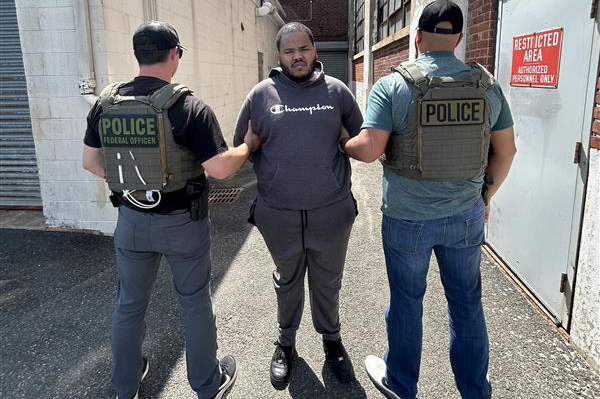

As federal immigration enforcement intensifies across the Northeast, a series of high-profile arrests in New Jersey has placed renewed focus on the intersection of public safety, immigration policy, and the legal complexities shaping cooperation between local and federal authorities. In recent weeks, U.S. Immigration and Customs Enforcement (ICE) operations out of Newark have resulted in the apprehension of multiple individuals previously convicted of serious sexual offenses involving minors, underscoring a targeted enforcement strategy that federal officials describe as focused on removing “high-threat” offenders from communities across the state.
The most recent case, unfolding on March 22, 2026, involved the arrest of Alvaro Tuero, a Cuban national taken into ICE custody immediately upon his release from a state correctional facility in Bridgeton. Federal authorities characterize Tuero as a repeat offender with a documented history of violent and predatory criminal behavior. His record includes convictions for sexually assaulting a child under the age of 13, endangering the welfare of a child through sexual conduct, as well as charges of lewdness and burglary. The timing of his arrest—executed at the precise moment of release—reflects a broader federal tactic designed to prevent reentry into communities by individuals deemed to pose an ongoing risk.
Earlier in the month, on March 12, 2026, ICE Newark publicly called on New Jersey officials to honor a detainer request involving Gerardo Garcia Gonzalez, a Mexican national arrested by the Ocean County Sheriff’s Office. Gonzalez faces allegations of sexual assault involving a minor between the ages of 13 and 15, along with charges of criminal sexual contact and sexual assault involving force or coercion. The case has become emblematic of a recurring friction point between federal enforcement agencies and state-level policies, particularly as New Jersey continues to operate under directives that limit the extent to which local law enforcement can cooperate with federal immigration detainers.
This tension is not new, but it has become increasingly pronounced as federal agencies escalate operations under initiatives such as Operation Apex Predator, a program specifically designed to identify, track, and remove non-citizens convicted of sex offenses. According to federal enforcement officials, this initiative prioritizes individuals with serious criminal histories involving exploitation, abuse, or violence against minors, categorizing them as among the highest priority threats within the broader immigration enforcement framework.
The scope of these operations extends beyond isolated arrests. Over the past several months, ICE Newark has highlighted a series of cases tied to individuals previously convicted of severe offenses across multiple New Jersey jurisdictions. Among them is Francisco Morales-Corado, a Guatemalan national whose criminal record includes convictions for sexual assault and kidnapping in Plainfield. His case, spanning from late 2025 into early 2026, has been included in what federal authorities have described as “worst of the worst” enforcement actions—operations aimed at removing individuals whose crimes are considered particularly egregious.
Similarly, Brallan Josue Garcia-Castro, a Honduran national arrested on January 2, 2026, was taken into custody following convictions in Morris County for sexual assault and endangering the welfare of a child, including offenses involving child pornography. His arrest was part of a broader New Year’s enforcement surge that signaled a more aggressive posture entering 2026, with federal agencies emphasizing a zero-tolerance approach toward repeat offenders with documented histories of predatory conduct.
These cases collectively illustrate a consistent operational pattern: identify individuals with prior convictions involving minors, coordinate with correctional facilities or local agencies where possible, and execute custody transfers at critical moments—often immediately upon release from state or county detention. The strategy is designed to minimize gaps in enforcement that could allow individuals to evade federal custody or reestablish themselves within communities.
At the same time, the legal and political landscape in New Jersey continues to shape how these operations unfold. The state’s sanctuary policies, which restrict certain forms of cooperation between local law enforcement and federal immigration authorities, have become a focal point in discussions surrounding public safety and jurisdictional authority. In cases like that of Gerardo Garcia Gonzalez, federal officials have openly criticized what they view as missed opportunities for collaboration, arguing that detainer noncompliance can result in preventable risks.
State officials, however, have consistently maintained that these policies are designed to build trust between immigrant communities and local law enforcement, ensuring that victims and witnesses feel safe reporting crimes without fear of immigration consequences. This ongoing policy divide has created a complex enforcement environment in which federal agencies must often operate independently, relying on targeted operations rather than routine coordination with local jurisdictions.
What is clear is that federal enforcement activity in New Jersey is not slowing down. If anything, the pace and visibility of these operations suggest a sustained and potentially expanding effort throughout 2026. With initiatives like Operation Apex Predator continuing to drive enforcement priorities, and with ICE Newark maintaining a high operational tempo, additional arrests and custody actions are expected in the months ahead.
For New Jersey residents, the issue sits at the intersection of public safety concerns and broader national debates over immigration enforcement. The recent arrests highlight the federal government’s focus on removing individuals with serious criminal histories, particularly those involving crimes against children. At the same time, they bring renewed attention to the structural and policy challenges that define how, when, and where enforcement actions take place within the state.
As these dynamics continue to evolve, New Jersey remains a critical focal point in the national conversation—where enforcement priorities, legal frameworks, and community considerations converge in ways that are both immediate and deeply consequential.