


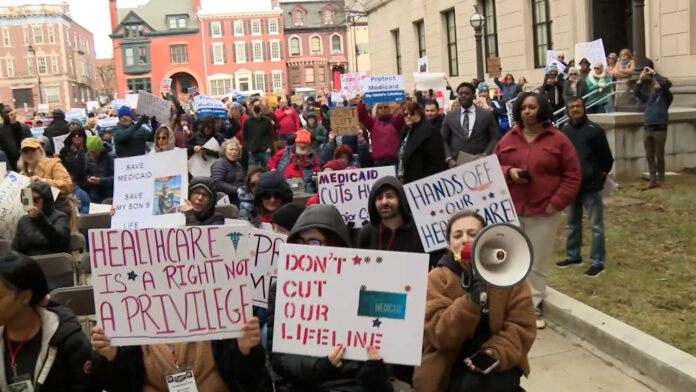

As Medicaid Awareness Month begins, New Jersey finds itself at the center of a rapidly intensifying health care and political crisis that is reshaping access to care for seniors, working families, and vulnerable communities across the state. What was once viewed as a stable foundation of the public health safety net is now under mounting pressure, with federal policy decisions, economic realities, and local political accountability converging in ways that are impossible to ignore.
At the heart of the issue is a sweeping reduction in federal Medicaid funding tied to broader fiscal legislation backed by national Republican leadership and supported by members of New Jersey’s congressional delegation, including Representative Tom Kean Jr. The scale of the cuts—approaching $1 trillion nationwide over the coming decade—marks one of the most significant restructurings of the program since its modern expansion under the Affordable Care Act. For New Jersey, where more than 1.48 million residents rely on Medicaid for access to essential care, the implications are immediate, measurable, and deeply consequential.
Across the state, the early signs of strain are already visible. Within just a four-month period in 2025, more than 9,000 New Jersey residents lost Medicaid coverage, contributing to a broader national contraction that has removed over 1.8 million individuals from the program. Analysts and health policy advocates warn that this is only the beginning of a much larger shift, with projections indicating that as many as 173,000 New Jerseyans could ultimately lose coverage due to new administrative requirements and eligibility barriers embedded within the policy changes.
These barriers, often described as procedural safeguards, are increasingly being characterized by critics as systemic obstacles that disproportionately impact low-income individuals and families. Expanded documentation requirements, periodic eligibility reviews, and stricter compliance thresholds are creating a landscape where maintaining coverage is becoming as challenging as qualifying for it in the first place. For many households, this translates into delayed care, missed prescriptions, and a growing reliance on emergency services as preventive access declines.
The long-term outlook presents an even more sobering picture. By 2034, estimates suggest that more than 211,000 additional New Jersey residents could lose Medicaid coverage as the full impact of funding reductions takes hold. This trajectory is not only a health care issue but a broader economic concern, as the ripple effects extend into hospital systems, local employment, and community stability.
New Jersey’s health care infrastructure—long regarded as one of the most comprehensive in the region—is now facing unprecedented financial pressure. Hospitals across the state are bracing for a combined loss of more than $825 million in funding, a figure that is forcing administrators to reevaluate service lines, staffing levels, and long-term viability. Facilities that serve as critical access points for underserved populations are particularly vulnerable, with some already reducing services and others facing the possibility of closure.
The stakes are especially high for institutions that anchor both care delivery and local economies. Hospitals such as Hudson Regional Health, University Hospital, and Secaucus University Hospital are among those identified as being at elevated risk, reflecting a broader pattern in which financial instability within the health sector translates directly into community-wide consequences. The closure of multiple care facilities and medical offices, including a network of outpatient locations, has further compounded access challenges, leaving gaps that are not easily filled.
This contraction is expected to extend into the workforce, with projections indicating that New Jersey could lose more than 11,000 health care jobs by the end of the decade as funding declines and operational costs rise. In a state already navigating economic uncertainty, these losses represent more than employment statistics—they signal a reduction in capacity at a time when demand for services remains high.
The economic implications are equally significant at the state level. Over the next ten years, New Jersey is projected to lose nearly $200 million from its general fund as a direct result of reduced federal Medicaid support. This loss of revenue places additional pressure on state budgeting decisions, potentially forcing trade-offs that extend beyond health care into education, infrastructure, and other public services.
For residents, however, the most immediate impact is personal. Families across New Jersey are increasingly finding themselves in difficult positions, forced to make choices that were once unthinkable: delaying doctor visits, rationing medications, or prioritizing basic living expenses over health care needs. Seniors, particularly those who rely on Medicaid for long-term care services, are facing heightened anxiety about the stability of the support systems that allow them to maintain independence and dignity.
This moment also carries significant political weight. The debate over Medicaid funding has become a focal point within New Jersey’s broader political discourse, raising questions about representation, accountability, and the role of federal decision-making in shaping local outcomes. As coverage losses mount and system pressures intensify, elected officials are facing increased scrutiny over their positions and the tangible effects those positions are having on constituents.
Coverage and analysis across the politics landscape continue to reflect how deeply intertwined health policy has become with electoral dynamics, particularly in a state where access to care is widely viewed as a fundamental expectation rather than a variable benefit. The current environment underscores a broader shift in which voters are not only evaluating policy outcomes but also demanding greater transparency around how those outcomes are produced.
Amid the challenges, the broader legacy of Medicaid expansion remains a critical point of reference. Since its implementation, expansion has extended coverage to millions of Americans, improved access to preventive care, and strengthened financial security for families facing medical uncertainty. In New Jersey, the program has become an essential component of the health care ecosystem, supporting children, individuals with disabilities, and seniors while serving as a primary funding source for long-term care services.
The contrast between that trajectory and the current direction of policy underscores the magnitude of what is at stake. As funding reductions take effect and administrative barriers reshape eligibility, the question facing New Jersey is not simply how to manage the immediate fallout but how to preserve the core function of a system that has become indispensable to so many.
What is unfolding is more than a policy shift—it is a structural transformation that will define the future of health care access in the state. The decisions made in Washington are now being felt in hospitals, clinics, and households across New Jersey, creating a chain reaction that connects federal legislation to local reality in unmistakable ways.
As the state navigates this evolving landscape, the path forward will require a level of coordination, clarity, and leadership that matches the scale of the challenge. For the more than one million residents who depend on Medicaid—and for the communities that rely on the stability it provides—the outcome of this moment will shape not only the accessibility of care but the broader trajectory of New Jersey’s social and economic health.



