


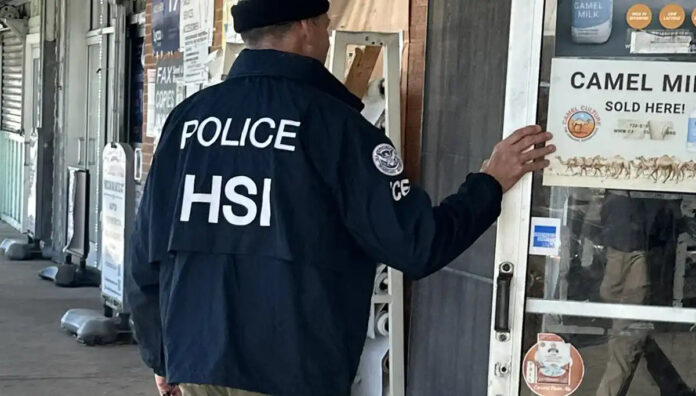

A significant constitutional confrontation is now unfolding between federal authorities and the State of New Jersey, as the U.S. Department of Justice moves to block a newly enacted state law that directly challenges how law enforcement officers—particularly federal agents—operate in public settings. Filed on April 29, 2026, the lawsuit names the State of New Jersey, Governor Mikie Sherrill, and Attorney General Jennifer Davenport, marking one of the most consequential legal disputes of the year in the ongoing national debate over policing transparency, federal authority, and immigration enforcement.
At the center of the conflict is the Law Enforcement Officer Protection Act, signed into law in March 2026, which introduces sweeping restrictions on the use of face coverings by law enforcement personnel during public interactions. The legislation bars officers from wearing masks or other forms of concealment that obscure their identity while on duty and requires that clear, visible identification be presented prior to any detention or arrest. While framed by state officials as a measure to reinforce accountability and restore public trust, the law has triggered immediate federal opposition on constitutional grounds.
New Jersey’s position is rooted in a broader push toward transparency in policing practices. State leaders argue that the rise of what they describe as “anonymized policing” erodes public confidence and introduces risks that extend beyond perception. According to this perspective, when officers operate without identifiable markers, it becomes more difficult for civilians to verify authority, raising the potential for impersonation and undermining the integrity of legitimate law enforcement actions. By mandating visible identification and prohibiting concealment, the state seeks to establish a uniform standard that prioritizes clarity and accountability in every public interaction.
The federal government, however, views the law through a fundamentally different lens. In its legal filing, the Department of Justice contends that New Jersey’s statute represents an unconstitutional overreach into federal jurisdiction, specifically targeting agencies such as Immigration and Customs Enforcement and Homeland Security Investigations. The DOJ argues that the Supremacy Clause of the U.S. Constitution preempts state laws that attempt to regulate the conduct of federal officers performing their official duties. From the federal perspective, the ability to determine operational protocols—including the use of protective or concealing equipment—is an essential component of national law enforcement authority that cannot be constrained by state legislation.
Beyond constitutional arguments, federal officials have also emphasized the practical and security implications of the law. They point to what they characterize as an increasingly hostile environment for certain categories of federal agents, citing incidents of harassment, doxing, and targeted threats. In this context, the use of face coverings is presented not as a tool for anonymity, but as a protective measure designed to safeguard personnel engaged in sensitive operations. The DOJ’s position suggests that restricting such measures could expose agents to heightened risk, potentially compromising both individual safety and operational effectiveness.
The legal challenge does not exist in isolation; it is part of a broader pattern of escalating tensions between federal authorities and the Sherrill administration. Earlier in 2026, the federal government filed a separate lawsuit contesting Executive Order No. 12, which limits the ability of federal immigration agents to utilize nonpublic areas of state-controlled property without a judicial warrant. That directive effectively restricts the use of locations such as parking lots and state buildings for staging or processing activities, further intensifying the debate over the boundaries of state and federal authority.
Taken together, these actions have led federal officials to frame New Jersey’s policy direction as an effort to create a de facto sanctuary framework that constrains federal immigration enforcement capabilities. State leaders reject that characterization, maintaining that their policies are designed to ensure lawful, transparent, and accountable practices within their jurisdiction, rather than to obstruct federal operations. This divergence in interpretation underscores the complexity of the legal and political landscape, where questions of authority, safety, and public trust intersect in ways that defy simple resolution.
The outcome of the DOJ’s lawsuit carries significant implications not only for New Jersey but for states nationwide grappling with similar issues. At stake is a fundamental question about the extent to which states can regulate the conduct of law enforcement within their borders when those officers represent federal agencies. A ruling in favor of the federal government could reaffirm the primacy of national authority in setting operational standards, while a decision supporting New Jersey’s position could expand the scope of state-level oversight in areas traditionally dominated by federal jurisdiction.
Within the broader political and policy discourse covered by Sunset Daily News, this case represents a defining moment in the evolving relationship between state governance and federal enforcement. It reflects a broader national trend in which states are increasingly asserting their perspectives on issues ranging from policing to immigration, even as federal agencies seek to maintain uniformity and control over their operations.
As the legal process moves forward, the case is expected to draw intense scrutiny from policymakers, legal scholars, and advocacy groups across the political spectrum. Its resolution will likely influence not only the immediate practices of law enforcement in New Jersey but also the broader framework through which states and the federal government negotiate authority in an increasingly complex and contested policy environment.



