



Newark’s next phase of vertical growth has taken a decisive step forward, as developer Pedro Gomes has secured long-awaited zoning approval for a 14-story residential tower at 253 Orange Street—an ambitious project that signals both a personal milestone and a broader evolution in how the city defines its gateway corridors. After years of persistence, setbacks, and recalibration, Gomes is now positioned to deliver what could become one of the most visually and strategically significant developments along one of Newark’s most visible entry points.
For Gomes, whose portfolio already includes more than 1,000 completed residential units across New Jersey, the approval represents more than just another project—it marks the realization of a long-standing ambition to bring a true high-rise presence to Orange Street. In a development landscape often defined by mid-rise, formula-driven construction, this project stands apart in both scale and architectural intent, signaling a shift toward more assertive and identity-driven design within Newark’s urban core.
The site itself carries strategic weight. Positioned along a corridor that connects suburban communities like West Orange and Livingston directly into Newark and onward to major highway access points, the intersection at Orange Street functions as a daily visual threshold for thousands of commuters. Gomes has consistently framed the location not simply as a development opportunity, but as a defining urban moment—an architectural statement that introduces the city to those entering and leaves a lasting impression on those exiting.
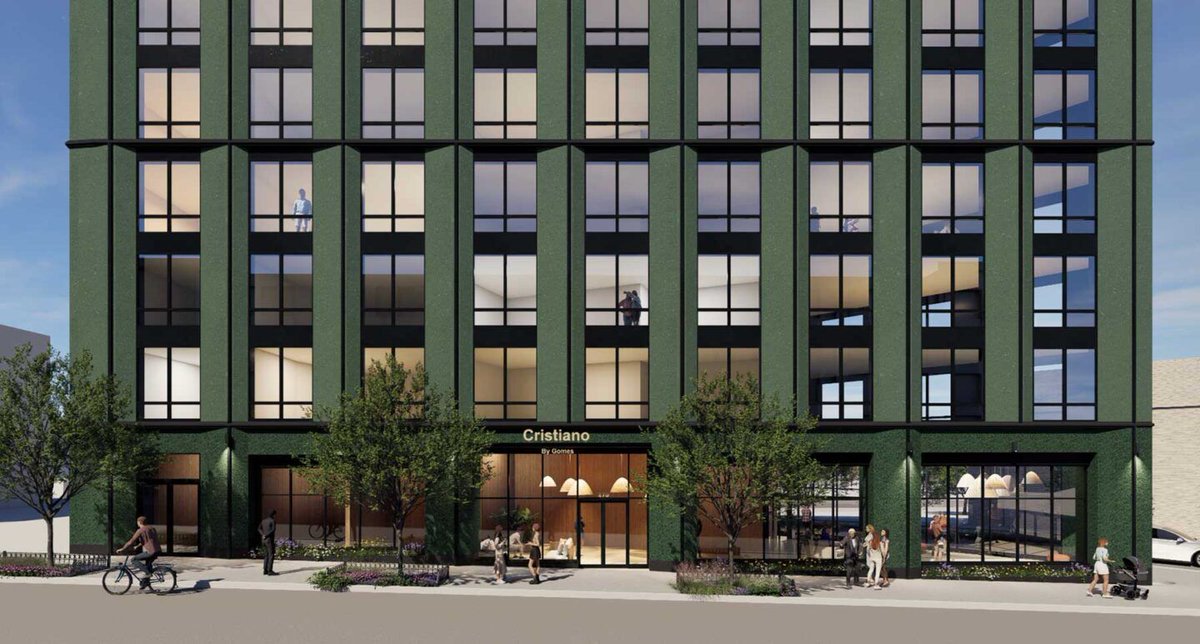
That vision has now materialized in the approved concept for “Christiano,” a project named after Gomes’s son, which will rise 14 stories and serve as a vertical landmark within the Broad Street Station District. While earlier renderings suggested a taller structure, Gomes made a strategic decision to reduce the height to align more closely with zoning expectations and community considerations, ultimately securing the approval that had eluded him in previous attempts.
The path to this moment has been anything but straightforward. In 2023, Gomes faced two consecutive zoning denials for proposed high-rise developments on a nearby parcel at 250 Orange Street. Those proposals—first at 15 stories and later scaled down to 12—were rejected, forcing a reassessment of both design and positioning. Rather than retreat, Gomes moved forward with a six-story version on that site, demonstrating his ability to adapt while maintaining forward momentum. Still, the ambition to deliver a true high-rise on Orange Street remained unresolved—until now.
This persistence has become a defining characteristic of Gomes’s development approach. In a market where numerous approved projects remain stalled or unrealized, his emphasis on execution has distinguished him from peers. The contrast is particularly visible in nearby sites, including the long-vacant former Bears Stadium location, where approved plans for a high-rise have yet to materialize. Gomes has consistently emphasized that approvals alone do not transform cities—construction does. His track record of moving projects from concept to completion has become a central argument in support of his proposals.
The newly approved Christiano tower is also notable for its architectural ambition. Designed in collaboration with the Musial Group, a firm that has worked closely with Gomes on previous developments, the building draws inspiration from one of Newark’s most iconic modernist structures—the Colonnade, originally designed by Ludwig Mies van der Rohe. This influence is not superficial; it is embedded in the building’s structural language and material expression.
The design incorporates pronounced vertical elements, deep recesses, and a textured façade that interacts dynamically with natural light. Throughout the day and across seasons, the building is intended to shift in appearance, capturing and reflecting sunlight in ways that create depth, contrast, and visual interest. The use of dark-green pigmentation, combined with a Flatiron-style footprint and strong vertical piers, sets the structure apart from the more standardized “four-over-two” residential buildings that have come to dominate much of Newark’s recent development cycle.
This departure from uniformity is significant. As Newark continues to grow, the question is no longer just about adding housing units—it is about shaping a skyline that reflects ambition, identity, and long-term vision. Projects like Christiano signal a move toward more intentional urban design, where individual buildings contribute to a broader architectural narrative rather than blending into a homogenous landscape.
Support for the project was further reinforced by alignment with the Broad Street Station District redevelopment plan, a long-standing framework that identifies key parcels for transformative development. According to project architect Noel Musial, the Orange Street site was specifically highlighted within the plan as a location suited for a “gateway” structure—one that commands visibility from major vantage points including Branch Brook Park and the Interstate 280 corridor. In this context, the Christiano tower is not an outlier; it is a realization of a vision that has been in place for more than a decade.
The timing of the project also reflects broader momentum within Newark’s real estate sector. Recent developments, including the completion of Hoyt Tower—a 15-story residential building delivering over 200 units—demonstrate increasing acceptance of vertical density in key corridors. These projects collectively indicate a shift in both market demand and municipal strategy, as Newark positions itself to accommodate growth while enhancing its urban profile.
For readers following the evolving dynamics of development across the state, this project represents a clear example of how persistence, design innovation, and strategic alignment can converge to produce meaningful progress. As highlighted in ongoing coverage within the Real Estate section of Sunset Daily News New Jersey, the state’s development landscape is entering a new phase—one defined not just by expansion, but by the quality and impact of that expansion.
Pedro Gomes’s latest approval is more than a personal achievement; it is a signal that Newark’s next chapter will be shaped by developers willing to think beyond conventional models and deliver projects that redefine both skyline and street-level experience. As construction moves forward, the Christiano tower is poised to become a visible marker of that transformation—an architectural statement at one of the city’s most prominent gateways, and a tangible reflection of Newark’s continued rise.