


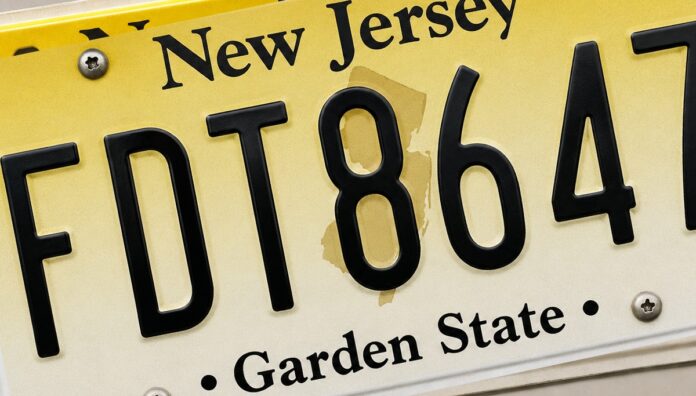

A New Jersey vanity license plate controversy has rapidly escalated into a broader national debate over political expression, coded language, government oversight, and the increasingly volatile intersection between symbolism and perceived threats in modern American political culture. The New Jersey Motor Vehicle Commission confirmed this week that it is recalling a personalized license plate reading “FDT 8647” after the combination of letters and numbers drew intense scrutiny online and triggered accusations that the message constituted a veiled threat directed at President Donald Trump.
The situation has transformed what would normally be a routine administrative enforcement matter into a highly charged political flashpoint now touching on free speech, state authority, social media amplification, political polarization, and the growing role coded language plays in public discourse. The controversy also arrives at a moment when federal authorities, political activists, media organizations, and law enforcement agencies nationwide remain deeply sensitive to rhetoric, symbolism, and messaging interpreted as threatening toward public officials.
According to the New Jersey Motor Vehicle Commission, the plate was originally approved in April 2025 before later drawing widespread attention after photographs of the vehicle circulating in Mercer County spread rapidly across social media platforms earlier this month. Critics argued the personalized plate contained language and numerical symbolism interpreted as hostile toward President Trump, while others defended it as political speech falling within the realm of protest expression rather than direct threats.
At the center of the controversy is the interpretation of the plate’s combination of letters and numbers. The “FDT” portion has widely been associated online with derogatory anti-Trump messaging for years, while the numerical sequence “8647” has recently become the subject of intense political and legal scrutiny nationwide.
Within restaurant industry slang, “86” historically means to remove something, deny service, or eject an item or person. The number “47” references Trump’s position as the 47th President of the United States. Critics of the plate argued the combined message could be interpreted as implying harm or violent intent toward the president. Others insisted the phrase represented political opposition or protest rhetoric rather than a literal threat.
That distinction has become increasingly important in today’s hyper-politicized digital environment, where symbolism, memes, coded messaging, and viral social media language often spread far faster than legal or contextual interpretation can keep pace.
The New Jersey MVC announced on May 7 that it would revoke the plate on the grounds that it violated state regulations governing offensive or inappropriate personalized license messages. Under the recall notice, the vehicle owner has reportedly been given 15 days to surrender the plate or risk revocation of the vehicle’s registration.
While vanity plate controversies are not uncommon nationwide, this particular case carries substantially larger political implications because it intersects directly with ongoing national debates surrounding political rhetoric and perceived threats involving elected officials. The issue became even more politically charged because it follows the recent federal case involving former FBI Director James Comey, who faced major controversy after posting an image on social media showing seashells arranged into the numbers “86 47.”
That incident escalated rapidly into a national legal and political firestorm after federal authorities interpreted the post as potentially threatening toward President Trump. Comey publicly maintained the image represented political speech and not a call for violence, but the controversy intensified already heated national conversations surrounding symbolism, intent, and how coded political messaging should be interpreted by both the public and law enforcement.
The New Jersey license plate dispute now exists squarely within that same broader climate of heightened political sensitivity. Across the country, phrases, symbols, memes, and coded numerical references increasingly become subjects of intense interpretation battles as political polarization continues deepening.
The MVC’s decision to revoke the plate also raises broader questions regarding how state agencies determine what constitutes offensive or inappropriate personalized messaging. Most motor vehicle agencies nationwide maintain policies prohibiting plates containing profanity, hate speech, explicit sexual language, threats, or offensive material. Yet enforcement standards can become highly subjective, especially when political symbolism or coded language enters the equation.
In today’s digital culture, meaning itself is often fluid, context-dependent, and rapidly amplified online. Phrases or symbols that may appear obscure to one audience can carry highly charged political interpretations within another. That dynamic places government agencies in increasingly difficult positions when attempting to determine which personalized messages cross administrative or legal boundaries.
The controversy additionally reflects how social media now functions as an accelerant for political outrage cycles. Personalized license plates that might once have remained unnoticed locally can now become national stories within hours after photographs spread online. Viral amplification frequently pressures agencies and institutions into rapid public responses, particularly when controversies intersect with already polarized political narratives.
New Jersey’s involvement in the issue also arrives during a period of intensified political tension nationally as rhetoric surrounding elections, public officials, protest movements, and political identity continues escalating. Public institutions and agencies increasingly operate under intense scrutiny from activists, media figures, political organizations, and online communities capable of mobilizing rapidly around symbolic controversies.
The state’s response through the MVC demonstrates how even relatively routine administrative systems — such as vanity plate approval processes — can suddenly become entangled in larger national political battles. Personalized license plates themselves have long functioned as expressions of identity, humor, affiliation, and political messaging. Yet the line between political expression and perceived intimidation has become increasingly contested in the current environment.
Supporters of the recall argue that state agencies have both the authority and obligation to prevent potentially threatening or inflammatory messaging from appearing on state-issued plates. Critics, however, raise concerns about viewpoint discrimination, subjective enforcement standards, and the expanding interpretation of political symbolism as criminal or threatening behavior.
Those debates mirror broader national legal arguments already unfolding around free speech protections, political rhetoric, and symbolic expression. Courts throughout the United States continue grappling with increasingly complicated questions involving online speech, coded messaging, artistic expression, satire, memes, and symbolic communication in the digital age.
The situation also illustrates how political symbolism itself has evolved in modern America. Numeric codes, acronyms, slogans, hashtags, and layered references increasingly function as shorthand within online political communities. Meanings often develop organically across digital platforms, creating entire symbolic vocabularies capable of carrying multiple interpretations simultaneously.
That ambiguity creates enormous challenges both legally and culturally. Intent, audience interpretation, historical context, and political climate all influence how messages are perceived. What one group views as political protest, another may interpret as incitement or threat language. Government agencies and law enforcement entities increasingly find themselves forced to navigate those ambiguities under enormous public pressure.
For the New Jersey MVC specifically, the incident may prompt additional scrutiny regarding how vanity plates are reviewed and approved moving forward. The fact that the plate initially passed through the agency’s screening process before later being recalled publicly raises questions about consistency, review standards, and the practical limitations of administrative oversight systems attempting to monitor thousands of personalized applications.
The broader political atmosphere surrounding President Trump further intensifies the sensitivity surrounding any symbolic language perceived as threatening. Political rhetoric involving public officials remains under heightened national attention, particularly following years of increasing polarization, online radicalization concerns, and politically motivated violence incidents that have elevated law enforcement sensitivity regarding potentially threatening communications.
At the same time, civil liberties advocates continue warning against overly expansive interpretations of symbolic speech that could blur the distinction between protected political expression and genuine threats. That constitutional tension remains unresolved and is likely to continue shaping political and legal debates for years to come.
The New Jersey license plate controversy ultimately reflects much more than a dispute over vanity registration language. It serves as another example of how political symbolism, online culture, government authority, and public interpretation increasingly collide in an era where every phrase, image, code, or digital reference can instantly become part of a much larger national ideological battle.
What once might have been dismissed as a localized controversy involving a personalized plate has instead evolved into a broader reflection of America’s deeply fractured political climate — a climate where symbolism itself now carries extraordinary cultural, legal, and political weight.
For more New Jersey political coverage, public affairs reporting, and statewide government news, visit Sunset Daily News Politics



