


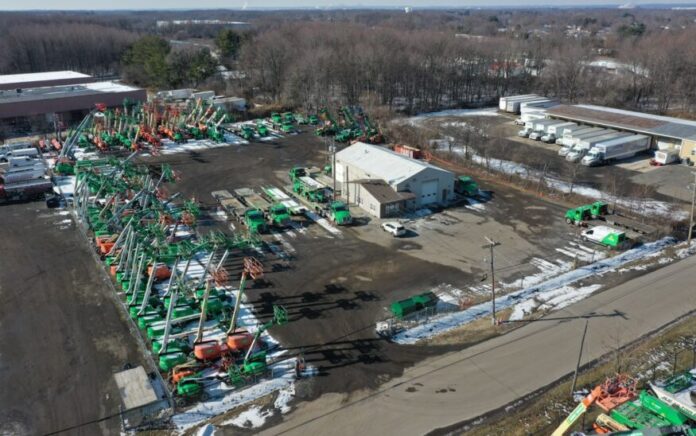

A relatively modest industrial property transaction in Plainfield is drawing outsized attention within commercial real estate circles because it reflects one of the fastest-growing and most competitive sectors in the modern industrial economy: industrial outdoor storage, better known throughout the industry as IOS.
The acquisition of the 14,924-square-foot IOS property located at 1600 South Second Street, arranged by CBRE on behalf of buyer Ridgecut Road, is more than a routine commercial sale. It is another indication that investors are increasingly targeting highly specialized industrial properties tied directly to infrastructure, logistics, utility operations, and regional distribution networks.
The transaction was brokered by CBRE professionals Mark Silverman, Liam McGregor, and Elli Klapper, who represented the buyer in securing the strategically positioned property. While the site itself may not carry the scale or profile of New Jersey’s mega-warehouse developments, its value lies in something increasingly difficult to find across the Northeast corridor: functional industrial outdoor storage with long-term operational relevance.
That distinction is becoming critical in today’s market.
Industrial outdoor storage facilities have quietly evolved into one of the most sought-after real estate categories in the country. Unlike traditional warehouses focused on interior square footage, IOS properties are built around outdoor operational capacity—staging areas for trucks, equipment, fleet vehicles, utility materials, infrastructure components, and logistics operations that require secure, accessible outdoor space near dense population centers.
In a state like New Jersey, where land availability continues to tighten and zoning restrictions have intensified, those characteristics have become extraordinarily valuable.
The Plainfield site’s appeal was amplified by its long-term occupancy by PSE&G, one of the region’s most significant utility providers. Stable tenancy from a high-credit infrastructure-oriented company immediately changes the profile of an industrial asset. Investors increasingly favor properties connected to essential services because they offer not only predictable income streams, but also operational durability during periods of economic uncertainty.
According to CBRE’s Mark Silverman, the combination of strategic location and utility-backed tenancy created a compelling investment profile that resonated strongly with Ridgecut Road. In the current industrial market, those attributes are becoming increasingly rare.
The broader market forces behind IOS demand are tied directly to structural changes within the American economy. Logistics expansion, infrastructure modernization, utility grid upgrades, and e-commerce distribution have dramatically increased the need for operational staging space. At the same time, municipalities across the Northeast have implemented tighter zoning controls on industrial development, limiting the supply of new IOS sites entering the market.
That imbalance between supply and demand has transformed IOS from what was once considered a niche asset class into a major institutional investment target.
New Jersey sits at the center of that trend.
Its geographic position between major metropolitan markets, combined with dense transportation infrastructure and proximity to ports, highways, and rail systems, has made the state one of the country’s most strategically important logistics hubs. As industrial land becomes increasingly scarce, even relatively compact IOS properties can command significant investor interest if they are well-located and tied to stable operations.
Plainfield itself continues to evolve within that broader industrial landscape. Positioned with strong regional access and proximity to key transportation corridors, the city has become increasingly relevant for logistics-adjacent uses that support utility operations, fleet management, and industrial services. Properties like 1600 South Second Street are not speculative plays; they are functioning operational assets integrated into the region’s infrastructure economy.
The transaction also highlights a larger shift in how industrial real estate is being evaluated. For years, warehouse square footage dominated investment conversations. Today, operational flexibility, outdoor usability, transportation access, and infrastructure connectivity are often carrying equal or greater weight. Investors are looking beyond traditional distribution centers and focusing on the entire ecosystem required to keep regional logistics and utility systems functioning efficiently.
This evolution is particularly important as New Jersey continues to experience pressure from population density, transportation demand, and infrastructure modernization. Utility providers, contractors, logistics operators, and service fleets all require strategically located outdoor storage and operational space. The challenge is that those sites are becoming harder to develop due to environmental regulations, zoning barriers, and competition from residential and mixed-use redevelopment.
As a result, stabilized IOS properties with established tenants are increasingly viewed as premium long-term holdings.
The competitive nature of these transactions reflects that reality. Institutional capital, private equity firms, and specialized industrial investors are all aggressively pursuing assets with secure tenancy and operational importance. In many cases, the scarcity value of the land itself becomes just as important as the current income stream.
Within the broader Sunset Daily News real estate landscape, the Plainfield acquisition represents another example of how industrial real estate continues to redefine itself in response to economic and infrastructure demands. Warehousing remains important, but the market is becoming more nuanced, with specialized asset categories like IOS emerging as critical components of regional commerce and utility operations.
For Ridgecut Road, the acquisition signals confidence not only in the property itself but in the continued strength of infrastructure-oriented industrial assets throughout New Jersey. For CBRE, the transaction reinforces the growing sophistication of IOS investment strategy and the increasingly competitive nature of this once-overlooked segment.
Most importantly, the deal illustrates how industrial real estate is no longer solely about buildings. It is increasingly about functionality, connectivity, operational resilience, and the infrastructure systems that support daily life across the region. In that environment, properties like 1600 South Second Street are becoming far more valuable than their size alone might suggest.



