


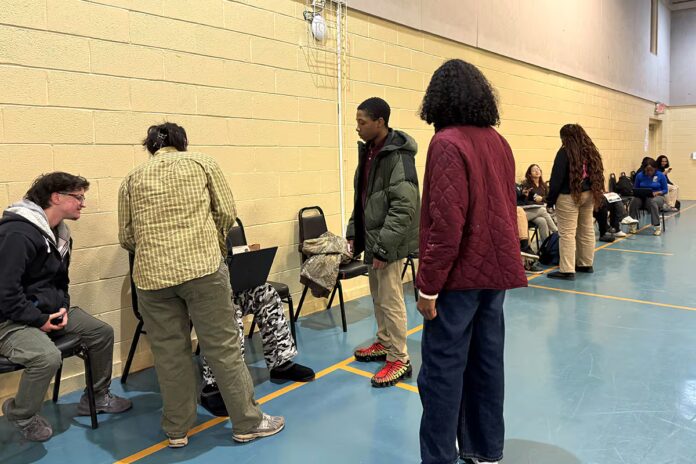

A revealing moment unfolded during April’s school board elections in Newark, one that exposed both the promise and the growing pains of expanding civic participation to younger generations. For many 16- and 17-year-old voters casting ballots for the first time under Newark’s groundbreaking youth voting initiative, election day was supposed to represent a milestone in democratic engagement. Instead, numerous students encountered confusion, administrative breakdowns, incorrect polling information, and uncertainty from election workers who appeared unfamiliar with the law itself.
What emerged was not a story about apathy or disengagement among young voters. It was, in many ways, the opposite. Students arrived prepared to participate in the democratic process. The larger challenge was whether the infrastructure around them was equally prepared to support that participation.
The election marked one of the most closely watched tests of youth voting access in New Jersey, following Newark’s decision to allow 16- and 17-year-olds to vote in local school board elections. Advocates viewed the move as a historic expansion of civic inclusion, designed to encourage lifelong participation in democracy by engaging voters earlier and more directly in issues that affect their education and communities.
On paper, the initiative represented a major civic innovation. In practice, however, election day revealed the operational complexities involved in implementing a new voting framework at the local level.
Reports from across Newark described a series of recurring problems. Some young voters arrived at polling locations only to discover their names were missing from registration rolls. Others were directed to incorrect polling places. In several cases, election staff reportedly appeared unaware that 16- and 17-year-olds were legally permitted to vote in the election at all. For students experiencing the voting process for the first time, those barriers created confusion and frustration at the very moment intended to inspire civic confidence.
The significance of those breakdowns extends beyond a single election cycle. Voting is not only a legal process; it is also a psychological and civic experience. First encounters with democracy shape perceptions about whether institutions are accessible, functional, and responsive. When eligible voters are met with uncertainty or administrative obstacles, the impact can linger well beyond one election day.
Yet despite those issues, one detail remained impossible to ignore: Newark’s young voters still showed up.
That fact may ultimately become the defining story of the election.
At a time when national conversations frequently frame younger generations as politically disconnected or disengaged, the turnout effort in Newark demonstrated a strong willingness among students to participate in civic life when given the opportunity. Many arrived informed, motivated, and ready to engage with issues directly affecting their schools and futures. The failures they encountered were not failures of enthusiasm or interest. They were failures of implementation.
The broader implications for election administration are substantial. Expanding access to younger voters requires more than passing legislation. It demands coordination between election officials, schools, poll workers, registration systems, and community organizations. Every operational detail—from voter databases to poll-site training—must align to ensure the law functions effectively in practice.
The Newark experience highlights what can happen when policy innovation outpaces administrative readiness. While the legal right to vote had been extended, portions of the election infrastructure had not fully adapted to accommodate the change. In an environment where election integrity and public trust remain intensely scrutinized, those operational gaps become magnified.
At the same time, the election also revealed the potential long-term value of youth engagement. School board races are often among the least visible elections in American politics, despite directly influencing educational policy, curriculum priorities, budgeting decisions, and student experiences. Allowing younger residents to participate introduces a new layer of accountability and relevance to those contests, potentially reshaping how local educational governance is understood.
For Newark, the election represented both a warning and an opportunity.
The warning is clear: civic expansion without logistical preparation risks undermining confidence in the very systems designed to encourage participation. If future elections are to succeed under the youth voting framework, officials will likely need to strengthen poll worker training, improve voter registration coordination, enhance public communication, and ensure election infrastructure fully reflects the realities of expanded eligibility.
The opportunity, however, may prove even more significant.
Newark’s young voters demonstrated that civic participation can begin earlier than traditionally assumed. Their willingness to engage suggests that political involvement is not inherently tied to age alone, but to whether communities create meaningful pathways for participation. When students feel directly connected to issues affecting their schools and neighborhoods, many are eager to contribute.
Within the broader Sunset Daily News political and civic landscape, Newark’s election experience reflects a larger national conversation about democratic participation, institutional trust, and generational engagement. Across the country, policymakers and civic organizations are exploring ways to increase voter turnout and strengthen civic literacy. Newark’s experiment has now become one of the most closely watched case studies in that movement.
Importantly, the issues reported during the election do not necessarily invalidate the concept of youth voting. Instead, they underscore the importance of implementation. Expanding democratic participation is not accomplished solely through legislation; it requires systems capable of supporting the people those laws are intended to empower.
The students who arrived at polling sites in April were prepared to take part in democracy. They had followed the process, understood their eligibility, and made the effort to participate. The administrative confusion they encountered revealed weaknesses in execution, not in the idea itself.
As Newark moves forward, the focus will likely shift toward refinement rather than retreat. Election officials, educators, and civic leaders now face the task of transforming the lessons of this election into improvements for the next one. If they succeed, Newark could emerge not as a cautionary tale, but as an example of how democratic systems evolve through real-world testing, adaptation, and persistence.
The larger story is not that young voters failed. It is that they arrived ready to participate—and exposed the work still required to ensure democratic institutions are equally prepared to welcome them.