


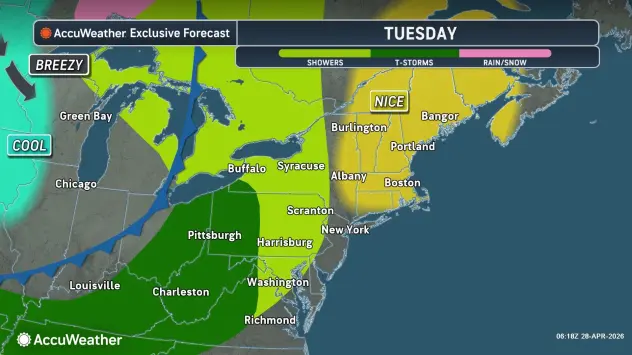

Across New Jersey, Tuesday, April 28, 2026, is delivering exactly the kind of transitional spring day that often precedes a meaningful pattern change. The atmosphere is stable, the temperatures are moderate, and while cloud cover is gradually building, the state remains dry—for now. Beneath this relatively quiet surface, however, a more dynamic setup is organizing, one that will redefine the region’s weather heading into the final days of April and the opening stretch of May.
Today’s Hourly Forecast
| Hour | Sky Condition | Temperature | Chance of Rain |
|---|---|---|---|
| 10 AM | 59°F | 10% | |
| 12 PM | 64°F | 10% | |
| 2 PM | 64°F | 10% | |
| 4 PM | 61°F | 10% | |
| 6 PM | 56°F | 10% | |
| 8 PM | 52°F | 5% |
Daily Outlook
| Day | Sky Condition | Temperature | Chance of Rain |
|---|---|---|---|
| Tue, Apr 28 | 65°F / 43°F | 10% | |
| Wed, Apr 29 | 56°F / 47°F | 75% | |
| Thu, Apr 30 | 62°F / 41°F | 20% | |
| Fri, May 1 | 61°F / 43°F | 70% |
As of this morning, conditions across much of the state are characterized by cloudy skies, temperatures hovering around the mid-50s, and light westerly winds that are barely registering. Humidity levels remain moderate, contributing to a comfortable feel despite the increasing cloud presence. Through the late morning and into the afternoon, temperatures are expected to climb into the mid-60s inland, with coastal areas holding closer to the low 60s, reinforcing the typical spring gradient between interior and shoreline climates.
The hourly progression today remains largely uneventful in terms of precipitation risk. Skies will stay predominantly cloudy, with only minimal breaks possible late in the day. Temperatures will peak in the mid-60s early this afternoon before gradually cooling into the 50s by evening. By nightfall, partial clearing may emerge in some regions, though the broader trend favors lingering cloud cover as the next system begins to approach from the west.
This calm window, however, is limited. Beginning Wednesday afternoon and intensifying into the evening hours, a developing cold front will begin to assert itself across the region. This system is expected to bring a widespread, steady rainfall event that could deliver between half an inch to a full inch of precipitation statewide. While not a severe storm system by classic standards, it is significant in context—particularly given the ongoing concerns surrounding dry ground conditions across parts of New Jersey.
There is also a non-zero risk of embedded thunderstorms Wednesday evening, especially as the frontal boundary interacts with modest instability in the atmosphere. These would likely be scattered and brief, but they underscore the evolving nature of the system as it moves through. Rainfall is expected to continue overnight into early Thursday before gradually tapering off from south to north by late morning.
Behind this system, the broader atmospheric pattern becomes the defining story. Forecast models consistently indicate the establishment of a prolonged trough across the eastern United States, including New Jersey. In practical terms, this means a sustained period of below-average temperatures, increased cloud cover, and a recurring threat of scattered showers rather than singular, large-scale storm events.
This shift is being driven by a series of upper-level disturbances—commonly referred to as “swinging troughs”—that will cycle through the region over the coming days and potentially into the following week. These features allow cooler air aloft to filter downward, reducing atmospheric stability and making it easier for showers to develop during the daytime heating cycle. Unlike the intense, capped environments that produce isolated severe weather, this setup favors frequent, lighter, and more widespread springtime showers.
The result is a classic unsettled spring regime. While temperatures at the surface will still respond to solar heating—especially as the sun angle strengthens heading into May—the presence of cooler air aloft will limit how warm conditions can become. Most high temperatures through the remainder of the week are expected to remain in the low 60s, with some areas struggling to move beyond the upper 50s, particularly in northern elevations.
Looking at the day-by-day breakdown, Wednesday will bring increasing clouds and the onset of rain later in the day, with highs ranging from the mid-50s along the coast to the low-to-mid 60s inland. Thursday begins with lingering rainfall before gradual clearing takes hold, especially across southern portions of the state first. Temperatures will remain subdued, generally in the upper 50s to mid-60s depending on location, with breezy conditions developing as the system exits.
Friday continues the cooler trend, with highs near 60 degrees statewide and a mix of sun and clouds. Winds will remain active early before calming later in the day, reinforcing the transitional feel of the atmosphere as it attempts to stabilize—though only briefly. By the weekend, early indications suggest continued cool conditions, with highs in the mid-50s Saturday and near 60 on Sunday, accompanied by mostly sunny skies but persistent breeziness.
Beyond the weekend, the pattern shows little indication of a rapid warm-up. Instead, the continuation of this trough-dominated setup suggests that early May will lean cooler and wetter than average. However, it is important to contextualize what “wetter” means in this scenario. Rather than large, soaking storm systems, the expectation is for periodic, passing showers—often driven by daytime heating and localized instability. These showers, while scattered, are expected to occur frequently enough to provide meaningful cumulative rainfall.
From a broader environmental perspective, this pattern carries a notable upside. The incoming precipitation—beginning with this midweek system and extending through next week’s intermittent showers—will contribute to alleviating moderate to severe drought conditions that have persisted across parts of the state. Recent rainfall over the past weekend marked the beginning of this recovery trend, and the upcoming stretch of unsettled weather is expected to build upon that progress.
Temperature variability remains a key variable moving forward. If the upper-level troughs remain relatively shallow, daytime highs could push into the mid-to-upper 60s, occasionally touching the low 70s in more favorable inland areas. However, if deeper troughing develops, colder air aloft could suppress temperatures further, keeping highs constrained to the mid-50s to low 60s. This distinction will ultimately depend on the amplitude and frequency of the disturbances moving through the region—an evolving detail that forecasters will continue to refine in the coming days.
For residents across New Jersey, the takeaway is clear: today represents a brief window of stability before a more complex and active spring pattern takes hold. The shift will not bring extreme weather, but it will introduce variability—cooler temperatures, increased cloud cover, and a near-daily chance of passing showers that define the season at its most transitional.
In the balance between inconvenience and necessity, this pattern leans toward the latter. The return of consistent precipitation, even in fragmented form, plays a critical role in stabilizing soil moisture levels, supporting vegetation growth, and resetting the environmental baseline as the state moves deeper into spring.



