


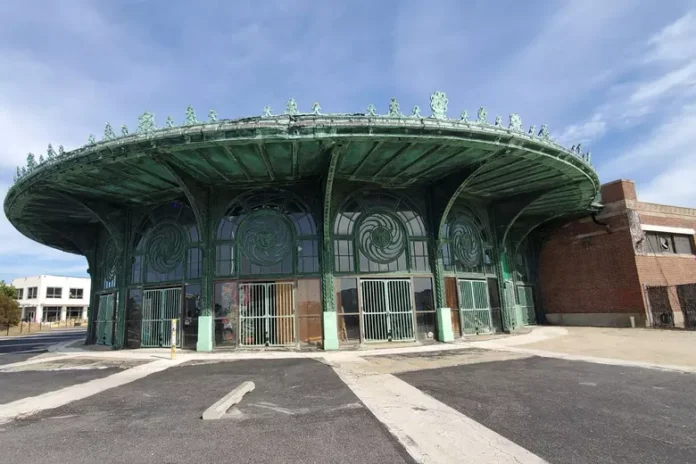

One of New Jersey’s most iconic boardwalk landmarks has become the center of an escalating debate that blends historic preservation, redevelopment ambitions, legal oversight, and community activism. The future of the historic Casino building in Asbury Park—particularly the breezeway connecting the city to neighboring Ocean Grove—has triggered a high-profile standoff between city officials, residents, and the property’s developer, Madison Marquette.
At the center of the dispute is the fate of the Casino’s open-air breezeway, a structural passage that has long served as both a literal and symbolic gateway between Asbury Park and Ocean Grove. The developer’s request to demolish the breezeway due to safety concerns sparked immediate backlash from city leaders and residents who view the structure as an irreplaceable element of the boardwalk’s architectural and cultural identity.
The controversy has rapidly evolved into a broader confrontation about redevelopment commitments, preservation responsibilities, and the long-term future of the city’s historic oceanfront structures.
For decades, the Asbury Park Casino complex has stood as one of the most recognizable landmarks along the Jersey Shore. Built in the early twentieth century as part of the city’s original boardwalk infrastructure, the building served as an entertainment hub connecting visitors arriving by rail and trolley to the beach and boardwalk attractions.
Although the building’s interior spaces have been largely vacant for years, its distinctive arches and breezeway passage remain a defining visual feature of the boardwalk skyline. The structure is closely tied to Asbury Park’s cultural identity, standing adjacent to Convention Hall and overlooking the Atlantic Ocean.
The current dispute began to intensify in late January 2026 when Madison Marquette submitted an application seeking a permit to demolish the breezeway portion of the building. The developer cited structural deterioration—particularly rusted steel trusses—as evidence that the breezeway posed safety risks and could no longer be preserved.
City officials responded quickly, rejecting the demolition request and demanding additional engineering documentation. Municipal leaders argued that demolition should only be considered if independent structural analysis proves that restoration is not feasible.
In public statements, city representatives described the proposal as an alarming departure from preservation commitments associated with the redevelopment of the boardwalk area. Officials stressed that the Casino complex is not merely another building but a cornerstone of Asbury Park’s historic character and tourism economy.
The disagreement soon evolved into a legal dispute rooted in redevelopment agreements signed more than a decade ago. In 2010, Madison Marquette entered into agreements with the city as part of a broader redevelopment initiative aimed at revitalizing the boardwalk district.
City officials now argue that the developer has failed to uphold obligations to maintain the historic structures, raising accusations of what preservation advocates describe as “demolition by neglect.” This phrase refers to situations in which property owners allow historic buildings to deteriorate over time until demolition appears to be the only practical option.
As tensions grew, the city issued notices of default to the developer, asserting that the failure to maintain the Casino building violates the redevelopment agreement. Determining whether the city has the legal authority to reclaim the property has become one of the central questions in the ongoing dispute.
In an effort to resolve conflicting legal interpretations, the Asbury Park City Council voted on March 11, 2026, to hire retired New Jersey Supreme Court Justice Lee A. Solomon to conduct an independent review of the redevelopment contracts. Solomon’s task is to examine whether the city has the legal grounds to declare the developer in default and potentially regain control of the property.
The decision to bring in a former member of the state’s highest court reflects the seriousness of the legal questions involved. The outcome of the review could determine whether the city retains leverage to compel repairs or pursue alternative redevelopment strategies.
Meanwhile, physical work on the building has finally begun after years of deterioration that fueled criticism from residents and preservation groups. Emergency roof repairs commenced in early March and were expected to conclude around March 13.
Once those repairs are inspected and approved by structural engineers, city officials hope to reopen the Oceanside Passage, the outdoor walkway located along the eastern side of the building that allows pedestrians to move between the boardwalk and Ocean Grove.
However, the interior breezeway remains closed for the foreseeable future as engineers continue evaluating the structural integrity of the building.
Facing mounting public pressure, Madison Marquette has recently adjusted its public messaging regarding the Casino complex. Following a wave of criticism and a large “Save the Casino” rally held on February 7, the developer announced that it is now pursuing a preservation-focused approach rather than immediate demolition.
According to the developer’s revised plan, the company is seeking state and federal historic tax credits to support a proposed $130 million restoration project for the Casino building and surrounding structures.
If approved, the project would transform the aging complex into a large-scale arts, entertainment, and dining destination along the boardwalk. The centerpiece of the plan is a proposed 5,000-seat outdoor amphitheater located on the oceanfront side of the property.
Under the proposal, the amphitheater would become a new venue for concerts and cultural programming, potentially replacing the current Stone Pony Summer Stage with a larger and more permanent facility.
The developer has described the amphitheater concept as part of a vision to create a “world-class destination” that would attract visitors from across the region while revitalizing one of the boardwalk’s most underutilized spaces.
City officials have expressed cautious support for the tax credit applications because they offer a potential pathway toward restoring the historic structures without placing the financial burden solely on local taxpayers.
However, officials have also emphasized that securing tax credits would only represent the beginning of a lengthy restoration process rather than an immediate solution.
For many residents and advocacy groups, the developer’s proposal has been met with skepticism. Organizations such as Save Our Shore Asbury Park (SOS AP) argue that the amphitheater plan risks diverting attention from the urgent need to stabilize the Casino building itself.
These groups contend that the focus on new entertainment venues may serve as a distraction while the century-old structure continues to deteriorate. Critics have also called for greater transparency regarding engineering assessments, redevelopment timelines, and the city’s legal authority to enforce maintenance requirements.
Public rallies held earlier this year demonstrated the depth of community sentiment surrounding the issue. Residents, preservationists, and local business owners gathered along the boardwalk to demand action and accountability regarding the future of the Casino complex.
For many in the community, the debate is about more than a single building. It represents a broader question about how Asbury Park balances redevelopment with preservation as the city continues its transformation into one of New Jersey’s most vibrant coastal destinations.
Over the past two decades, Asbury Park has experienced a remarkable revival. Once struggling with economic decline and abandoned properties, the city has emerged as a thriving hub for music, arts, hospitality, and tourism.
The boardwalk district now features a mix of historic venues, modern residential development, restaurants, and entertainment spaces that attract visitors throughout the year. The success of this revitalization has made the preservation of remaining historic structures an increasingly important issue for residents who want to maintain the city’s unique character.
The upcoming City Council meeting scheduled for March 25, 2026, is expected to provide additional updates regarding the legal review of redevelopment agreements and the status of ongoing repairs at the Casino building.
City leaders have indicated that public meetings will continue to serve as forums for discussing the evolving situation, providing residents with information about engineering reports, legal developments, and potential next steps.
For now, the future of the Casino building remains uncertain. The structure sits at the intersection of historic preservation, real estate development, and public policy, making it one of the most closely watched redevelopment issues along the Jersey Shore.
Whether the building ultimately becomes a restored cultural landmark, a modern entertainment venue, or the subject of a prolonged legal battle will depend on the outcomes of ongoing negotiations, engineering evaluations, and legal determinations.
What remains clear is that the Casino building continues to hold a powerful place in the identity of Asbury Park. For residents, visitors, and preservation advocates alike, its fate represents a defining moment in the ongoing story of the city’s redevelopment and the preservation of its historic oceanfront legacy.



