


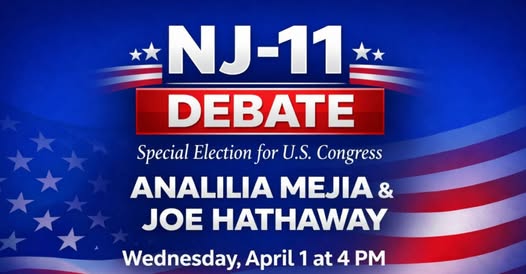

New Jersey’s 11th Congressional District has become the focal point of one of the most consequential political contests in the state’s recent history, and the first—and likely only—head-to-head debate between Republican Joe Hathaway and Democrat Analilia Mejia delivered exactly what the moment demanded: intensity, ideological contrast, and a clear delineation of competing visions for the region’s future. Held on April 1, 2026, and unfolding against the backdrop of both Passover and Easter, the debate quickly evolved beyond traditional policy exchanges into a broader examination of values, identity, and the direction of governance in a district that sits at the intersection of suburban stability and economic disruption.
The stakes could not be higher. The April 16 special election will determine who fills the congressional seat vacated by Mikie Sherrill, now serving as New Jersey’s governor, with the winner representing parts of Essex, Morris, and Passaic counties through the remainder of the 119th Congress. But beyond the immediate outcome, this race has become a referendum on affordability, development, and the broader pressures reshaping life across New Jersey—issues that have been consistently explored throughout the [real estate] landscape as housing costs, infrastructure demands, and economic realities collide.
From the opening exchanges, the debate established a tone of sharp contrast. Hathaway, a Randolph councilman with a reputation for pragmatic conservatism, framed Mejia as aligned with what he described as “left-wing, radical” economic thinking, arguing that such policies are disconnected from the everyday realities facing suburban families. Mejia, a labor organizer with national political experience, countered by positioning Hathaway within the orbit of MAGA-aligned politics, asserting that his approach would exacerbate the very economic pressures residents are struggling to manage.
These competing narratives were not abstract—they were grounded in the lived experience of a district grappling with rising costs, limited housing access, and shifting economic expectations. Mejia repeatedly returned to the issue of affordability, emphasizing housing and healthcare as central pillars of her platform. Her argument reflects a growing sentiment across New Jersey: that the cost of living has outpaced income growth to a degree that requires structural intervention. Hathaway, by contrast, emphasized economic discipline and what he described as a “workhorse mentality,” arguing that inflation and regulatory overreach—not insufficient government action—are the primary drivers of financial strain.
The debate’s most charged moments emerged during discussions of foreign policy, particularly regarding Israel, an issue that resonates deeply within the district’s diverse population. Hathaway’s campaign has consistently centered on the assertion that Mejia’s positions reflect hostility toward Israel, a claim he reiterated forcefully during the debate. Mejia rejected that characterization, framing her stance as one rooted in accountability and humanitarian concern, including criticism of Israeli leadership and support for conditioning aid to protect civilian populations.
This exchange underscored a broader dynamic at play throughout the evening: the tendency of national and global issues to intersect with local political identity. For many voters, these debates are not isolated—they inform broader perceptions of leadership, values, and alignment with community priorities. Hathaway’s insistence on unconditional support for a longstanding ally contrasted sharply with Mejia’s call for a more conditional, policy-driven approach, illustrating the ideological divide that defines this race.
Religion and moral framing also entered the discussion, adding another layer of complexity. Hathaway pressed Mejia on comments she allegedly made regarding religious teachings, attempting to position her within a broader ideological framework. Mejia responded by referencing scriptural themes centered on social justice, including care for the poor and marginalized, while avoiding direct alignment with any specific political label. Hathaway, in turn, emphasized that support for social welfare does not necessitate adherence to socialist principles, reinforcing his broader critique of her platform.
While these exchanges captured headlines, the underlying narrative of the debate remained rooted in economic reality. Across New Jersey, the cost of housing has surged to levels that are reshaping entire communities, a trend that has become a defining issue for voters in CD-11. The district’s suburban character—once synonymous with accessibility and upward mobility—is now marked by escalating home prices, constrained inventory, and increasing barriers to entry for younger residents.
This context gives particular weight to Mejia’s focus on housing policy. Her emphasis on affordability aligns with a growing recognition that the traditional suburban model is under strain. Hathaway’s response, centered on economic growth and regulatory restraint, reflects an alternative approach that prioritizes market-driven solutions. The debate between these perspectives mirrors broader conversations unfolding across the state, where policymakers, developers, and residents are grappling with how to balance growth, affordability, and sustainability.
The path to this debate was itself marked by controversy, adding another dimension to an already charged race. A previously scheduled forum organized by the League of Women Voters was canceled following a dispute over moderator selection, with each campaign offering differing accounts of the breakdown. Hathaway publicly challenged Mejia to participate in a debate, framing the issue as one of transparency and accountability. Mejia, for her part, cited concerns over representation and fairness in the moderation process. Ultimately, both candidates agreed to participate in the April 1 event organized by the New Jersey Globe, ensuring that voters would have at least one opportunity to see them engage directly.
Even within the debate itself, procedural tensions surfaced. Hathaway expressed frustration with time management, suggesting that moderation allowed for uneven speaking opportunities. While such moments may seem minor, they reflect the heightened sensitivity surrounding every aspect of the campaign, where even format and structure become points of contention.
As the election approaches, the political landscape presents both opportunities and challenges for each candidate. Democrats hold a significant voter registration advantage in the district, with early mail-in ballot returns also favoring Mejia. For Hathaway, this reality necessitates a strategy that extends beyond traditional party lines, appealing to independent voters and moderate Democrats who may be open to his message of economic restraint and pragmatic governance. His campaign has highlighted engagement efforts in traditionally Democratic areas, signaling an attempt to broaden his coalition.
Mejia, meanwhile, enters the final stretch with momentum derived from her primary victory in a crowded field and a platform that resonates with voters concerned about affordability and social equity. Her challenge lies in translating that momentum into turnout while addressing critiques that her policies may be perceived as too progressive for certain segments of the district.
The broader significance of this race extends beyond CD-11. It serves as a microcosm of the political and economic tensions shaping New Jersey as a whole. Issues of housing, cost of living, and development are no longer peripheral—they are central to the state’s identity and future. As explored across ongoing coverage within the poltical sector, these challenges are interconnected, influencing everything from local governance to federal policy priorities.
What unfolded on April 1 was more than a debate—it was a reflection of a state in transition. The exchanges between Hathaway and Mejia captured the urgency of the moment, the depth of the divisions, and the high stakes facing voters. As April 16 approaches, the outcome will not only determine representation in Congress but will also signal how New Jersey’s voters are choosing to navigate a rapidly changing economic and political landscape.



