



New Jersey’s political landscape entered a new chapter this week as Governor Mikie Sherrill unveiled her first state budget proposal, a sweeping $60.7 billion Fiscal Year 2027 spending plan that has already ignited debate across the State House in Trenton. Branded as an “affordability and accountability” blueprint, the governor’s inaugural budget outlines record investments in schools, full pension funding, property tax relief, and economic development—while simultaneously drawing scrutiny from critics who question spending priorities, tax policy changes, and the broader direction of the state’s finances.
The proposal represents the largest budget in New Jersey history and signals the opening move in what is expected to be one of the most closely watched budget negotiations in recent years. As lawmakers begin their formal review of the plan in the Legislature, the proposal is already shaping the central political conversation across the Garden State.
Governor Sherrill framed the spending plan as a direct response to economic pressures facing residents while attempting to address structural fiscal challenges that have lingered in New Jersey for decades.
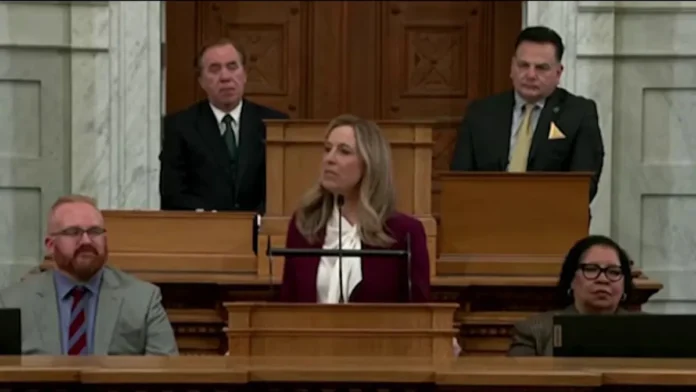
“This is an affordability budget, rooted in lowering costs for hardworking families and making state government more accountable,” Sherrill said while presenting the plan at the State House in Trenton. According to the governor, the proposal seeks to reduce the state’s structural deficit while preserving key investments in education, pension obligations, and programs designed to support the middle class.
At the core of the spending blueprint are several major funding commitments.
The budget allocates a record $12.4 billion for school funding across New Jersey, continuing a multi-year effort to fully fund the state’s school aid formula. Education spending remains one of the largest components of the state budget and reflects ongoing efforts to ensure districts receive resources necessary to support classroom instruction, facilities, and student services.
Another centerpiece of the proposal is a $7.3 billion full pension payment. For decades, New Jersey struggled with underfunded pension obligations, a fiscal challenge that accumulated after successive administrations delayed or reduced payments into the system. The state has recently resumed making full annual contributions, and Sherrill emphasized that continuing those payments is essential for restoring long-term fiscal stability.
In addition, the budget proposes $4.2 billion in property tax relief, one of the most politically sensitive issues in New Jersey. The Garden State consistently ranks among the highest property tax states in the country, and both parties have long sought solutions that ease the burden on homeowners while maintaining funding for schools and local governments.
Sherrill’s proposal also includes approximately $2 billion in spending cuts combined with more than $700 million in new revenue measures. Much of that revenue would come from closing what the administration describes as corporate tax loopholes, a move that has already drawn mixed reactions from business leaders concerned about the potential impact on investment and job growth.
Beyond those headline figures, the governor emphasized broader reforms designed to modernize how the state government operates.
Among them is a proposed “government report card” intended to increase transparency by allowing residents to see how tax dollars are being spent. The administration also outlined plans to accelerate permitting processes for businesses, which could reduce delays that often slow construction projects and economic development across New Jersey.
These proposals come as the state navigates an increasingly uncertain financial environment shaped by federal policy shifts, inflationary pressures, and changing economic conditions.
In laying out the budget, Sherrill also warned that New Jersey cannot continue relying on temporary fiscal fixes that have characterized past budget cycles.
The governor pointed to a projected structural deficit of roughly $3 billion heading into the budgeting process. Without corrective action, she argued, the state’s current $7.2 billion surplus could be depleted within two years, potentially leaving the state with an additional budget gap of hundreds of millions of dollars.
For Sherrill, addressing that imbalance requires rethinking long-standing practices in Trenton.
“There have been too many one-offs, too many temporary fixes, and too little willingness to challenge what’s always been done,” she said. Her administration has positioned the budget as a turning point aimed at reshaping fiscal priorities while maintaining investments in programs that affect everyday residents.
Still, the proposal has sparked immediate political debate.
Democratic leaders in the Legislature responded largely with support for the governor’s approach, particularly her commitment to continuing full pension payments and maintaining strong school funding.
Senate President Nicholas Scutari, Senate Majority Leader Teresa Ruiz, and Senate Budget Committee Chairman Paul Sarlo issued a joint statement praising the continued focus on fiscal responsibility and collaboration between the executive branch and the Legislature.
The Democratic leadership emphasized that the state has successfully navigated significant fiscal challenges in recent years, pointing to the resumption of full pension payments as a major accomplishment.
For decades, New Jersey skipped or reduced contributions to the pension system, a decision that ultimately created billions of dollars in long-term liabilities. According to state officials, the current annual payment reflects both current obligations and the accumulated cost of those missed contributions.
Sherrill acknowledged that reality during her budget address, noting that the state now spends nearly $6 billion annually on pension payments because past administrations failed to meet their obligations.
She contrasted that with neighboring states such as New York, which spends significantly less on pension contributions because it maintained more consistent payments over time.
The governor argued that the consequences of those past decisions continue to affect what the state can accomplish today.
“Imagine what we could be doing with that money,” she said, referring to the billions now required each year to stabilize the pension system.
Despite the praise from Democratic leadership, Republican lawmakers responded with sharp criticism.
Several Republican leaders expressed concern about the overall size of the budget and questioned whether new revenue measures could ultimately increase costs for residents and businesses.
Senate Republican Anthony Bucco said lawmakers would carefully examine the details of the proposal, noting that the budget introduced by a governor is rarely identical to the version ultimately adopted by the Legislature.
He emphasized that Republicans would continue advocating for structural reforms aimed at controlling long-term spending growth.
Other Republican leaders focused on proposed tax and revenue changes within the budget.
One key proposal involves limiting deductions that corporations can take for net operating losses, a change the governor said could save taxpayers nearly $500 million. The administration argues that the policy is necessary because companies began claiming larger deductions following the COVID-era economic slowdown.
Republican lawmakers, however, argue that business taxes are ultimately passed along to consumers through higher prices or reduced economic activity.
Some lawmakers also raised concerns about adjustments to the Alternative Business Calculation tax structure, which the governor said would now be limited to companies earning less than $1 million annually. The administration argues the change will help small businesses while preventing large corporations from benefiting disproportionately from deductions originally intended for smaller enterprises.
Another area drawing attention involves programs connected to immigrant services within the broader state budget.
Critics reviewing the budget proposal have identified roughly $17 to $18 million in funding tied to programs that can serve individuals regardless of immigration status. Legislative critiques of the Fiscal Year 2027 Budget in Brief typically point to two specific line items within that total.
Approximately $11.2 million is allocated for immigration legal defense programs that provide legal representation to individuals facing deportation proceedings. Another $6 to $7 million supports the state’s Office of New Americans, which works to connect immigrant communities with government services and resources.
These allocations have become a flashpoint in the political debate surrounding the budget.
Supporters argue the programs help ensure fairness within the legal system while strengthening integration and economic participation among immigrant communities.
Opponents contend that taxpayer resources should be prioritized for programs serving citizens and long-term residents.
The debate highlights the broader policy tensions that often accompany major budget proposals.
Advocacy groups on the immigration side have also raised concerns that other programs supporting language access and legal services may have been reduced or omitted compared with previous budgets.
These differing perspectives underscore the balancing act facing the governor and lawmakers as they work toward a final budget agreement.
Beyond immigration policy debates, the budget also includes continued support for broader programs such as Cover All Kids, which provides health coverage to children regardless of immigration status.
Programs like this have become a defining part of New Jersey’s approach to public health policy, reflecting efforts to ensure that children have access to medical care regardless of their family’s circumstances.
As discussions unfold in Trenton, the budget will move through the Legislature’s committee review process.
Lawmakers will hold hearings, question agency leaders, and propose adjustments before ultimately negotiating a final version of the spending plan. The state constitution requires the budget to be adopted before the start of the new fiscal year on July 1.
Between now and then, political negotiations are expected to intensify.
Democratic leaders have already signaled their intention to work closely with the governor to craft a final budget that balances fiscal responsibility with continued investment in key programs.
Republicans, meanwhile, are calling for deeper structural reforms aimed at controlling spending growth and preventing future deficits.
For residents across New Jersey, the outcome of these negotiations will shape everything from property tax relief to education funding, healthcare programs, and economic development policies.
Governor Sherrill described the moment as a turning point for the state.
“In life, you rarely get to choose your mission; you rise to it,” she said while presenting the plan in the Assembly chamber.
As budget negotiations now move into full swing in Trenton, the fiscal roadmap laid out in this $60.7 billion proposal will serve as the foundation for one of the most consequential policy debates of the year in New Jersey politics.