


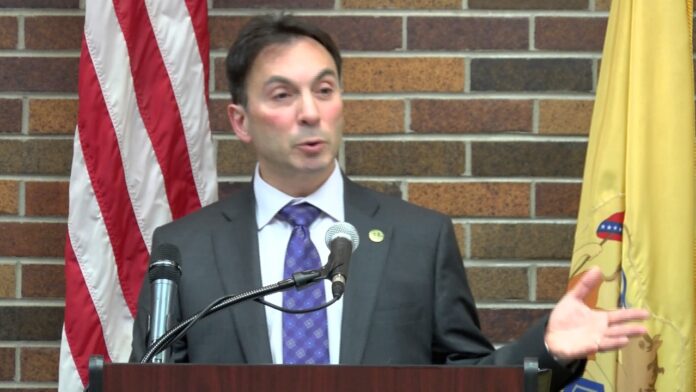

A pivotal moment has emerged in the race to represent New Jersey’s 12th Congressional District as East Brunswick Mayor Brad Cohen captured a commanding endorsement from the Middlesex County Democratic Committee, delivering one of the most decisive early signals yet in the increasingly competitive battle to succeed longtime U.S. Representative Bonnie Watson Coleman.
The convention vote, held in front of hundreds of party members and local leaders, produced a resounding victory for Cohen, who secured 67 percent of the vote in his home county. The outcome places the physician and mayor in a powerful early position as the Democratic field continues to take shape in one of New Jersey’s most influential congressional districts.
Approximately 380 participants took part in the Middlesex County Democratic convention, which was overseen by Committee Chairman Kevin McCabe. The county organization is particularly significant in the 12th District because it includes the largest concentration of municipalities within the district’s boundaries, giving its endorsement substantial political weight as candidates build regional support.
Cohen’s overwhelming margin demonstrated a strong consolidation of local backing. Activist and political organizer Sue Altman finished second in the voting with 11 percent of the support, while Assemblywoman Verlina Reynolds-Jackson of Trenton placed third in the convention tally. Reynolds-Jackson has secured backing from the Mercer County Democratic Committee, giving her a foothold in her home political base while the broader district contest continues to evolve.
The Middlesex endorsement underscores the strength of Cohen’s local leadership record and the political network he has developed during his tenure as mayor of East Brunswick. For many party insiders, the result was not entirely surprising given Cohen’s longstanding presence in the county’s political landscape and the early support he had secured from influential Democratic leaders across the region.
Among those backing Cohen heading into the convention was State Senator Linda Greenstein of the 14th Legislative District, whose support signaled growing momentum within key Democratic circles. Greenstein’s endorsement carried particular significance given the overlap between her district and areas within the congressional territory, reinforcing Cohen’s credibility as a candidate with established regional relationships.
Cohen’s path to this moment reflects a career that bridges public service, medicine, and municipal leadership.
Before entering elected office, Cohen built his professional reputation as a practicing physician specializing in obstetrics and gynecology at St. Peter’s Hospital, one of the region’s most respected healthcare institutions. His medical background has shaped much of his public messaging during the congressional campaign, particularly on issues related to healthcare access, insurance coverage, and national health policy.
Cohen first entered municipal politics in 2016 when he ran for mayor of East Brunswick, a township in Middlesex County known for its diverse residential neighborhoods, active commercial corridors, and strategic location within the central New Jersey economic region.
Upon taking office, Cohen made economic revitalization a central priority of his administration.
One of the most notable initiatives during his mayoral tenure was the redevelopment of the Route 18 corridor, a major transportation and commercial artery running through East Brunswick. Recognizing both the opportunities and challenges presented by redevelopment, Cohen worked to establish a bipartisan redevelopment agency designed to ensure that the community maintained a direct role in shaping development decisions.
The approach emphasized collaborative planning rather than top-down executive control, allowing residents, business owners, and community stakeholders to participate in discussions about how redevelopment projects would impact the township’s character and future growth.
The redevelopment effort produced a mix of projects that included retail development, restaurant expansion, commercial space, and residential construction. Importantly, the plan also incorporated affordable housing elements intended to ensure that growth remained balanced and accessible.
East Brunswick spans roughly 24 square miles and contains four distinct neighborhood areas with varying development needs. Cohen has frequently pointed to the importance of recognizing those differences when designing redevelopment strategies that preserve community identity while supporting economic expansion.
Fiscal management has also been a defining component of Cohen’s mayoral record.
Throughout his time in office, he has emphasized careful budgeting and tax restraint, often highlighting that municipal taxes have not increased by more than one percent in any year of his administration. For local voters, that approach has reinforced Cohen’s image as a pragmatic leader focused on balancing infrastructure improvements and development with financial stability for residents.
As the congressional race intensifies, Cohen has been urging voters to evaluate not only his political experience but also the perspective he brings as a healthcare professional.
Healthcare policy remains one of the central themes of his campaign.
Cohen has repeatedly warned that ongoing national debates around healthcare coverage, insurance protections, and federal healthcare policy could leave millions of Americans vulnerable if reforms weaken existing protections. As a practicing physician who has worked directly with patients navigating insurance barriers and treatment costs, Cohen argues that healthcare access is one of the defining challenges facing the country.
He believes the United States must continue strengthening systems that ensure families can obtain medical care without facing financial hardship.
At campaign events and political gatherings across the district, Cohen has framed healthcare policy not just as a national debate but as a local concern affecting communities throughout New Jersey.
Hospitals, medical research centers, and pharmaceutical innovators form a major part of the regional economy within the 12th Congressional District. Cohen frequently references the powerful life sciences ecosystem stretching through central New Jersey, a corridor that includes Princeton, Trenton, and communities along the Interstate 287 region.
This area is widely recognized as one of the country’s most important centers for pharmaceutical development, biotechnology research, and medical innovation.
The corridor is sometimes referred to as “Einstein Alley,” a nickname reflecting the concentration of scientific research institutions, corporate laboratories, and technology-driven companies operating within the region.
According to Cohen, protecting and expanding that innovation economy should be a central focus for federal leadership.
He has warned that national policies undermining research funding, education investment, or scientific development could threaten the economic engine that powers many communities across the district.
For Cohen, the stakes extend beyond economic policy.
The research institutions and technology companies located in central New Jersey create thousands of high-paying jobs, support small businesses, and contribute significantly to local school systems and municipal services through economic growth.
When companies establish research centers or corporate headquarters within the region, they bring highly skilled professionals who contribute to the broader economy while strengthening local communities.
Maintaining that environment, Cohen argues, requires strong federal support for science, healthcare innovation, and education programs that develop the workforce needed to sustain the life sciences industry.
The 12th Congressional District itself represents a complex and dynamic political region.
Stretching across parts of Middlesex, Mercer, Somerset, and Hunterdon counties, the district includes a blend of suburban communities, university centers, research institutions, and historic towns. It encompasses major academic institutions such as Princeton University, state government centers in Trenton, and thriving suburban areas that serve as residential hubs for professionals working throughout the New York–Philadelphia corridor.
The district’s diversity means candidates must connect with voters across a wide range of economic priorities, community concerns, and regional identities.
For Democrats, the upcoming election carries added significance because Representative Bonnie Watson Coleman’s retirement will mark the end of a decade of leadership in Congress. Watson Coleman has served as a prominent voice on civil rights, social justice, and progressive policy initiatives during her tenure representing the district.
Her departure opens the door to a new generation of leadership at a time when national political debates over healthcare, science funding, infrastructure investment, and economic competitiveness are shaping the country’s policy agenda.
Within that context, the Middlesex County endorsement represents a critical early milestone for Cohen.
Party endorsements at the county level often influence fundraising momentum, volunteer recruitment, and regional organizing efforts that are essential for building a competitive congressional campaign.
Winning two-thirds of the vote at the convention sends a strong message to political observers that Cohen has consolidated significant support among party activists and local leaders in one of the district’s most influential counties.
As the campaign moves forward, the focus will expand beyond county conventions to broader voter engagement across the district’s diverse communities.
Candidates will need to address issues ranging from transportation infrastructure and economic development to housing affordability, education funding, and environmental protection.
For now, however, the Middlesex County Democratic convention has clearly reshaped the early landscape of the race.
With a commanding endorsement from the county that anchors much of the district’s population, Mayor Brad Cohen has emerged from the convention as a leading contender in the contest to represent New Jersey’s 12th Congressional District.
The months ahead will determine how that momentum translates across the rest of the district, but one thing is already clear: the race to succeed Bonnie Watson Coleman has officially entered a new phase, and East Brunswick’s mayor has positioned himself squarely at the center of the conversation.



