


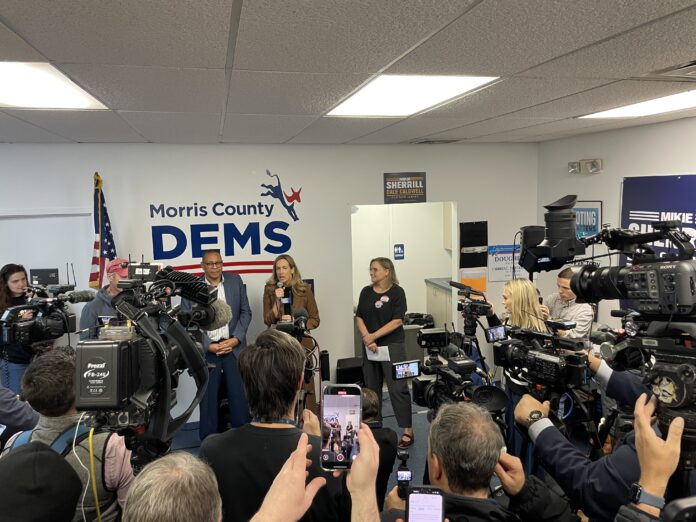

In Morris Township, a community that has undergone one of New Jersey’s most notable political transformations over the past two decades, a new chapter is unfolding—one defined not by partisan rivalry, but by internal fracture. What was once a Republican stronghold surrounding Morristown has evolved into a municipality where Democratic dominance is so firmly entrenched that the most consequential political contest is now taking place within the party itself. The result is a high-stakes recalibration of local power, identity, and political direction that is drawing attention far beyond township borders.
This moment did not materialize overnight. Morris Township’s political trajectory reflects a broader statewide shift that has seen Democratic influence expand into historically competitive or Republican-leaning suburban regions. The breakthrough came in 2007, when Jeff Grayzel secured a special election victory that signaled the beginning of a sustained Democratic ascent. Over time, that foothold became full control, with Democrats now occupying all five seats on the township committee. In a political environment where opposition has effectively disappeared, the dynamics of competition have turned inward, reshaping how influence is contested and exercised.
That internal tension is now fully visible. Two incumbent Democrats—William “Bud” Ravitz and Siva Jonnada—have found themselves on the outside of their own party’s endorsement process. Instead, the local Democratic committee has backed a new slate, elevating Jeremy Godwin and Dr. Stephanie Lyon as its preferred candidates for the upcoming election cycle. The decision signals not just a routine reshuffling, but a deliberate pivot toward new leadership, new priorities, and a recalibrated vision for governance within the township.
Jonnada has opted to remain within the party structure, entering the June primary in a direct challenge to the endorsed candidates. His campaign represents a traditional intra-party contest, one that reflects ideological nuance and strategic differences but remains anchored within the Democratic framework. Ravitz, however, has chosen a dramatically different path—one that introduces an entirely new variable into the township’s political equation.
Rather than competing in the primary, Ravitz is breaking away from the Democratic Party altogether, launching a new political organization under the banner of “USA2.0” and preparing to run as an independent in the general election. It is a move that carries both symbolic and practical implications, signaling dissatisfaction not only with the local endorsement process but with the broader structure of partisan politics itself.
Ravitz’s political journey adds further complexity to this development. Approaching his mid-60s and recently retired from a career with AT&T, he entered the Democratic Party less than a decade ago, motivated by the 2016 presidential campaign of Bernie Sanders. That moment of engagement evolved into sustained political involvement, culminating in his election to the township committee in 2020 and reelection in 2023. His subsequent bid for Morris County Commissioner in 2024, though unsuccessful, demonstrated an ambition to expand his influence beyond the municipal level.
Now, with USA2.0, Ravitz is articulating a broader vision—one that positions itself as a long-term, grassroots-driven effort to rethink governance and institutional trust. Describing himself as a “pragmatic progressive,” he has framed his approach as one that prioritizes outcomes over ideological rigidity, emphasizing service to residents rather than adherence to party orthodoxy. The creation of a new political entity, however, raises immediate questions about viability, electoral impact, and the potential reshaping of local political alignments.
Independent and third-party candidacies have historically faced structural challenges, particularly in local elections where party infrastructure, voter loyalty, and turnout dynamics play decisive roles. In Morris Township, where Democrats have consolidated power so completely, the introduction of an independent candidacy from within their own ranks introduces a level of unpredictability that has been absent for years. It also raises the possibility of vote fragmentation—an outcome that could, at least in theory, reopen the door for Republican relevance in a township where it has largely disappeared.
Ravitz has dismissed that concern, arguing that the division was initiated not by his candidacy, but by the party’s decision to withhold its endorsement. From his perspective, the current moment is less about splitting votes and more about offering voters an alternative that reflects a different philosophy of governance. Whether that argument resonates with the electorate remains to be seen, but it underscores the broader ideological tension at play.
The local Democratic leadership, meanwhile, has offered a contrasting explanation for its endorsement decisions. Party officials have pointed to concerns about focus and priorities, suggesting that Ravitz’s engagement with broader political discourse—particularly through opinion writing on national issues—has come at the expense of attention to local governance. At the same time, they have emphasized the potential of new candidates, framing the endorsement of Godwin and Lyon as an investment in emerging leadership rather than a repudiation of incumbency.
This divergence in perspective highlights a deeper question that extends beyond Morris Township: what does effective local leadership look like in an era where political discourse is increasingly nationalized? For some, engagement with broader issues reflects a commitment to larger principles and systemic change. For others, it risks diluting the focus required to address the immediate, tangible needs of a municipality. In Morris Township, that debate is no longer theoretical—it is shaping the outcome of a real and consequential election.
The emergence of USA2.0 adds yet another layer to this evolving narrative. While its long-term structure and platform remain to be fully defined, its introduction signals a willingness to challenge entrenched systems and explore alternative models of political organization. Whether it gains traction or remains a singular candidacy will depend on its ability to translate abstract vision into concrete, localized relevance for voters.
As the June primary approaches and the general election looms in the fall, Morris Township is poised to become a focal point for understanding how political dominance can give rise to internal fragmentation—and how that fragmentation can, in turn, reshape the landscape. The township’s evolution from Republican control to Democratic consolidation was once the defining story. Now, the more compelling narrative is what happens next when a dominant party must confront its own divisions.
For observers across New Jersey, this is more than a local dispute. It is a case study in the lifecycle of political power, the pressures of one-party dominance, and the unpredictable consequences that emerge when competition turns inward. Morris Township is no longer just a reflection of partisan change—it is a testing ground for what comes after control is achieved, and whether unity can be sustained once the external opposition has faded from view.



