


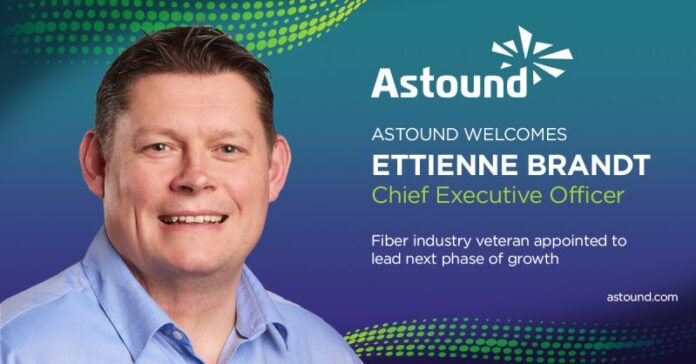

New Jersey’s position at the forefront of the nation’s evolving digital infrastructure economy just strengthened in a major way. Princeton-based Astound, a leading provider of Wi-Fi, mobile, television, and fiber-optic broadband solutions, has appointed industry veteran Ettienne Brandt as its new chief executive officer—an immediate leadership move that arrives at a defining moment for both the company and the broader telecommunications landscape.
The announcement is more than a routine executive transition. It is a strategic inflection point tied directly to Astound’s aggressive growth trajectory, its expanding fiber network footprint, and its planned combination with GFiber, formerly known as Google Fiber. That pending deal, unveiled earlier this month, is poised to create the largest independent fiber-based broadband provider in the United States—an outcome that could reshape competitive dynamics across the industry.
For New Jersey, where innovation, infrastructure, and proximity to major metropolitan markets converge, this move underscores the state’s growing relevance in the future of high-speed connectivity and next-generation broadband deployment.
A Leadership Appointment Timed for Scale and Transformation
Ettienne Brandt steps into the CEO role with more than 25 years of experience across global telecommunications platforms, bringing operational depth across both wireless and wireline ecosystems. His appointment reflects a deliberate effort to align leadership with scale—particularly as Astound prepares for a complex integration with GFiber while continuing to expand its national footprint.
Brandt’s most recent role as executive vice president of Commercial at Frontier Communications positioned him at the center of one of the industry’s most notable transformations. During his tenure, Frontier underwent a significant operational and strategic overhaul that ultimately culminated in a $20 billion acquisition by Verizon. That experience—navigating restructuring, scaling infrastructure, and driving customer-focused growth—maps directly onto the challenges and opportunities Astound now faces.
His earlier career includes leadership roles with global telecommunications giants such as British Telecom, EE, and Orange & ntl, now part of Virgin Media. This international perspective adds another layer of strategic capability, particularly as broadband providers increasingly operate within a global framework of technology standards, infrastructure investment, and service innovation.
The GFiber Combination: A Defining Moment for the Fiber Industry
At the core of this leadership transition is Astound’s planned combination with GFiber, a move that has the potential to redefine the competitive landscape of U.S. broadband. By bringing together two fiber-focused organizations, the combined entity is expected to achieve unprecedented scale among independent providers.
This is not simply about size. It is about positioning. Fiber-optic infrastructure is widely regarded as the gold standard for broadband delivery, offering faster speeds, lower latency, and greater long-term scalability than legacy cable or DSL networks. As demand for high-performance connectivity accelerates—driven by remote work, streaming, cloud computing, and smart technologies—fiber is becoming essential infrastructure.
Under Brandt’s leadership, Astound is expected to accelerate its network expansion strategy, leveraging the combined resources and capabilities of the new organization to reach more markets, improve service delivery, and compete more effectively with established incumbents.
New Jersey’s Strategic Role in the Broadband Evolution
Astound’s headquarters in Princeton places New Jersey squarely within the strategic orbit of this transformation. The state’s unique geographic and economic positioning—bridging New York City and Philadelphia while hosting a dense concentration of businesses, institutions, and residential communities—makes it a critical node in the national connectivity network.
As fiber deployment expands, New Jersey stands to benefit from increased investment, enhanced infrastructure, and improved access to high-speed broadband across both urban and suburban areas. This has implications not only for consumers, but also for economic development, business growth, and technological innovation.
The state’s technology ecosystem continues to evolve rapidly, with companies across sectors relying on robust connectivity to power operations, enable digital services, and support hybrid work environments. The expansion of fiber networks directly supports these needs, reinforcing New Jersey’s role as a hub for innovation and enterprise.
For continued coverage of how companies like Astound are shaping the future of connectivity, visit the latest updates in Technology & Tech on Sunset Daily News.
Scaling Infrastructure to Meet Surging Demand
The timing of this leadership change is critical. Demand for high-speed internet is no longer cyclical—it is structural. Households are consuming more bandwidth than ever before, while businesses are increasingly dependent on cloud-based platforms, data-intensive applications, and real-time communication tools.
Fiber networks are uniquely positioned to meet this demand, but scaling them requires significant capital investment, operational expertise, and long-term strategic planning. Brandt’s track record suggests a focus on disciplined growth—balancing expansion with service quality and customer experience.
Astound’s existing infrastructure, combined with GFiber’s capabilities, creates a foundation for accelerated deployment. The challenge—and opportunity—lies in executing that expansion efficiently while maintaining the reliability and performance that customers expect.
Customer Experience as a Competitive Differentiator
Beyond infrastructure, the broadband market is increasingly defined by customer experience. Reliability, speed, transparency, and service responsiveness are becoming key differentiators in a crowded field.
Brandt’s leadership history emphasizes these elements. His experience across both consumer and commercial segments positions him to address the diverse needs of Astound’s customer base—from residential users seeking seamless streaming and connectivity to businesses requiring enterprise-grade solutions.
As competition intensifies, particularly with the entry of new players and the evolution of existing ones, delivering consistent, high-quality service will be essential to sustaining growth and market share.
A Broader Technology Shift with Local Impact
The appointment of a new CEO at a Princeton-based telecommunications leader may appear, at first glance, to be a corporate development. In reality, it reflects a broader technological shift with direct implications for communities across New Jersey.
As fiber networks expand and connectivity improves, the benefits extend beyond faster internet speeds. They enable smarter cities, support digital education, enhance healthcare delivery through telemedicine, and create new opportunities for businesses of all sizes.
This is the infrastructure of the future—and decisions being made today at companies like Astound will shape how that future unfolds.
Positioning for Long-Term Growth
With Ettienne Brandt at the helm, Astound is entering a new phase defined by scale, integration, and innovation. The planned combination with GFiber represents a rare opportunity to build a national leader in fiber-based broadband outside of traditional incumbents.
For New Jersey, this moment reinforces the state’s role as both a participant in and a beneficiary of the next wave of telecommunications evolution. As infrastructure expands and technology advances, the impact will be felt across industries, communities, and everyday life.
In a market where connectivity is increasingly synonymous with opportunity, the leadership decisions made today are setting the stage for tomorrow’s digital economy—and New Jersey is firmly in that equation.