



At a moment when parents, educators, and school systems across New Jersey continue grappling with the long-term academic and developmental consequences of screen dependency, learning disruption, shrinking attention spans, and mounting classroom pressure, a growing number of families are beginning to search for something that feels increasingly rare in modern education: meaningful human connection inside the learning process itself.
That shift is helping propel a broader movement throughout early childhood education centered around tactile learning, emotional confidence-building, literacy integration, sensory engagement, and hands-on developmental experiences that prioritize curiosity over memorization. In New Jersey, one of the educators increasingly associated with that movement is Danielle Puzzo, the Bernardsville-based educational consultant, literacy specialist, instructional coach, and founder of the.manipulative.mama LLC, whose work is now drawing wider national recognition for its emphasis on experiential learning and family-centered educational support.
Puzzo’s growing visibility accelerated further after being featured by Influential Women, a professional platform spotlighting women leaders making an impact across education, entrepreneurship, advocacy, and business development. The recognition reflects not only the expansion of her consulting platform, but also the growing cultural conversation surrounding how young children learn best in an increasingly digital and overstimulated world.
The foundation of Puzzo’s philosophy begins with a word that often causes initial confusion for people unfamiliar with educational terminology: “manipulative.”
Within educational practice, manipulatives are not psychological tactics or deceptive tools. They are physical learning objects — blocks, counting beads, magnetic letters, textured materials, sensory tools, STEM components, puzzles, counters, sorting games, and interactive learning pieces children physically touch, organize, move, stack, compare, and explore while developing literacy, mathematical reasoning, spatial awareness, language development, and problem-solving skills.
That distinction sits at the heart of Puzzo’s broader educational mission.
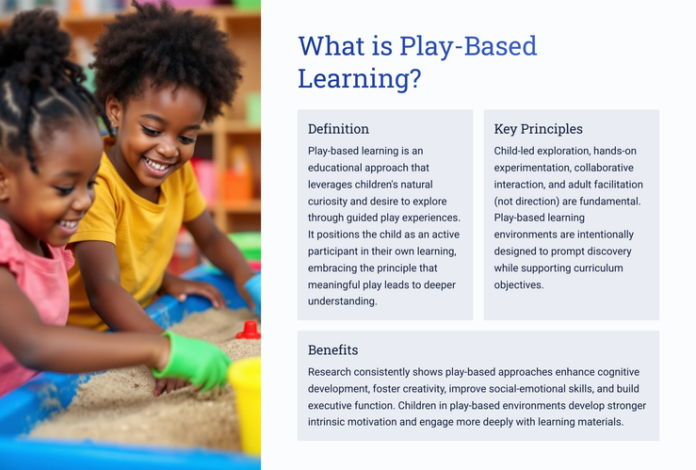
Her platform argues that many children do not learn most effectively through passive information absorption alone. Instead, they build deeper understanding through movement, repetition, tactile engagement, experimentation, play structures, storytelling, and emotionally safe learning environments that reduce anxiety while increasing curiosity and confidence.
It is an educational philosophy increasingly resonating with overwhelmed parents attempting to navigate modern childhood development inside a world saturated with devices, fragmented attention, accelerated academic expectations, and constant digital stimulation.
Across New Jersey, educators continue confronting difficult post-pandemic realities inside classrooms. Teachers report widening developmental gaps among younger learners, increased emotional regulation struggles, literacy setbacks, socialization difficulties, and growing concern surrounding excessive screen exposure during formative years. Those challenges have intensified conversations about whether modern educational systems have drifted too far from experiential learning foundations that historically helped children develop naturally through interactive exploration.
Puzzo’s work positions itself directly inside that conversation.
With more than 15 years of experience as a certified literacy specialist, special education teacher, and early childhood educator throughout New Jersey, she has developed a framework centered around reducing intimidation surrounding childhood learning while simultaneously helping parents understand that educational engagement does not necessarily require expensive products, rigid tutoring structures, or overwhelming curriculum schedules.
Instead, her approach focuses on embedding intentional learning moments into ordinary daily life.
Kitchen counters become math stations. Grocery shopping becomes vocabulary development. Blocks become engineering lessons. Movement games become literacy reinforcement. Household routines become opportunities for sequencing, communication, categorization, and cognitive development.
The broader idea is not simply academic acceleration.
It is educational accessibility.
One reason the.manipulative.mama platform continues attracting attention is because it reframes educational support in ways that feel achievable for ordinary families. Rather than presenting learning as something exclusively controlled by institutions, expensive enrichment programs, or rigid academic systems, the model emphasizes how parents themselves can create powerful developmental experiences through consistency, engagement, and interactive play.
That message has gained significant traction nationally as parents increasingly question how to balance technology with childhood development.
The explosion of tablets, phones, streaming media, educational apps, AI-assisted learning systems, and digital entertainment has fundamentally altered the environment in which children grow up. While technology offers undeniable advantages, many educators and developmental specialists continue warning about the consequences of replacing physical exploration, interpersonal interaction, and sensory learning with prolonged passive screen engagement during critical developmental stages.
Puzzo’s work does not position itself as anti-technology.
Rather, it advocates for restoring balance.
That distinction matters increasingly within modern educational discourse.
Many early childhood specialists now argue that young learners require more opportunities for tactile interaction precisely because modern environments have become so digitally dominated. Physical manipulatives help children visualize abstract concepts, develop motor coordination, improve memory retention, strengthen communication skills, and build emotional resilience through trial-and-error learning experiences.
For children with learning differences or developmental challenges, those approaches can become even more important.
Puzzo’s background in special education additionally shapes much of her instructional philosophy. Her work emphasizes educational equity, differentiated instruction, and adaptive learning strategies that recognize children process information differently depending on developmental needs, communication styles, emotional regulation patterns, and cognitive strengths.
That broader inclusivity helps explain why her platform increasingly resonates not only with parents of struggling learners, but also with families simply searching for more emotionally grounded educational experiences.
The growing popularity of hands-on learning models additionally reflects changing cultural attitudes toward childhood itself.
For years, educational systems across the country experienced mounting pressure to accelerate academic benchmarks earlier and earlier into childhood development. Kindergarten increasingly became structured around measurable performance metrics. Preschool environments adopted more formal academic expectations. Play itself often became secondary to performance outcomes.
Now, however, many educators and developmental experts are revisiting whether some of those shifts unintentionally undermined long-term learning confidence, creativity, emotional development, and intrinsic curiosity.
New Jersey remains deeply invested in educational performance and academic competitiveness, but conversations surrounding social-emotional learning, sensory integration, experiential instruction, and developmental balance continue growing louder across districts, universities, and family communities alike.
That environment creates fertile ground for educational entrepreneurs and instructional specialists capable of translating complex developmental ideas into practical tools families can realistically implement.
Puzzo’s rise also illustrates how educational leadership itself continues evolving.
Traditional classroom teaching remains foundational, but many modern educators now operate across multiple ecosystems simultaneously: coaching parents, consulting with schools, developing instructional resources, creating digital learning communities, conducting workshops, supporting neurodiverse learners, and building entrepreneurial educational brands capable of reaching audiences far beyond a single classroom.
The.manipulative.mama platform exists inside that expanding educational landscape where instruction, advocacy, coaching, content creation, and family support increasingly intersect.
Recognition from organizations like Influential Women further signals how educational entrepreneurship itself is becoming a larger part of the national conversation surrounding innovation and community impact.
Importantly, Puzzo’s growing visibility also reflects broader demand for educators capable of humanizing learning again during a period where many families feel overwhelmed by constant performance pressure, technological saturation, and institutional uncertainty.
Parents increasingly want practical guidance that feels supportive rather than judgmental.
They want educational systems that recognize emotional development alongside academic achievement.
They want learning experiences that build confidence rather than fear.
And they increasingly want educators who understand that children are not standardized systems to optimize, but developing human beings whose curiosity, imagination, emotional security, and sense of self matter just as much as measurable performance outcomes.
That cultural shift continues reshaping educational conversations throughout New Jersey and across the country.
As schools, families, and policymakers continue debating the future of childhood learning in an AI-driven, digitally accelerated era, the work being done by educators like Danielle Puzzo represents a growing counterbalance emphasizing tactile engagement, developmental intentionality, emotional safety, and hands-on learning experiences rooted in human connection.
In many ways, that may be precisely why her message is resonating now.
Because amid all the algorithms, screens, data metrics, automation systems, and technological disruption transforming modern life, more families are rediscovering something education researchers have understood for generations: children often learn best when they can physically touch the world around them, experiment without fear, and feel genuinely connected to the process of discovery itself.