


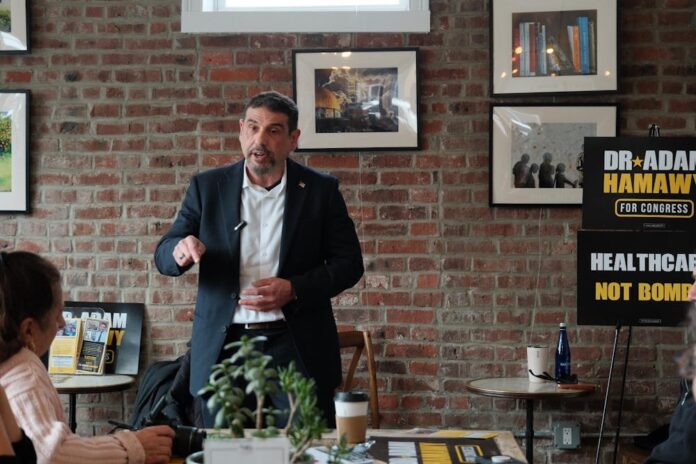

The race for New Jersey’s open 12th Congressional District seat just experienced a dramatic political escalation after Alexandria Ocasio-Cortez officially endorsed Dr. Adam Hamawy, injecting one of the most recognizable and influential progressive political brands in America directly into one of New Jersey’s most closely watched congressional primaries.
The endorsement immediately transforms the political atmosphere surrounding the contest, elevating Hamawy’s campaign from a regional Democratic primary into part of a broader national ideological struggle over the future direction of the Democratic Party itself. With the June 2 primary rapidly approaching, the support from Ocasio-Cortez signals that national progressive organizations increasingly view New Jersey’s 12th District as an important battleground in the continuing effort to expand the influence of left-wing populist politics inside Congress.
The endorsement arrived through Team AOC’s social media operation, where the organization publicly framed Hamawy as a candidate aligned with the modern progressive platform centered on universal healthcare expansion, immigration reform, economic restructuring, and aggressive working-class advocacy.
According to the statement, the congresswoman’s political organization believes Hamawy would enter Congress fighting for Medicare for All, the abolition of ICE, universal childcare expansion, and policies aimed at reshaping economic conditions for working families across New Jersey and the country.
For Hamawy, the endorsement represents much more than symbolic support from a nationally recognized political figure.
It solidifies his position as the most aggressively progressive candidate in the field while simultaneously giving his campaign access to the organizational energy, activist credibility, digital fundraising ecosystem, and ideological momentum associated with Ocasio-Cortez’s political movement. In modern Democratic politics, few endorsements carry greater influence among younger progressive voters, activist networks, and issue-based grassroots organizations than support from the Bronx congresswoman.
Hamawy himself leaned directly into that framing following the announcement.
In his response, the candidate described Ocasio-Cortez as a transformational figure within the progressive movement while emphasizing that his campaign was fundamentally built around a series of core ideological positions increasingly defining the activist left wing of the Democratic Party. He argued that government priorities should shift away from military spending and toward healthcare expansion, reiterated support for abolishing ICE, and framed his candidacy as part of a broader movement aimed at dismantling what he described as a political and economic system that routinely fails working-class Americans.
Importantly, Hamawy also emphasized that his candidacy is not intended to function as an isolated congressional campaign, but rather as part of a growing coalition of lawmakers and activists attempting to fundamentally reshape federal priorities surrounding healthcare, labor rights, immigration enforcement, economic equity, and corporate political influence.
That messaging places the New Jersey 12th District race squarely inside the national conversation currently reshaping Democratic politics.
For years, New Jersey Democratic politics traditionally leaned toward institutional pragmatism, coalition-building, and establishment-driven organization structures. But the rise of nationally networked progressive activism, particularly following the emergence of figures like Ocasio-Cortez and Bernie Sanders, has increasingly challenged those traditional structures in congressional races throughout the country, including New Jersey.
Hamawy’s growing coalition of endorsements reflects exactly that changing political environment.
In addition to Ocasio-Cortez, Hamawy has now assembled backing from Sanders, Tammy Duckworth, Ro Khanna, Rashida Tlaib, Ilhan Omar, Delia Ramirez, and several other nationally recognized progressive lawmakers and former elected officials associated with the activist left.
That coalition matters because it demonstrates the degree to which national progressive infrastructure increasingly sees opportunities inside suburban and highly educated Democratic districts once considered firmly establishment territory.
The 12th District itself carries enormous political significance within New Jersey.
Long represented by Bonnie Watson Coleman, the district has historically functioned as one of the state’s safest Democratic seats while simultaneously serving as an important platform for progressive policy advocacy at the federal level. With Watson Coleman retiring, the open-seat contest created a rare opportunity for competing ideological factions within the Democratic Party to battle for control over the district’s future political identity.
Hamawy’s campaign has attempted to position itself as the authentic continuation—and expansion—of that progressive legacy.
A physician and military veteran, Hamawy has increasingly centered his campaign around issues including healthcare access, anti-war messaging, immigration reform, labor protections, economic inequality, and campaign finance reform. His rhetoric consistently frames political conflict through the lens of working-class struggle, institutional accountability, and resistance to concentrated corporate and billionaire influence.
That messaging has resonated strongly with progressive activist organizations.
More than 25 organizations have now endorsed Hamawy’s campaign, including Justice Democrats, Our Revolution, CAIR Action, and several labor, climate, and advocacy groups operating throughout the progressive movement ecosystem.
The endorsement from Rutgers Adjunct Faculty Union additionally underscores the degree to which labor-aligned activist groups increasingly view the race as part of broader struggles surrounding worker rights, public investment, and economic restructuring.
At the same time, Ocasio-Cortez’s endorsement will almost certainly intensify criticism from moderates and establishment Democrats concerned about the electoral implications of some of Hamawy’s positions, particularly calls to abolish ICE and aggressively restructure federal economic policy.
That tension reflects the larger ideological divide now defining many Democratic primaries nationwide.
One faction argues that bold progressive policies energize younger voters, activate disengaged constituencies, and better address structural economic inequality. Another argues that highly ideological messaging risks alienating moderate suburban voters essential for maintaining broader Democratic governing coalitions.
The New Jersey 12th District primary increasingly appears to be testing those competing theories in real time.
For progressive activists, Hamawy’s candidacy represents an opportunity to deepen the ideological transformation of the Democratic caucus in Washington by adding another unapologetically left-wing voice to Congress. For establishment-oriented Democrats, the race also raises questions about electability, coalition management, and how aggressively the party should align itself with activist-driven national messaging.
The endorsement additionally illustrates how dramatically congressional campaigning has evolved in the digital era.
A decade ago, congressional primaries in New Jersey were often heavily shaped by county organizations, local political machines, labor structures, and regional institutional relationships. Those forces still matter enormously. But nationally networked ideological movements now possess the ability to inject outside fundraising, activist mobilization, social media amplification, and volunteer infrastructure into local races with unprecedented speed.
Ocasio-Cortez’s political operation excels precisely in those areas.
Her endorsement brings with it not only attention, but national visibility capable of generating online donations, volunteer enthusiasm, digital organizing energy, and expanded media coverage far beyond traditional New Jersey political circles.
That visibility could prove particularly important in the final days leading into the primary.
Open-seat congressional contests often hinge on turnout intensity, grassroots enthusiasm, and late-stage momentum shifts among undecided or low-frequency voters. Progressive campaigns historically rely heavily on energized volunteer networks and digital outreach operations capable of driving voter participation among younger demographics less connected to traditional party organizations.
Hamawy’s campaign clearly believes the endorsement strengthens that pathway.
At the same time, the broader political stakes continue growing.
Control of the Democratic Party’s ideological future is increasingly being contested district by district, race by race, and coalition by coalition throughout the country. New Jersey, long viewed as institutionally stable and politically establishment-oriented, is no longer insulated from those internal national battles.
The AOC endorsement makes that reality unmistakably clear.
The 12th District race is no longer simply a local congressional primary.
It is rapidly becoming a referendum on the future direction of Democratic politics in New Jersey itself.