


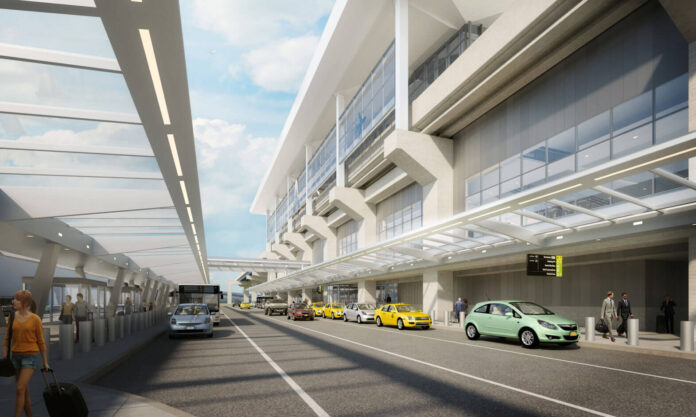

A sweeping modernization effort is officially moving forward at Newark Liberty International Airport as the Port Authority of New York and New Jersey begins a long-awaited $200 million overhaul of the airport’s oldest operating terminal, launching a multi-year infrastructure initiative aimed at stabilizing passenger operations, reducing overcrowding pressures, and extending the functional lifespan of Terminal B until a full terminal replacement can eventually be delivered sometime in the mid-2030s.
The investment represents one of the most significant transitional infrastructure upgrades currently underway at Newark Liberty, where explosive passenger growth, aging systems, operational strain, and evolving international travel demands have increasingly pushed the 53-year-old terminal far beyond the environment it was originally designed to support.
While Newark’s newer Terminal A redevelopment project captured enormous public attention over the past several years with its gleaming architecture, digital modernization systems, expanded retail spaces, and next-generation passenger amenities, Terminal B has remained the airport’s most visibly strained facility — a heavily utilized international and domestic operations hub still functioning within structural systems dating back to the early 1970s.
The contrast between terminals has become impossible for both travelers and airport planners to ignore.
Now, rather than waiting another decade for a complete rebuild, the Port Authority is moving aggressively to modernize the existing structure in phases, acknowledging both the operational realities facing Newark Liberty today and the impossibility of allowing one of the airport’s most critical terminals to continue deteriorating under mounting passenger volumes.
At its core, the project reflects a larger truth now confronting major transportation infrastructure systems across the Northeast corridor: airports originally designed for 20th-century travel patterns are being forced to evolve rapidly in response to 21st-century passenger demand.
Newark Liberty is experiencing exactly that pressure.
Passenger traffic throughout the New York-New Jersey metropolitan aviation network has surged dramatically over the past decade despite pandemic-era disruptions, with international travel, business mobility, tourism, logistics activity, and regional population growth all contributing to sustained demand increases. Newark in particular has become increasingly vital due to its strategic location, international connectivity, and role as one of the primary aviation gateways serving both New Jersey and New York City.
But Terminal B was never designed for modern throughput levels.
Originally opened more than five decades ago, the facility was constructed during an entirely different era of commercial aviation — long before today’s security requirements, digital infrastructure needs, expanded baggage systems, passenger technology expectations, and massive airline operational complexity transformed global airport environments into highly sophisticated transportation ecosystems.
As a result, travelers passing through Terminal B have increasingly encountered visible signs of aging infrastructure: overcrowded gate areas, outdated restrooms, constrained seating capacity, aging mechanical systems, narrow circulation patterns, operational bottlenecks, and passenger flow inefficiencies that have become especially pronounced during peak international travel periods.
The Port Authority’s modernization strategy specifically targets those immediate stress points.
The approved three-year improvement program focuses heavily on infrastructure stabilization rather than cosmetic redesign alone. Planned upgrades include substantial restroom modernization projects, expanded and improved passenger seating environments, mechanical systems replacement, circulation improvements, and broader structural modifications intended to alleviate congestion inside the terminal while improving operational resilience under record passenger loads.
Importantly, officials are framing the investment not as a permanent solution, but as a critical bridge phase between Newark’s current operational demands and the eventual replacement terminal envisioned for the mid-2030s.
That distinction matters.
Terminal B is not being fully reinvented in the way Terminal A was. Instead, the Port Authority is effectively attempting to extend the terminal’s useful operational life while simultaneously improving the passenger experience enough to sustain Newark’s growing traffic demands over the next decade.
In transportation planning terms, this is infrastructure triage on a massive scale.
The challenge facing airport planners is particularly complex because Newark Liberty cannot simply pause operations while construction occurs. Terminal B remains an active and essential component of the airport’s overall aviation network, handling large volumes of domestic and international passengers every day. That means modernization work must unfold carefully in phases while maintaining continuous operational functionality inside one of the busiest transportation facilities in the region.
The logistical balancing act will likely become one of the defining challenges of the project.
Airport modernization projects rarely occur without passenger disruption, particularly inside aging terminals where infrastructure limitations constrain construction flexibility. Travelers using Terminal B over the next several years should therefore expect a gradually evolving environment as sections of the facility undergo renovation, mechanical upgrades, and circulation adjustments.
Still, for many travelers, even incremental improvements may provide noticeable relief.
One of the most persistent criticisms of Terminal B has involved overcrowded seating areas incapable of comfortably accommodating modern passenger volumes, especially during delays or peak international departure windows. Expanding and redesigning waiting areas alone could significantly improve passenger comfort levels while reducing circulation bottlenecks throughout gate zones.
Restroom modernization may sound minor on paper, but inside airports handling millions of annual travelers, restroom quality, maintenance reliability, accessibility compliance, and throughput capacity become major operational factors directly impacting customer satisfaction.
Mechanical infrastructure replacement may prove even more important behind the scenes.
Many older airport terminals face mounting stress tied to HVAC systems, escalators, elevators, electrical infrastructure, plumbing networks, ventilation systems, baggage support equipment, and temperature control environments originally designed decades before current usage levels. Upgrading those systems is essential not just for passenger comfort, but for long-term operational reliability and safety.
The broader significance of the Terminal B project also extends beyond Newark itself.
The New York-New Jersey metropolitan region remains one of the most economically critical transportation corridors in the world, with aviation infrastructure serving as a foundational component of regional commerce, tourism, finance, logistics, international business, and labor mobility. Every operational weakness inside the airport system carries ripple effects across broader economic activity.
For New Jersey specifically, Newark Liberty functions as both a transportation hub and a major economic engine supporting thousands of jobs tied directly and indirectly to aviation activity.
That makes terminal modernization not merely an airport project, but an infrastructure investment with statewide economic implications.
The project additionally reflects the Port Authority’s broader long-term strategy surrounding airport redevelopment across the region.
In recent years, the agency has aggressively pursued modernization efforts spanning airports, bridges, tunnels, ports, transit facilities, and regional transportation systems as part of a wider push to address decades of deferred infrastructure investment. Newark Terminal A, LaGuardia Airport’s massive reconstruction, JFK redevelopment efforts, and now Terminal B stabilization all fit within that broader modernization agenda.
Still, Terminal B occupies a uniquely symbolic position inside Newark Liberty’s evolution.
For decades, the terminal served as one of the airport’s defining operational centers during eras when commercial aviation itself looked dramatically different from today. International travel volumes were smaller. Security systems were simpler. Passenger expectations were lower. Airline operations were less digitally integrated. Airport retail environments were secondary considerations rather than revenue-driving ecosystems.
Today, airports function more like miniature cities than transportation depots.
Passengers expect fast digital systems, charging stations, expanded food and retail environments, accessible design, efficient security processing, comfortable waiting areas, strong climate control, and reliable operational flow. Aging terminals built long before those expectations emerged face enormous structural disadvantages.
That reality is exactly why the Port Authority ultimately plans to replace Terminal B entirely in the future.
But until that larger redevelopment arrives, the current modernization effort represents an attempt to stabilize one of the region’s most important transportation assets during a period of sustained passenger growth and mounting infrastructure pressure.
For millions of travelers passing through Newark Liberty over the next decade, the success of this transitional investment may significantly shape how the airport is experienced during one of the busiest eras in its history.
And for New Jersey itself, the project underscores a broader infrastructure reality becoming increasingly unavoidable throughout the state: modernization is no longer optional. Aging transportation systems built for another century must now evolve rapidly to meet the demands of a dramatically different future.



