


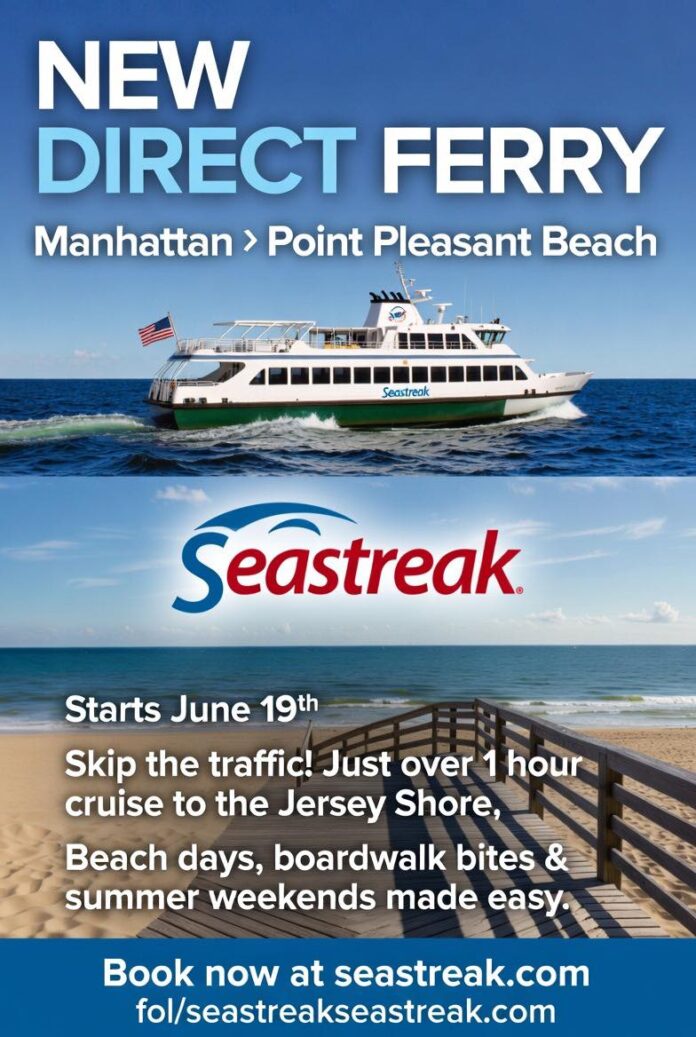

A major new transportation link between New York City and the Jersey Shore is officially arriving for Summer 2026 as Seastreak prepares to launch its first-ever nonstop seasonal ferry service connecting Lower Manhattan directly to Point Pleasant Beach, creating a high-speed alternative to one of the most dreaded summer travel experiences in the Northeast: sitting for hours in Garden State Parkway traffic trying to reach the Shore on a Friday afternoon.
The announcement marks a potentially significant shift not only for regional tourism transportation, but for the broader evolution of how travelers increasingly move between dense urban centers and New Jersey’s coastal economy. For decades, Shore access has been overwhelmingly dependent on highways, personal vehicles, buses, and rail connections that often become severely congested during peak summer weekends. Seastreak’s new route introduces something fundamentally different — a direct maritime corridor capable of transporting passengers from Lower Manhattan to the Manasquan Inlet in just one hour and fifteen minutes without a single roadway bottleneck along the way.
In practical terms, the service is designed to bypass nearly every major frustration associated with summer Shore travel.
No Parkway backups.
No tunnel traffic.
No multi-transfer train combinations.
No hours-long bus delays.
Instead, passengers board directly at the historic Battery Maritime Building in Lower Manhattan and travel straight down the coast to Point Pleasant Beach aboard Seastreak’s high-speed vessels, arriving steps away from the Shore’s restaurants, beaches, bars, marinas, and boardwalk destinations.
For New Jersey’s tourism and transportation sectors, the implications are larger than a simple seasonal ferry announcement.
The new route reflects the growing economic and cultural convergence between New York City and the Jersey Shore, where coastal communities increasingly function not just as vacation destinations, but as integrated extensions of the broader metropolitan lifestyle economy. Remote work flexibility, hybrid employment schedules, rising Shore real estate demand, and evolving regional tourism patterns have dramatically increased demand for faster, easier, and more experience-oriented transportation options connecting urban residents to coastal communities.
Seastreak appears positioned directly at the center of that shift.
The company has spent years building a strong reputation for premium commuter and leisure ferry services connecting New Jersey waterfront communities to Manhattan, but the Point Pleasant Beach expansion represents one of its most aggressive seasonal tourism plays yet. Rather than simply offering another commuter alternative, the new service is effectively marketing the Jersey Shore itself as a seamless same-day or weekend-accessible extension of New York City’s recreational ecosystem.
The timing also aligns with broader changes happening across the transportation industry.
Throughout the Northeast corridor, travelers increasingly prioritize convenience, experience quality, and predictability over purely price-driven decisions. After years of worsening highway congestion, expensive parking, construction delays, and overcrowded transit infrastructure, premium ferry services have gained growing appeal among both commuters and leisure travelers seeking more reliable alternatives.
For many New Yorkers, the psychological value alone may prove significant.
The ability to leave Lower Manhattan in the late morning and arrive directly at the beach by early afternoon without touching the Garden State Parkway fundamentally changes how Shore travel is experienced. Instead of beginning a weekend exhausted from traffic, travelers arrive via open water transit with skyline views, coastal scenery, onboard seating, and dramatically reduced logistical stress.
The operational details behind the service illustrate how carefully the route has been structured around peak summer travel behavior.
The seasonal launch officially begins Friday, June 19, 2026, intentionally timed to coincide with the core summer tourism period after schools close and beach traffic intensifies. Service will run on select weekends through August 9 before briefly pausing during late August and then resuming for the Labor Day holiday period from September 4 through September 7.
The ferry route itself operates as a pure point-to-point express service with no intermediary stops, helping maintain the rapid one-hour-fifteen-minute travel time.
Departures originate from Slip 5 at the Battery Maritime Building located at 10 South Street in Lower Manhattan, one of the city’s most historically significant waterfront transportation hubs. Upon arrival in New Jersey, vessels dock at the Seastreak Ferry Dock at 49 Inlet Drive directly adjacent to Captain Bill’s Landing along the Manasquan Inlet, placing travelers immediately within walking distance of major Point Pleasant Beach destinations including restaurants, waterfront bars, marina activity, and the beachfront itself.
The Friday departure schedule appears strategically designed to maximize same-day Shore access.
Southbound ferries leave Manhattan at 11:30 a.m., arriving in Point Pleasant Beach at approximately 12:45 p.m. Meanwhile, northbound return service departs Point Pleasant at 1:00 p.m. for travelers returning into New York City, while Sunday return schedules are intended to accommodate weekend visitors heading back north before traditional evening traffic peaks.
The pricing structure further positions the service as a premium but accessible leisure transportation product rather than luxury-only tourism.
Adult fares are set at $69 one-way or $99 round-trip, while children between ages three and twelve can travel for reduced rates. Infants under two ride free, though reservations remain mandatory due to vessel capacity management requirements.
Importantly, Seastreak is requiring all reservations to be booked in advance online through its dedicated Point Pleasant service portal, signaling expectations for strong demand and controlled passenger volumes throughout the summer season.
Additional options for bicycles and non-electric scooters also reveal how the company envisions the broader Shore mobility experience. Riders may bring standard bikes or scooters onboard for additional fees, allowing travelers to navigate beach communities more flexibly after arrival without relying on local vehicle rentals or rideshare services.
One operational caveat, however, may catch some visitors by surprise.
Ferry tickets cover transportation only and do not include beach admission passes, which must still be purchased separately at Point Pleasant Beach itself. That distinction matters because beach badge systems remain a core part of Shore municipal operations throughout New Jersey, particularly during peak summer weekends.
The launch also arrives during a period of increasing innovation across New Jersey transportation infrastructure more broadly.
Statewide conversations surrounding ferry expansion, rail modernization, transit-oriented tourism, waterfront redevelopment, and regional mobility alternatives have intensified as population density, tourism demand, and infrastructure pressures continue rising simultaneously throughout the Northeast corridor.
In many ways, the Point Pleasant route functions as a test case for future seasonal ferry expansion throughout the Shore region.
If successful, similar direct maritime connections could eventually emerge linking Manhattan to additional coastal destinations including Asbury Park, Long Branch, Atlantic Highlands expansions, Belmar-adjacent services, or even future South Jersey tourism corridors. The economics of premium ferry tourism become increasingly attractive as roadway congestion worsens and travelers seek alternatives capable of transforming transit itself into part of the leisure experience.
There is also a larger symbolic dimension to the service launch.
For generations, the Jersey Shore has occupied a unique cultural role within the New York metropolitan region — simultaneously close enough to feel accessible yet often frustratingly difficult to reach during peak travel periods. Seastreak’s new route effectively compresses that psychological distance even further, making spontaneous Shore trips feel significantly more attainable for urban residents.
The concept taps directly into changing lifestyle behavior patterns where consumers increasingly value short-duration experiential travel over longer, logistically complex vacations. A direct ferry ride from Lower Manhattan to Point Pleasant Beach fits neatly into the growing popularity of flexible weekend escapes, remote work mobility, hybrid scheduling, and experience-centered leisure planning.
For Point Pleasant Beach itself, the economic upside could be substantial.
Restaurants, bars, marinas, boardwalk businesses, retail operators, and tourism-dependent employers may all benefit from increased direct visitor flow arriving without the limitations associated with parking shortages or highway fatigue. The ferry potentially introduces an entirely new segment of higher-frequency visitors who previously avoided Shore travel due to transportation frustrations.
At the same time, the service reinforces New Jersey’s increasingly important role within the broader Northeast tourism economy, where transportation innovation is becoming just as important as the destinations themselves.
As Summer 2026 approaches, Seastreak’s newest route may ultimately become far more than a convenient seasonal ferry. It could represent the beginning of a new transportation era where maritime travel once again becomes one of the most desirable ways to experience the Jersey Shore.



