


As New Jersey employers continue battling labor shortages, technological disruption, shifting hiring standards, and the accelerating impact of artificial intelligence across nearly every industry sector, a major conversation is unfolding across the state’s education landscape about what modern workforce preparation should actually look like.
For decades, higher education debates often framed vocational education and liberal arts education as competing philosophies — one focused on immediate job readiness and the other centered on broad intellectual development. Increasingly, however, educators, employers, policymakers, and workforce strategists across New Jersey are arguing that the future belongs not to one model or the other, but to institutions capable of blending both into a flexible, adaptable, career-ready educational framework.
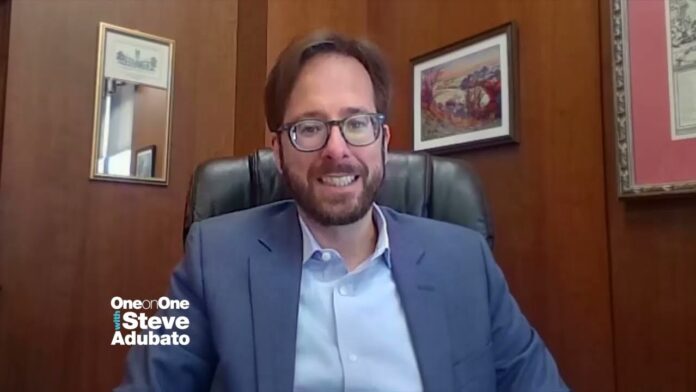
That evolving conversation took center stage as veteran New Jersey broadcaster and public affairs host Steve Adubato sat down with Jonathan Farina, PhD, Dean of the College of Arts and Sciences at Seton Hall University, to examine how universities are preparing students to enter a rapidly transforming labor market where technical skill, communication ability, adaptability, and interdisciplinary thinking increasingly carry equal weight.
The discussion arrives during a pivotal moment for New Jersey’s economy.
Employers across healthcare, construction, engineering, advanced manufacturing, logistics, education, cybersecurity, technology, energy infrastructure, finance, transportation, and skilled trades continue searching for qualified workers at a time when demographic shifts and evolving career expectations are reshaping the labor force itself.
At the same time, students and families are demanding clearer returns on educational investment, particularly as tuition costs, economic uncertainty, automation concerns, and changing hiring practices alter how young adults evaluate career pathways.
The result is a growing statewide focus on workforce-aligned education models capable of balancing specialized training with long-term intellectual flexibility.
Farina’s conversation with Adubato reflects that broader transition now taking place throughout New Jersey higher education.
Rather than viewing liberal arts and vocational preparation as separate tracks, institutions like Seton Hall increasingly argue that the strongest workforce candidates are often individuals capable of combining technical competency with communication skills, analytical reasoning, ethical judgment, leadership capacity, cultural literacy, and problem-solving adaptability.
That distinction matters enormously in today’s economy.
Many of the jobs students will hold over the next two decades either do not yet exist or will evolve significantly due to artificial intelligence, machine learning, automation systems, data analytics, robotics, and digital infrastructure expansion. Employers are therefore placing increasing value on workers capable not simply of performing one specific technical task, but of adapting repeatedly as industries evolve.
That is where proponents of broad-based higher education believe liberal arts disciplines remain critically important.
Communication.
Critical thinking.
Research literacy.
Writing ability.
Presentation skills.
Team collaboration.
Ethical reasoning.
Cross-disciplinary analysis.
Creative problem-solving.
These capabilities increasingly serve as career stabilizers in industries being transformed by rapid technological change.
Farina emphasized that universities now face mounting pressure to prepare students not just for their first job, but for long-term professional resilience.
That philosophy is becoming increasingly influential throughout New Jersey’s educational ecosystem, particularly as employers themselves begin reevaluating what qualifications truly matter in hiring and advancement decisions.
The conversation also highlights how vocational education itself has evolved dramatically.
For years, vocational pathways were often unfairly stigmatized as secondary alternatives to traditional academic routes. Today, however, career-focused education programs are among the fastest-growing and most strategically important sectors within New Jersey’s workforce development system.
Modern vocational and technical education increasingly includes advanced healthcare training, engineering technology, cybersecurity systems, renewable energy infrastructure, robotics, logistics management, construction sciences, architecture, digital design, coding, AI integration, manufacturing automation, transportation systems, and biomedical technologies.
Many of these programs now connect directly into four-year degree pathways and graduate education tracks, eliminating the outdated binary between vocational learning and academic advancement.
New Jersey’s economy itself helps explain why this convergence matters so much.
The state sits at the center of one of the nation’s most sophisticated regional economies, where pharmaceutical research, financial services, logistics infrastructure, healthcare systems, higher education institutions, transportation networks, and advanced technology companies all compete simultaneously for talent.
That economic complexity requires workers capable of navigating multiple disciplines rather than operating inside narrow silos.
Farina’s discussion with Adubato underscores how universities increasingly recognize that reality.
Students entering the workforce today are expected to understand technology while also communicating effectively. They must interpret data while also managing interpersonal relationships. They need technical fluency while maintaining ethical awareness and cultural understanding.
This blended model of workforce readiness is becoming particularly important as artificial intelligence transforms white-collar professions once assumed immune from automation pressures.
Jobs involving repetitive analytical functions, standardized reporting, administrative review, and predictable procedural work are already being reshaped by AI systems capable of processing information at unprecedented speed.
As that transition accelerates, human-centered capabilities become even more valuable.
Employers increasingly prioritize individuals capable of nuanced judgment, strategic communication, leadership, collaboration, emotional intelligence, and creative adaptation — areas where human workers continue maintaining critical advantages.
Seton Hall’s emphasis on integrating broad educational foundations with workforce preparation reflects this emerging labor market reality.
The conversation additionally arrives as New Jersey intensifies statewide focus on workforce pipeline development.
Business leaders throughout the state continue warning about shortages in healthcare staffing, engineering, teaching, infrastructure trades, transportation operations, cybersecurity, and public sector administration. Simultaneously, universities and vocational institutions face growing expectations to align curricula more directly with economic demand.
This alignment is now influencing everything from internship development and experiential learning opportunities to employer partnerships, mentorship programs, and interdisciplinary coursework.
Farina stressed that preparing students for modern careers increasingly requires exposure to real-world applications long before graduation.
That means internships, professional simulations, collaborative projects, public-facing communication exercises, research opportunities, and cross-sector engagement are becoming central to higher education strategy rather than supplemental enrichment.
The broader discussion also touches on a growing societal reevaluation of educational prestige itself.
For many years, higher education culture often prioritized abstract credentialing over practical career alignment. Today, students and employers alike increasingly value educational models that combine intellectual depth with tangible employability.
That shift has elevated vocational education while simultaneously forcing traditional universities to rethink how they define workforce relevance.
Rather than abandoning liberal arts traditions, institutions like Seton Hall are instead attempting to modernize them.
The goal is not merely producing graduates who can secure employment immediately after college, but graduates capable of sustaining long-term professional growth across industries that may transform repeatedly throughout their careers.
In many ways, this conversation represents one of the defining educational questions facing New Jersey over the next decade.
How should schools prepare students for an economy changing faster than educational systems historically evolve?
How do universities balance specialized career preparation with broad intellectual development?
How can institutions ensure students remain adaptable as automation reshapes entire industries?
And how do states like New Jersey maintain economic competitiveness while simultaneously protecting long-term workforce resilience?
Farina’s appearance with Adubato reflects how seriously those questions are now being taken throughout New Jersey’s educational and economic leadership circles. The answer increasingly appears to involve integration rather than separation. Vocational education and liberal arts training are no longer operating as competing models.
They are converging into a new workforce framework where technical expertise, adaptability, communication ability, ethical reasoning, and interdisciplinary thinking are all becoming essential components of career readiness in the modern economy.
For New Jersey students entering one of the most volatile and technologically transformative labor markets in modern history, that evolution may ultimately become one of the most important educational shifts of the next generation.