



The battle for New Jersey’s 2nd Congressional District is continuing to gain momentum as National Organization for Women formally endorsed Tim Alexander for Congress, positioning the South Jersey candidate as part of a broader national political struggle centered on reproductive rights, civil liberties, gender equality, economic security, and the future direction of federal policymaking in the post-Roe political era.
The endorsement marks a significant moment in the increasingly competitive political landscape surrounding New Jersey’s southern congressional corridor, where Democrats are attempting to strengthen coalition support by emphasizing issues tied to civil rights protections, healthcare access, voting rights, and constitutional freedoms amid continuing national polarization.
In announcing its support, NOW highlighted Alexander’s background as a civil rights attorney and emphasized what the organization described as his commitment to reproductive freedom, equal opportunity, economic fairness, and legal protections for historically marginalized communities.
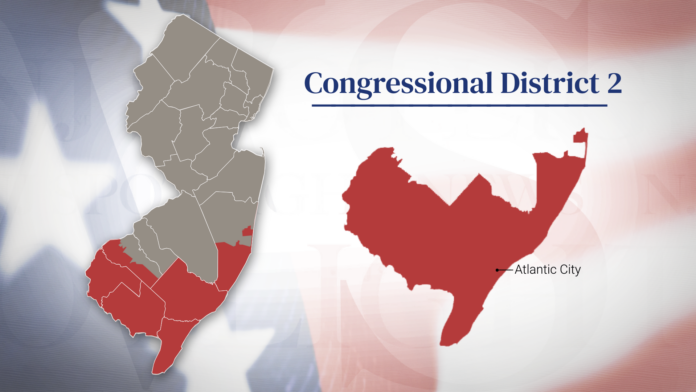
The endorsement also reflects the broader strategic importance of New Jersey’s 2nd Congressional District itself.
Long viewed as one of the more politically volatile and ideologically mixed districts in the state, NJ-2 occupies a uniquely complex position inside New Jersey’s electoral geography. Stretching across large portions of South Jersey, the district blends suburban communities, shore regions, working-class municipalities, rural territory, tourism economies, agricultural areas, and military-connected populations into one politically diverse congressional battleground.
That diversity has historically made the district difficult to categorize cleanly.
Unlike heavily Democratic urban districts or deeply Republican rural strongholds elsewhere in the country, NJ-2 often operates politically inside a narrower and more competitive middle ground where cultural issues, economic anxieties, healthcare policy, reproductive rights, taxation, infrastructure, and local identity all intersect simultaneously.
As a result, endorsements from major advocacy organizations carry heightened importance.
The endorsement from NOW signals an effort to frame the race not simply as a conventional partisan contest but as part of a larger national debate over bodily autonomy, civil protections, democratic institutions, and the role federal government should play in safeguarding individual rights.
That framing has become increasingly central to Democratic strategy nationwide following the Supreme Court’s overturning of Roe v. Wade and the subsequent wave of state-level abortion restrictions and legal battles that transformed reproductive rights into one of the defining issues of modern American politics.
For organizations like NOW, congressional races are no longer viewed in isolation.
Instead, they are treated as frontline battles inside a broader ideological struggle over judicial appointments, federal legislation, healthcare access, constitutional interpretation, and social policy direction.
Alexander’s legal background appears central to that positioning.
Civil rights attorneys often occupy a particularly powerful role inside Democratic political narratives because they symbolize institutional advocacy, constitutional protections, legal accountability, and direct engagement with questions surrounding equality and justice. That professional identity allows campaigns to frame candidates not merely as politicians, but as advocates shaped by courtroom experience and public-interest legal work.
In New Jersey specifically, that message may resonate strongly with portions of the Democratic electorate increasingly focused on institutional stability and civil protections amid ongoing national political volatility.
The endorsement also underscores how deeply reproductive rights remain embedded in New Jersey politics despite the state’s relatively strong abortion protections compared to many other parts of the country.
Even though New Jersey maintains legal safeguards for reproductive healthcare access, Democratic campaigns throughout the state continue emphasizing the issue heavily, arguing that federal elections remain critically important because congressional control affects judicial appointments, national legislation, healthcare funding, interstate protections, and broader constitutional interpretations.
That argument has become especially influential among suburban voters and women voters throughout the Northeast.
Organizations like NOW are therefore not simply endorsing based on state-level policy positions alone. They are evaluating candidates through the lens of national congressional control and the potential long-term direction of federal governance.
The endorsement additionally reflects the increasingly coalition-driven structure of modern Democratic politics.
Successful Democratic congressional campaigns now frequently rely on overlapping alliances involving labor groups, reproductive rights advocates, civil rights organizations, environmental groups, voting rights activists, healthcare advocates, education organizations, and grassroots mobilization networks.
Endorsements from established national organizations help campaigns consolidate credibility within those overlapping political ecosystems.
For Alexander, the endorsement offers several strategic advantages simultaneously.
It strengthens progressive credibility, enhances visibility among activist networks, potentially expands fundraising opportunities, energizes volunteer infrastructure, and reinforces issue alignment with key Democratic constituencies likely to play major roles in turnout operations.
At the same time, the endorsement highlights the continuing nationalization of local congressional races.
Historically, many congressional contests — especially in mixed suburban and regional districts — centered heavily on local issues such as transportation, taxes, economic development, veterans services, tourism, infrastructure, or constituent outreach.
Those issues still matter enormously.
But increasingly, congressional campaigns are also being absorbed into larger national ideological narratives surrounding democracy, reproductive rights, immigration, constitutional protections, cultural conflict, and federal institutional power.
The Alexander endorsement clearly fits within that larger nationalized framework.
The emphasis on “equality and justice” reflects language now deeply embedded within Democratic coalition messaging, particularly among organizations focused on gender equity, reproductive healthcare access, anti-discrimination protections, LGBTQ rights, economic fairness, and voting access.
Those themes continue shaping Democratic turnout strategy heading into upcoming federal election cycles.
South Jersey itself represents an especially fascinating political terrain for these battles.
The region often occupies a complicated middle space between New Jersey’s heavily Democratic urban cores and the more conservative political tendencies visible in portions of rural and exurban America. Voters in South Jersey frequently prioritize practical economic concerns alongside cultural moderation, local identity, and institutional trust.
That creates highly competitive political conditions where messaging balance becomes critical.
Candidates must simultaneously energize progressive coalitions while remaining credible to moderates, independents, suburban families, organized labor communities, and economically anxious voters concerned about affordability, taxes, healthcare costs, and quality-of-life issues.
The evolving political identity of South Jersey has therefore become increasingly important statewide.
Population shifts, housing development, migration patterns, tourism economies, healthcare expansion, infrastructure investment, and changing commuter dynamics continue reshaping the region politically. Both parties recognize the area’s growing strategic value.
That broader context helps explain why endorsements now receive such significant attention.
They are no longer merely symbolic gestures.
They serve as signals about coalition alignment, ideological positioning, institutional support networks, fundraising capability, activist energy, and the larger narrative campaigns hope to build heading toward Election Day.
The endorsement also arrives during a period when Democratic organizations nationally are placing renewed emphasis on candidate biography.
Voters increasingly respond not only to policy platforms but also to personal narrative — military service, legal advocacy, community activism, healthcare experience, educational background, or direct public-interest work. Campaigns now regularly attempt to frame candidates as embodiments of broader societal values rather than traditional career politicians alone.
Alexander’s profile as a civil rights attorney aligns closely with that modern strategy.
In many ways, the endorsement reveals how New Jersey congressional politics are evolving alongside national political culture itself.
Campaigns are becoming more coalition-oriented, more issue-driven, more nationally interconnected, and more emotionally centered around competing visions of rights, governance, and institutional direction.
For advocacy organizations like NOW, congressional races increasingly represent opportunities to shape not just individual districts, but the broader trajectory of federal power and constitutional interpretation nationwide.
And in New Jersey’s 2nd District — a politically complex region where suburban moderates, working-class voters, shore communities, and progressive activists all intersect — those national battles are increasingly playing out at the local level with growing intensity.