


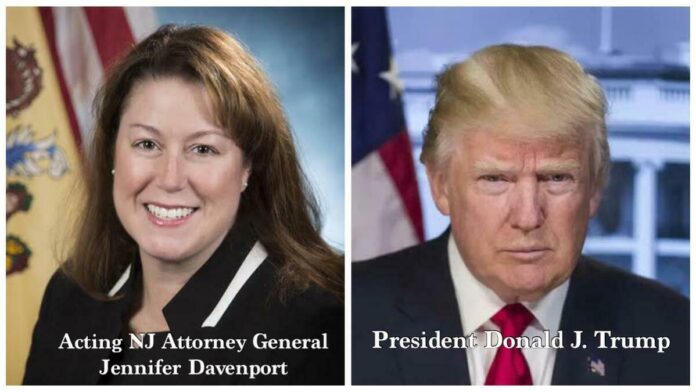

New Jersey has stepped squarely into the center of a defining national legal battle, with Attorney General Jennifer Davenport joining a powerful multistate coalition to challenge what is being framed as one of the most consequential federal election directives in recent memory. Filed in the U.S. District Court for the District of Massachusetts, the lawsuit targets President Donald Trump’s executive order titled “Ensuring Citizenship Verification and Integrity in Federal Elections,” setting the stage for a constitutional confrontation that could reshape the balance of power between states and the federal government ahead of the 2026 midterm elections.
This is not a routine policy disagreement. It is a structural dispute over who controls the mechanics of American democracy. At its core, the case raises fundamental questions about state sovereignty, executive authority, and the operational independence of federal institutions—questions that have long existed beneath the surface but are now being forced into direct legal scrutiny.
New Jersey’s participation in the lawsuit signals both legal conviction and strategic positioning. By aligning with attorneys general from states such as California, Massachusetts, Nevada, and Washington, Davenport is placing the state firmly within a coalition that is not only contesting the legality of the executive order but also asserting a broader principle: that the architecture of federal elections cannot be unilaterally redesigned by the executive branch. The argument is rooted in the Elections Clause of the U.S. Constitution, which explicitly delegates the authority to determine the “times, places, and manner” of elections to the states, subject only to congressional oversight—not presidential decree.
The coalition’s legal framework is methodical and expansive. It contends that the executive order represents a direct violation of separation of powers by attempting to bypass Congress, which has already legislated extensively in the area of voter registration and election procedures through statutes such as the National Voter Registration Act. In this view, the order is not merely an overreach—it is an attempt to rewrite established federal election law without legislative approval, effectively consolidating authority within the executive branch in a manner that the Constitution does not permit.
Equally significant is the challenge to the order’s directives involving the United States Postal Service. The attorneys general argue that the order improperly seeks to compel an independent federal agency to act as an enforcement mechanism within state-run election systems. By mandating restrictions on the delivery of mail-in and absentee ballots based on a federally compiled voter list, the order introduces a level of federal intervention that the coalition claims is both unlawful and operationally disruptive. For states like New Jersey, where mail-in voting has become a central component of electoral participation, this issue is not theoretical—it is immediate and tangible.
The executive order itself introduces a series of provisions that, taken together, would significantly alter how federal elections are administered. Among the most controversial is the directive for the Department of Homeland Security to create a national registry of eligible voters. This centralized database would serve as the foundation for determining who can receive and return mail-in ballots, effectively shifting a critical aspect of election administration from the states to the federal government. The order also requires the implementation of unique barcode systems on ballot envelopes, enabling federal-level tracking mechanisms that would integrate with this registry.
From a policy standpoint, these measures are being framed by the administration as necessary safeguards to ensure that only eligible citizens participate in federal elections. The White House has positioned the order as a corrective step toward election integrity, emphasizing verification and uniformity as key objectives. However, the coalition of states sees the same provisions through a fundamentally different lens—one that emphasizes disruption, legal overreach, and the potential for widespread disenfranchisement.
In New Jersey, the practical implications are particularly pronounced. State officials have indicated that compliance with the order would require a substantial overhaul of the existing election infrastructure, especially the mail-in voting system that has been refined and expanded in recent election cycles. More than 840,000 New Jersey residents utilized mail-in ballots in 2024, a figure that underscores the system’s scale and significance. Integrating a federally mandated registry and barcode system within a compressed timeline would not only strain administrative capacity but also introduce new layers of complexity that could impact voter access.
One of the most critical points of contention centers on timing. The executive order’s requirement to finalize the federal voter list within 60 days creates a misalignment with New Jersey’s established voter registration deadlines. This discrepancy raises the possibility that eligible voters who register in accordance with state law could be excluded from the federal registry, effectively preventing them from participating in federal elections via mail-in ballots. For the state, this is not a procedural nuance—it is a direct challenge to voter inclusion and electoral integrity as defined under existing law.
Governor Mikie Sherrill has been unequivocal in her response, framing the order as both inconsistent and impractical. Her criticism highlights a broader narrative emerging within the state’s leadership: that the order imposes a rigid federal framework onto a system that is designed to be flexible, responsive, and locally administered. The tension here is not simply political; it is structural. It reflects two competing visions of how elections should be governed—one centralized and standardized, the other decentralized and state-driven.
From a Sunset Daily perspective, what makes this moment particularly significant is how it encapsulates the evolving relationship between federal authority and state autonomy in the modern era. New Jersey’s decision to take a leading role in this legal challenge is not just about opposing a single executive order; it is about asserting a broader position within a national dialogue that is becoming increasingly defined by questions of jurisdiction, governance, and institutional boundaries.
This case also arrives at a time when public confidence in election systems remains a central issue across the country. Any changes to how elections are conducted—especially those introduced through executive action—carry heightened scrutiny and political sensitivity. For New Jersey, maintaining the integrity and accessibility of its election process is not only a legal obligation but also a strategic priority, particularly as the state navigates its role within a highly competitive and closely watched electoral environment.
The outcome of this lawsuit will have implications that extend far beyond the immediate parties involved. A ruling in favor of the coalition could reaffirm the primacy of state authority in election administration and reinforce the limits of executive power. Conversely, a ruling that upholds the executive order would represent a significant shift toward federal centralization, potentially redefining how elections are conducted across all states.
As the legal process unfolds, New Jersey’s position places it at the forefront of a pivotal constitutional debate—one that will shape not only the mechanics of the 2026 midterm elections but also the broader framework within which American democracy operates. In stepping into this role, the state is not simply reacting to federal action; it is actively shaping the conversation about where authority resides, how power is exercised, and what principles will guide the future of elections in the United States.



