


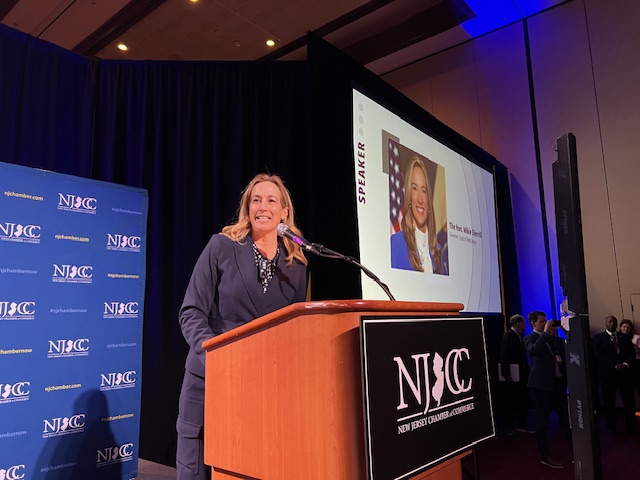

New Jersey’s economic future took center stage as Governor Mikie Sherrill delivered a defining address at the 2026 NJ Chamber ReNew Jersey Business Summit, outlining a comprehensive and forward-looking strategy designed to strengthen the state’s business climate, accelerate economic expansion, and redefine the relationship between government and the private sector. Speaking before a cross-section of business leaders, policymakers, and industry stakeholders, Sherrill framed her agenda with clarity and urgency, emphasizing that New Jersey’s next phase of growth will depend on efficiency, predictability, and a renewed commitment to partnership.
At the core of the governor’s message was a fundamental recalibration of how government interacts with business. Rather than functioning as a barrier or bureaucratic hurdle, Sherrill articulated a vision in which state government becomes a consistent, responsive, and performance-driven partner—one capable of supporting innovation, reducing friction, and enabling companies to scale with confidence. The emphasis on operational efficiency reflects a broader recognition that in today’s competitive economic environment, states are not only competing on incentives or geography, but on how seamlessly businesses can navigate regulatory and administrative processes.
Sherrill’s remarks come at a pivotal moment for New Jersey, as the state continues to balance its historical strengths—strategic location, a highly educated workforce, and proximity to major markets—with ongoing challenges tied to cost structures, regulatory complexity, and interstate competition. By addressing these dynamics directly, the governor positioned her administration’s economic agenda as both pragmatic and reform-oriented, signaling a willingness to modernize systems that have long been cited as obstacles to growth.
Central to the governor’s plan is a commitment to streamlining regulatory pathways and reducing delays that can hinder business development. In industries ranging from manufacturing and logistics to technology and life sciences, time-to-market has become a critical factor in determining success. Sherrill emphasized that improving permitting timelines, enhancing interagency coordination, and adopting digital-first processes will be key components of making New Jersey a more attractive destination for both established companies and emerging ventures. This focus aligns with broader themes explored across the Sunset Daily politics coverage, where the intersection of policy and economic competitiveness continues to shape the state’s trajectory.
Beyond regulatory reform, the governor highlighted workforce development as a cornerstone of sustained economic growth. Recognizing that talent is one of New Jersey’s most valuable assets, Sherrill outlined initiatives aimed at strengthening education-to-employment pipelines, expanding training programs, and aligning workforce skills with the evolving needs of high-growth industries. This approach reflects a strategic understanding that economic expansion is not solely about attracting businesses, but about ensuring that those businesses have access to a skilled and adaptable workforce capable of driving innovation and productivity.
Infrastructure investment also emerged as a critical pillar of the governor’s agenda. With New Jersey serving as a key hub within the broader Northeast corridor, maintaining and modernizing transportation networks, utilities, and digital infrastructure is essential to supporting both commerce and quality of life. Sherrill’s remarks underscored the importance of leveraging both public and private resources to advance projects that enhance connectivity, reduce bottlenecks, and position the state as a leader in next-generation infrastructure development.
Equally significant was the governor’s focus on fostering a business environment defined by predictability and trust. For many companies, long-term planning hinges on the ability to operate within a stable and transparent regulatory framework. Sherrill acknowledged this reality, emphasizing that consistency in policy and clear communication from government agencies are essential to building confidence among investors and entrepreneurs. By prioritizing these elements, her administration aims to create conditions in which businesses can make strategic decisions with greater certainty, ultimately contributing to sustained economic momentum.
The governor also addressed the importance of supporting small and mid-sized businesses, which remain the backbone of New Jersey’s economy. While large-scale corporate investments often dominate headlines, it is the network of smaller enterprises that drives job creation, innovation, and community development across the state. Sherrill’s agenda includes targeted efforts to expand access to capital, reduce administrative burdens, and provide resources that enable these businesses to grow and compete effectively in an increasingly complex marketplace.
In framing her vision, Sherrill positioned New Jersey not as a state content with incremental progress, but as one prepared to actively compete on a national and global stage. This perspective reflects an understanding that economic leadership requires both ambition and execution, particularly in an era where states are vying for investment in sectors such as clean energy, advanced manufacturing, and technology. By aligning policy initiatives with these high-growth areas, the governor is seeking to ensure that New Jersey remains at the forefront of economic innovation.
The ReNew Jersey Business Summit itself served as a fitting platform for this announcement, bringing together stakeholders who are directly invested in the state’s economic future. The event has increasingly become a focal point for dialogue between government and industry, offering a space where ideas can be exchanged and priorities aligned. Sherrill’s address leveraged this setting to not only present her agenda, but to invite collaboration, reinforcing the notion that economic success is a shared responsibility.
Underlying the governor’s message was a broader theme of accountability. By committing to measurable improvements in efficiency and responsiveness, her administration is effectively setting a benchmark against which progress will be evaluated. This approach signals a shift toward a more results-oriented model of governance, one that prioritizes outcomes over process and seeks to deliver tangible benefits for businesses and residents alike.
As New Jersey moves forward, the impact of this agenda will be closely watched by both local stakeholders and national observers. The state’s ability to translate vision into action will determine whether it can fully capitalize on its inherent advantages while addressing longstanding challenges. For business leaders, the governor’s remarks offer a clear indication that the state is actively working to enhance its competitiveness and create an environment conducive to growth.
The address at the ReNew Jersey Business Summit represents more than a policy outline—it marks a strategic inflection point in how New Jersey approaches economic development. By emphasizing efficiency, partnership, and forward-thinking investment, Governor Mikie Sherrill has laid out a roadmap that seeks to position the state as a leader in the next generation of economic growth, setting the stage for a more dynamic and resilient business environment in the years ahead.