


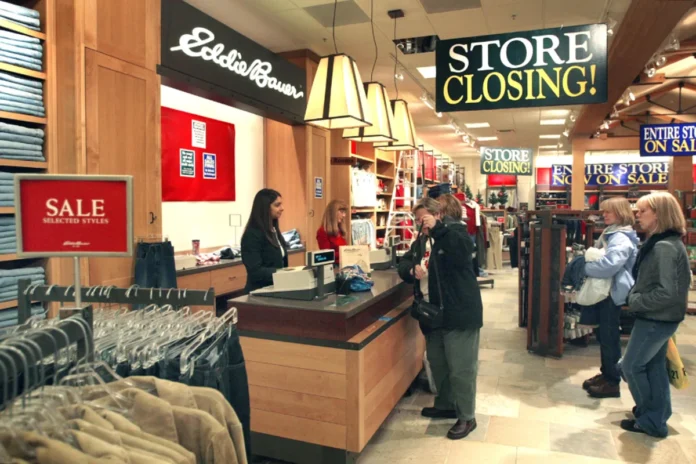

A major shift is unfolding across the North American retail landscape as Eddie Bauer LLC moves toward closing nearly all of its brick-and-mortar stores in the United States, triggering the availability of 174 retail leases across the U.S. and Canada—including five locations in New Jersey.
The iconic outdoor apparel brand, long recognized for its quilted down jackets and rugged lifestyle clothing, is dramatically restructuring its physical retail presence after canceling a planned bankruptcy auction that was expected to determine the future of its store network.
With no buyers stepping forward to acquire the retail operation, the company’s extensive footprint of mall and outlet stores is now being marketed individually to potential tenants, creating new opportunities for retailers seeking space in some of the most heavily trafficked shopping destinations in New Jersey.
For the Garden State’s retail sector, the development represents both a major brand exit and a potential reshaping of premium retail space across several of the state’s most prominent shopping centers.
Eddie Bauer LLC officially sought Chapter 11 bankruptcy protection earlier this year in a filing that revealed approximately $1.7 billion in debt tied to its retail operations. The company initially hoped to secure a buyer who would take control of the majority of its physical stores while continuing operations under new ownership.
A bankruptcy auction had been scheduled for early March, but the process came to an abrupt halt when the company announced that no qualifying bids had been received before the deadline.
Without a buyer for the retail division, the company is now proceeding with the liquidation of its physical store network.
Importantly, the bankruptcy case applies only to the retail store operator—Eddie Bauer LLC—and does not affect the broader Eddie Bauer brand’s online sales platform, wholesale distribution channels, or apparel manufacturing operations.
Those segments of the business continue to operate independently.
The result is a retail restructuring that mirrors broader changes across the apparel industry, where e-commerce growth and evolving consumer shopping habits have increasingly challenged traditional brick-and-mortar retail.
Across North America, the retailer’s real estate portfolio is now being actively marketed to prospective tenants through commercial brokerage firm RCS Real Estate Advisors.
The portfolio includes 174 store leases spread across 40 U.S. states and six Canadian provinces.
Many of the spaces range between approximately 2,500 and 15,000 square feet and are located within established shopping malls, lifestyle centers, and premium outlet destinations.
For retailers seeking ready-to-operate storefronts in high-traffic locations, these “second-generation” retail spaces present attractive opportunities because they already include infrastructure suited for apparel retail.
Within New Jersey, five prominent shopping destinations are affected by the closure of Eddie Bauer stores.
These locations represent some of the most visited retail centers in the state and serve regional shopping markets that attract customers from across the Northeast.
The New Jersey Eddie Bauer store leases now available include:
| Store Name | City | Sq. Footage | Lease Exp Date | Total Rent | Total Rent PSF |
| Gloucester Premium Outlets | Blackwood | 5,000 | 3/31 | $209,754 | $41.95 |
| American Dream | East Rutherford | 3,677 | 1/31/2031 | $40,000 | $10.88 |
| Garden State Plaza | Paramus | 4,119 | 7/31/2026 | $623,570 | $151.39 |
| Rockaway Townsquare | Rockaway | 5,305 | 7/31/2027 | $280,375 | $52.85 |
| Jersey Shore Premium Outlets | Tinton Falls | 6,508 | 7/31/2028 | $542,004 | $83.28 |
Gloucester Premium Outlets in Blackwood, a 5,000-square-foot retail space with a lease expiration date of March 31 and total annual rent of approximately $209,754, or about $41.95 per square foot.
American Dream in East Rutherford, a 3,677-square-foot location with a lease running through January 2031 and annual rent estimated at $40,000, or approximately $10.88 per square foot.
Garden State Plaza in Paramus, a 4,119-square-foot store with a lease expiration of July 2026 and annual rent of approximately $623,570, representing one of the highest-value retail spaces in the state at roughly $151.39 per square foot.
Rockaway Townsquare in Rockaway, a 5,305-square-foot location with a lease expiring July 2027 and annual rent of approximately $280,375, or about $52.85 per square foot.
Jersey Shore Premium Outlets in Tinton Falls, a 6,508-square-foot space with a lease through July 2028 and annual rent estimated at $542,004, equating to about $83.28 per square foot.
Each of these locations sits within major commercial hubs that draw steady consumer traffic from across New Jersey and neighboring states.
Retail analysts say the availability of these leases could trigger significant competition among brands seeking to expand their presence in the region’s high-profile shopping centers.
For shopping mall operators and property managers, the closure of Eddie Bauer stores creates both challenges and opportunities.
On one hand, losing a nationally recognized brand leaves temporary vacancies within established retail environments.
On the other hand, the availability of fully built retail spaces in prime locations often attracts new tenants eager to capitalize on existing customer traffic.
Retailers ranging from athletic apparel companies to lifestyle brands, specialty fashion labels, and experiential retailers may view these spaces as valuable entry points into high-performing shopping destinations.
The situation also reflects broader structural changes reshaping the American retail industry.
In recent years, the traditional mall model has faced increasing pressure from online shopping, shifting consumer preferences, and economic volatility.
Even well-known brands with decades of brand recognition have struggled to maintain large brick-and-mortar footprints in the face of rising operating costs and changing shopping habits.
Eddie Bauer’s journey illustrates those challenges.
Founded in Seattle and known for its heritage in outdoor clothing and adventure-inspired apparel, the brand has experienced multiple ownership transitions and financial restructurings over the past two decades.
The company previously filed for Chapter 11 bankruptcy protection in 2009 during the global financial crisis. After that restructuring, the brand was acquired by Golden Gate Capital.
In 2021, Eddie Bauer became part of the Authentic Brands portfolio, which specializes in acquiring and licensing heritage retail brands.
More recently, the company was purchased by Catalyst Brands in 2025 as part of a broader consolidation within the apparel and retail sector.
Despite the brand’s enduring recognition among outdoor enthusiasts and casual apparel consumers, the retail store operator continued to face mounting challenges.
Industry analysts cite a combination of factors contributing to the current bankruptcy proceedings.
Supply chain disruptions following the COVID-19 pandemic significantly affected inventory management across the retail industry.
Inflationary pressures raised operational costs for retailers while simultaneously reducing discretionary consumer spending on apparel.
Outdoor apparel brands in particular experienced fluctuating demand patterns as pandemic-era shifts in lifestyle and travel gradually normalized.
Together, those forces created financial pressures that ultimately led to the closure of Eddie Bauer’s retail store network.
The restructuring now underway highlights how many traditional retailers are pivoting toward digital-first business models.
E-commerce platforms allow brands to reach customers nationwide without the overhead associated with operating large numbers of physical stores.
At the same time, wholesale distribution partnerships with department stores and third-party retailers can extend brand reach without requiring standalone locations.
For customers who still hold Eddie Bauer gift cards, there is an additional development to be aware of.
Unused gift cards issued by the retail store operator must be redeemed soon, as the company has indicated they will no longer be honored after March 12.
Consumers who still have outstanding balances are encouraged to use them before the deadline while store-closing sales remain underway.
Across New Jersey, shoppers visiting malls and outlet centers in Paramus, East Rutherford, Rockaway, Blackwood, and Tinton Falls may already be seeing signs of liquidation sales as the retailer winds down its physical presence.
These store-closing sales often attract significant customer interest as merchandise is discounted ahead of final closures.
Yet beyond the immediate consumer impact, the bigger story lies in what happens next.
The retail spaces left behind by Eddie Bauer may soon be filled by a new generation of brands and retail concepts eager to establish themselves within New Jersey’s competitive commercial landscape.
The Garden State remains one of the most important retail markets in the United States due to its dense population, strong consumer spending, and proximity to New York City and Philadelphia.
Major shopping destinations like Garden State Plaza, American Dream, and the state’s premium outlet centers continue to attract both national brands and international retailers seeking visibility in a high-traffic environment.
As Eddie Bauer’s leases enter the market, industry observers expect leasing activity to accelerate as property owners work to fill prime retail spaces with new tenants.
For shoppers, the coming months could bring noticeable changes to the mix of brands inside some of New Jersey’s most prominent malls.
For the retail industry, the story of Eddie Bauer’s store closures serves as another powerful reminder of how quickly the sector continues to evolve.
Legacy brands that once dominated mall corridors are increasingly shifting toward digital platforms, while shopping centers themselves are adapting to new consumer expectations by introducing entertainment venues, restaurants, experiential retail, and mixed-use development.
The reshaping of Eddie Bauer’s physical retail presence is therefore more than just a store closure story—it is part of a broader transformation taking place across North American retail.
In New Jersey, where retail has long been a cornerstone of the state’s commercial economy, the next chapter for these newly available storefronts will be closely watched by both industry leaders and consumers alike.



