

Russell Crowe Turns Nightclub Owner Into Cartel Target in Derrick Borte’s Neon-Lit Crime Comedy
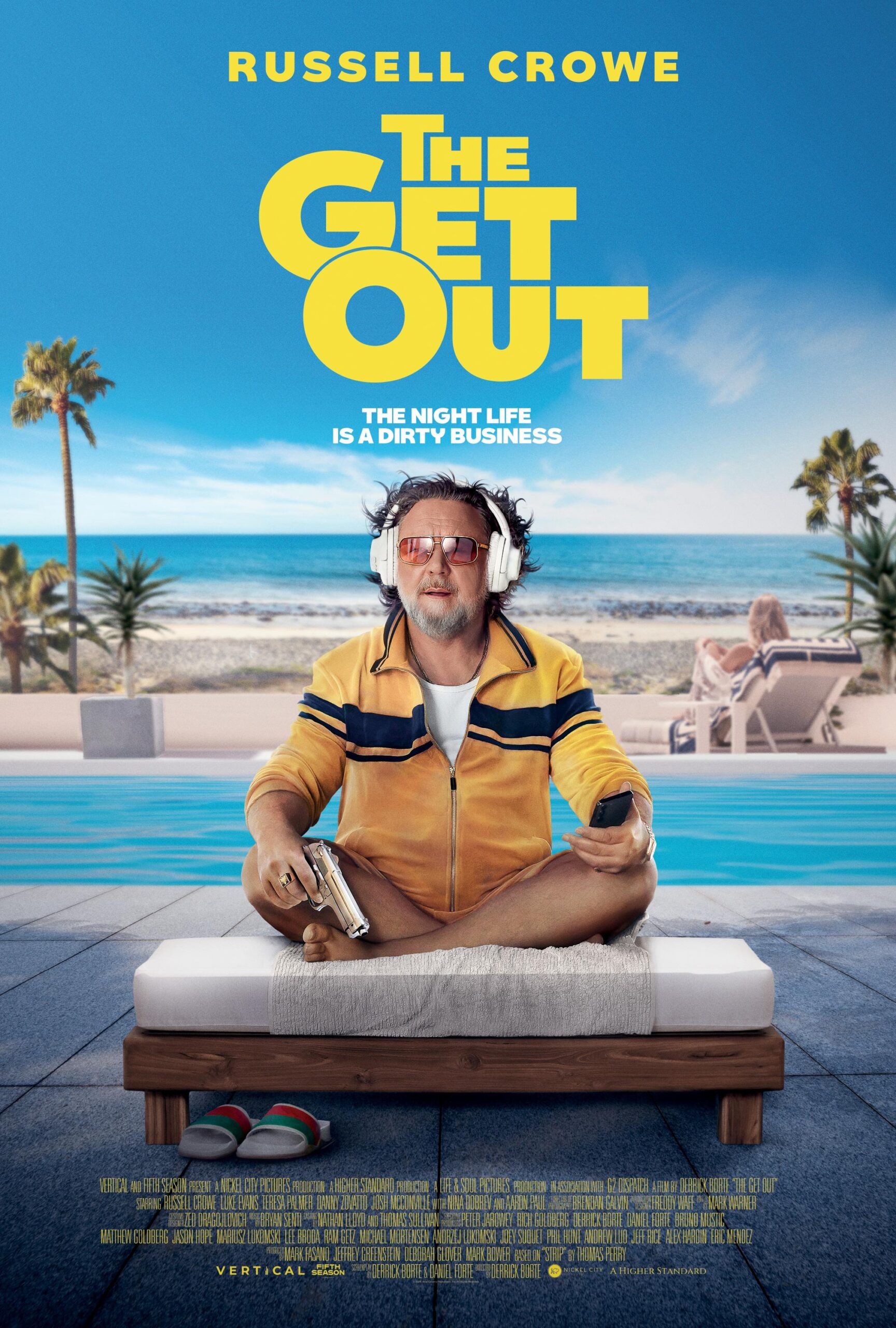
Russell Crowe has spent the back half of his career quietly building one of the most entertaining second acts in modern movie stardom, trading the weighty prestige dramas that once defined him for a string of gleefully unpredictable genre swings, and his latest, The Get Out, slots comfortably into that run. Released in select theaters on June 26, 2026 before moving to digital and video-on-demand platforms just four days later, the film reunites Crowe with director Derrick Borte for a neon-soaked Los Angeles crime story that trades the white-knuckle road rage of their previous collaboration for something looser, funnier, and considerably more chaotic. The result is a film built almost entirely around Crowe’s easy charisma, one that critics have described as a mixed bag on the whole but a showcase for an actor clearly enjoying himself in a genre he has quietly mastered over the past few years.
A Retirement Plan That Refuses to Cooperate
The Get Out centers on Manco Kapac, played by Crowe as an aging Albanian immigrant who arrived in Los Angeles decades earlier and built himself into the kind of only-in-America success story that looks flawless from the outside. He owns one of the city’s most sought-after nightclubs, lives comfortably, and has a devoted younger girlfriend named Sammy, played by Teresa Palmer. The wrinkle, as these stories tend to have one, is that his club doubles as a laundering operation for a ruthless cartel, a secret life that has quietly worn him down for years. After a health scare forces him to confront his own mortality, Manco decides the time has finally come to walk away from both the club and the criminal entanglements attached to it, cash out, and disappear into a quieter, safer chapter of life with the woman he loves.
Naturally, none of it goes according to plan. On a routine night making one of his usual cash runs, Manco is robbed at gunpoint by a masked amateur, a moment that sets off a chain reaction he cannot control. The cartel, unnerved by the disruption to their money and suspicious that Manco himself might be responsible, begins tightening the screws on him just as he is trying to extricate himself entirely. Compounding the pressure, an eccentric and slightly too-charming businessman named Joe Carver, played by Luke Evans, surfaces out of nowhere with a tempting offer to buy the club outright, arriving at precisely the moment Manco can least afford any more uncertainty in his life. As it turns out, the masked thief responsible for kicking off the entire mess is not some hardened professional but a small-time, in-over-his-head opportunist played by Aaron Paul, working alongside an equally underprepared accomplice played by Nina Dobrev. What follows is a tangle of overlapping schemes, mounting suspicion, and rising body counts as multiple factions with competing interests all converge on Manco at once, forcing him to talk, negotiate, and occasionally fight his way through a Los Angeles underworld that no longer has any patience left for his retirement plans.
Familiar Genre DNA With a European Update
The source material traces back to Thomas Perry’s 2010 crime novel Strip, and the finished film wears its genre lineage openly, evoking the loose, character-driven crime comedies that filmmakers like Elmore Leonard’s adaptations and Shane Black’s ensemble capers made popular in decades past. Borte and co-writer Daniel Forte lean into that tradition rather than away from it, building a story that thrives less on tight plotting than on the collision of colorful, morally compromised personalities all scrambling for the same pile of money. It is the kind of setup that lives or dies almost entirely on its cast’s chemistry, and the film leans heavily on Crowe’s ability to anchor a story that keeps threatening to spin off into several different directions at once.
What sets Manco apart from the typical world-weary crime boss archetype is a surprising thread of decency running through the character. Rather than meeting every threat with escalating violence, Manco is written as someone who reaches for his gun reluctantly, tries to de-escalate confrontations where he can, and treats even his own employees’ mistakes with more patience than the genre typically allows. It is an unusual choice for a story built around cartel pressure and armed robbery, and it gives Crowe’s performance a warmth that stands out amid the film’s darker, more comedic instincts.
Crowe Leans Into His Late-Career Comedic Streak
If there is a consistent throughline in how critics have responded to The Get Out, it is genuine enthusiasm for what Crowe is doing with the role. Building on the comedic instincts he first showcased opposite Ryan Gosling and has continued refining in a series of gonzo genre performances over recent years, Crowe plays Manco with a distinct, deliberately theatrical accent and a loose, self-amused energy that several reviewers singled out as the film’s most reliable pleasure. He is not chasing awards-season gravitas here; he is clearly having fun, and that enjoyment reads clearly on screen even when the surrounding material grows uneven.
The supporting cast brings its own texture to the chaos. Paul and Dobrev, playing the two amateur thieves whose bungled robbery sets the entire plot in motion, share a lived-in rapport that multiple critics noted as some of the film’s strongest material, even suggesting the pair had enough spark between them to headline a spinoff of their own. Evans, meanwhile, gets to indulge in some of the film’s most memorably eccentric touches as the mysterious would-be buyer, conducting business in unconventional settings and throwing himself into the character’s more theatrical flourishes with evident relish. Palmer rounds out the core ensemble as Manco’s girlfriend, providing a grounded emotional anchor amid the surrounding mayhem, while Daniel Zovatto brings a coiled menace to the cartel figure applying pressure from the shadows.
Shot on the Gold Coast, Set in the Heart of Los Angeles
Despite unfolding entirely within the geography of Los Angeles, from its Koreatown-adjacent nightlife scene to the tense back-alley confrontations that punctuate the back half of the story, The Get Out was actually filmed on Australia’s Gold Coast, a now-common production choice that speaks to the economics of contemporary studio filmmaking as much as anything else. The production team worked to recreate the specific texture of Los Angeles nightlife convincingly, and the finished film largely succeeds in selling its setting despite the geographic sleight of hand behind the camera.
This marks the second collaboration between Crowe and Borte, following their 2020 road-rage thriller that became a surprise hit during an unusual moment for theatrical releases. Where that earlier film built its tension through relentless, almost single-minded pursuit, The Get Out asks Borte to juggle a much wider ensemble and a considerably lighter tone, alternating between genuine crime-thriller stakes and broader comedic beats. Critics have been split on how successfully that tonal balancing act comes together, with some praising the film’s game cast and unexpectedly good-natured worldview, and others feeling the shifts between dark comedy and straight crime drama never fully resolve into a consistent identity. What nearly everyone agrees on, however, is that Crowe’s committed, clearly enjoyable performance provides more than enough reason to watch, particularly for audiences who have come to appreciate the actor’s willingness to poke fun at his own dramatic reputation in recent years.
Where the Film Lands in Crowe’s Ongoing Genre Renaissance
Taken as a whole, The Get Out fits neatly into the increasingly interesting late-career pattern Crowe has carved out for himself, one built on a genuine willingness to chase weird, high-concept genre material rather than coast on his earlier prestige-drama reputation. Whether audiences discover it in its brief theatrical window or, more likely, stumble onto it while scrolling through VOD offerings looking for something to fill an evening, the film offers exactly the kind of breezy, star-driven entertainment that has become something of a specialty for Crowe in this stage of his career. It may not be destined for major awards conversations, and even its most sympathetic reviews describe it as more reliably entertaining than truly memorable, but as a showcase for an actor who continues finding new, unexpected registers to play in, The Get Out delivers exactly what it promises: a loose, colorful, occasionally messy crime caper elevated by a star clearly enjoying every accented, over-the-top minute of it.