


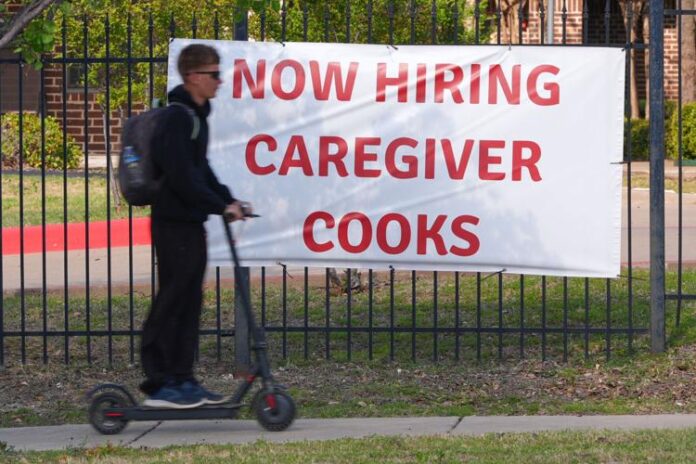

New Jersey’s small business economy is entering a more complex phase of the labor cycle, as the latest March data from the National Federation of Independent Business (NFIB) shows a measurable decline in the Small Business Employment Index alongside persistent challenges in hiring, workforce quality, and compensation strategy. While the headline figure—a 1.9-point drop to 101.6—suggests modest softening, the underlying data reveals a labor market that remains structurally tight, uneven, and difficult for employers to navigate.
The index, despite its decline, continues to sit above both its 2025 average and its long-term historical benchmark, indicating that small business employment activity is not contracting in a traditional sense. Instead, what is emerging is a recalibration period, where demand for labor remains elevated but the mechanisms required to meet that demand—qualified applicants, cost control, and policy alignment—are increasingly strained.
At the center of this dynamic is a persistent gap between open positions and available talent. In March, 32 percent of small business owners reported job openings they could not fill, a slight improvement from February but still significantly above the historical average of 24 percent. This gap is not simply a function of volume; it reflects a deeper issue tied to workforce readiness and skill alignment. Twenty-seven percent of businesses reported openings for skilled workers, while demand for unskilled labor edged upward, illustrating a labor market that is tight across multiple tiers rather than concentrated in a single segment.
For New Jersey businesses, this challenge is particularly acute. The state’s economy, characterized by a dense mix of service industries, healthcare, logistics, and professional services, requires a workforce that can operate across a wide spectrum of skill levels. When employers are unable to find candidates who meet those requirements, the impact is immediate—slower growth, reduced operational efficiency, and in some cases, delayed or canceled expansion plans.
Eileen Kean, the NFIB’s State Director in New Jersey, underscored this reality, noting that the difficulty is not merely about filling positions but about finding applicants with the appropriate qualifications. Her comments reflect a broader concern within the small business community: that policy decisions at the state level could exacerbate these challenges if they introduce additional costs or constraints on hiring flexibility. For many small businesses operating on narrow margins, even incremental increases in labor-related expenses can have outsized effects on hiring decisions.
The data supports this cautious outlook. While 52 percent of small business owners reported hiring or attempting to hire in March, that figure represents a decline from the previous month. More telling is the quality of the applicant pool. Among those actively hiring, 87 percent reported receiving few or no qualified applicants. Within that group, 23 percent indicated they received no qualified candidates at all, a figure that has increased, signaling that the talent pipeline is not keeping pace with employer needs.
This disconnect is further reflected in how business owners are prioritizing their challenges. Fifteen percent identified labor quality as their single most important problem, a figure that remains elevated relative to historical norms and underscores the persistence of this issue over time. Notably, this metric has not dipped below that level since 2016, indicating a long-term structural shift rather than a short-term fluctuation.
At the same time, labor costs are beginning to reassert themselves as a critical concern. Ten percent of business owners now cite compensation expenses as their primary issue, a gradual increase that suggests wage pressures are continuing to build even as hiring becomes more selective. This dual pressure—difficulty finding qualified workers and rising costs for those who are available—creates a challenging environment for small businesses attempting to balance growth with financial sustainability.
Compensation trends offer additional insight into how businesses are responding. A net 33 percent of owners reported raising wages in March, a slight decline from February but still well above historical averages. However, forward-looking indicators suggest a potential shift. Only a net 18 percent plan to increase compensation in the next three months, marking the lowest level since mid-2025. This suggests that while wage increases have been necessary to attract and retain talent, businesses may be approaching the limits of what they can sustainably offer.
Hiring plans themselves remain relatively stable, with a net 12 percent of owners expecting to create new jobs in the near term. This figure, consistent with historical averages, indicates that businesses have not lost confidence in growth but are proceeding with caution. The willingness to hire is still present; the ability to execute on that intention remains the primary constraint.
From a broader economic perspective, the current environment reflects a labor market that is neither weakening nor fully stabilizing. Instead, it is evolving into a more complex system where traditional indicators—such as job openings and wage growth—must be interpreted alongside qualitative factors like skill alignment and workforce participation. For New Jersey, this complexity is amplified by the state’s cost structure and regulatory environment, both of which influence how small businesses make hiring and investment decisions.
Coverage across the Business section of Sunset Daily News continues to track these shifts, highlighting how small businesses are adapting to changing conditions while navigating a landscape that demands both resilience and strategic flexibility. The March Jobs Report adds another layer to that narrative, illustrating that while the labor market remains active, it is increasingly defined by friction rather than fluidity.
For small business owners, the path forward will likely involve a combination of targeted hiring strategies, investment in training and development, and careful management of compensation structures. For policymakers, the data presents a clear signal that workforce development and regulatory balance will be critical in shaping the next phase of economic growth.
What emerges from the March report is not a story of decline, but one of constraint. New Jersey’s small businesses are still hiring, still investing, and still planning for the future. However, they are doing so in an environment where the margin for error is narrowing, and where the ability to align workforce capabilities with business needs has become one of the most defining challenges of the current economic cycle.



