


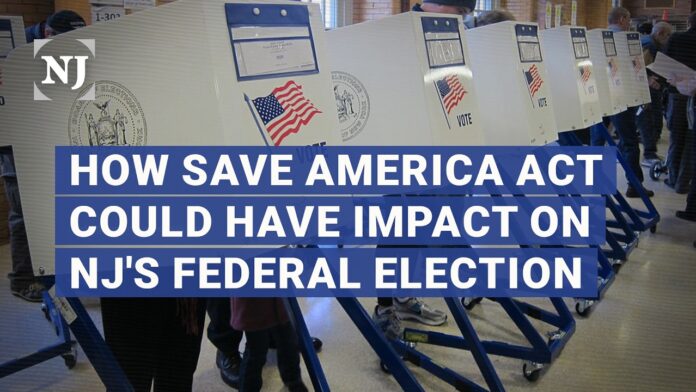

A new wave of headlines and online discussion has pushed the SAVE America Act into the spotlight, raising urgent questions across New Jersey about voter registration, driver’s licenses, and the future of election access. At the center of the conversation is a simple but critical issue: would a standard New Jersey driver’s license still be enough to register to vote if this federal proposal becomes law?
The answer, based on the current language of the bill, is clear—and it has significant implications. As written, most standard New Jersey driver’s licenses would not meet the requirements to serve as proof of citizenship for voter registration in federal elections.
To understand why, it is essential to separate what is happening now from what could happen if the proposal advances.
The SAVE America Act introduces a federal requirement that would fundamentally change how voter registration is verified. Instead of relying on attestation—where individuals affirm their citizenship status under penalty of law—the proposal would require documentary proof of U.S. citizenship at the point of registration. That means providing physical documentation such as a passport, birth certificate, or naturalization certificate.
This is where the conflict with New Jersey law emerges.
New Jersey has expanded access to driver’s licenses in recent years, allowing individuals without U.S. citizenship, including those with legal status such as green card holders, to obtain standard licenses. These licenses are valid for driving and identification purposes, but they do not indicate citizenship status on the card itself. There is no visual or encoded marker that distinguishes a citizen from a non-citizen.
Under the framework of the SAVE America Act, that distinction becomes critical. The proposal allows driver’s licenses to be used for voter registration only if the issuing state requires proof of citizenship to obtain the license and explicitly indicates that status on the credential. New Jersey does neither. As a result, a standard New Jersey license—while widely used today for registration—would not qualify under the proposed federal standard.
The practical impact of this shift would be immediate for new voter registrations. The familiar process of registering through the Motor Vehicle Commission, including the widely used “check-the-box” system, would effectively be eliminated for federal elections. Instead, individuals would need to present qualifying citizenship documents in person, introducing a new layer of documentation and logistical complexity.
For existing voters, the situation is less certain but no less important. Legal experts continue to debate how far the law would reach if enacted. One of the most closely watched questions is whether states would be required to re-verify the citizenship status of individuals who previously registered using a driver’s license. While no definitive enforcement mechanism has been finalized, the possibility of large-scale verification efforts has become a central concern in policy discussions.
At the same time, it is critical to emphasize the current reality for New Jersey voters. The SAVE America Act is not law. While it passed the U.S. House of Representatives in 2024, it has not been approved by the Senate and faces substantial opposition at the federal level. Until and unless it is enacted, New Jersey’s existing voter registration system remains fully in place.
That means residents can continue to register using their driver’s license number or Social Security number, consistent with longstanding federal guidelines under the National Voter Registration Act. For those already registered, there is no change to eligibility or status.
This continuity is especially important for New Jersey’s vote-by-mail system, which has become a cornerstone of the state’s election infrastructure. The “no-excuse” vote-by-mail program remains active and unchanged heading into the 2026 election cycle. Voters who have opted into permanent mail-in status will continue to receive ballots automatically, with no additional documentation required under current law.
Looking ahead to the 2026 election calendar, key dates are already in motion. Ballots for the primary election begin mailing in mid-April, with the primary itself scheduled for early June. The general election follows in November, maintaining the same structure and access points that voters have come to rely on.
However, the SAVE America Act introduces a series of potential changes that would reshape this process if it were to become law. Among the most significant is the requirement for additional documentation with mail-in ballots, including the possibility of submitting photocopies of citizenship documents. This would represent a substantial shift from the current system, where identity verification is handled through established procedures without the need for such materials.
Another major change would involve the registration process itself. Online and mail-based registration methods could be replaced by in-person requirements, effectively centralizing the process and introducing new barriers related to time, travel, and documentation access. For a state like New Jersey, where convenience and accessibility have been central to voter engagement strategies, this would mark a significant departure from current practice.
The broader implications extend beyond logistics into questions of policy direction and governance. The debate surrounding the SAVE America Act reflects a larger national conversation about election security, voter access, and the balance between verification and participation. New Jersey’s position within that conversation is shaped by its existing policies, which prioritize accessibility while maintaining compliance with federal standards.
For residents trying to navigate the current environment, the most important takeaway is clarity. Nothing has changed today. Registration procedures remain intact, mail-in voting continues without interruption, and existing voters retain their status without additional requirements.
What has changed is the level of attention being paid to what could happen next.
As discussions continue at the federal level, New Jersey’s voters, policymakers, and election officials are watching closely. The outcome will determine whether the state’s current system remains in place or undergoes a transformation that redefines how residents register and participate in federal elections.
For ongoing coverage of policy developments, legislative updates, and how national decisions intersect with local impact, follow the latest reporting through Sunset Daily’s politics section, where the evolving story continues to take shape.
In a moment where information is moving quickly and interpretations vary widely, understanding the distinction between current law and proposed change is essential. The SAVE America Act represents a potential shift with real consequences, but for now, New Jersey voters can proceed with confidence in the system that is currently in place.