


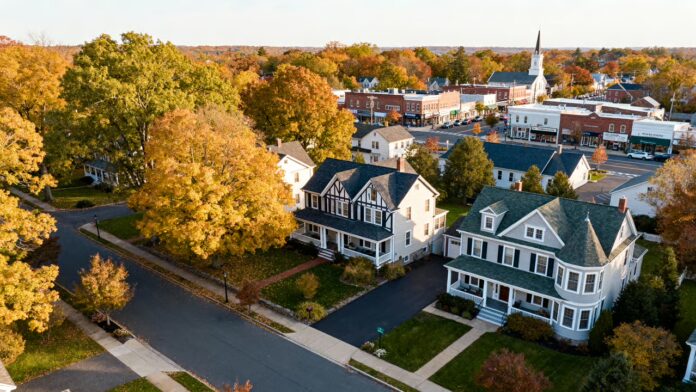

In a national housing market defined by cooling momentum and uneven regional performance, New Jersey has emerged as the clear outlier—and the new benchmark. According to newly compiled housing analytics, the Garden State recorded the strongest year-over-year home price growth in the United States in February 2026, posting a 5.93% increase that places it firmly at the top of the national rankings. At a time when many markets are flattening or contracting, New Jersey is not only holding its ground—it is accelerating.
This surge is not occurring in isolation. It reflects a deeper structural strength within the state’s economy, its geographic positioning, and its evolving role within the broader Northeast corridor. While the national housing market registered a modest 0.5% year-over-year increase in single-family home prices, New Jersey’s nearly 6% jump signals a level of demand and resilience that is increasingly rare in the current cycle.
Perhaps even more telling is what is happening at the metro level. Newark, long viewed as a market with untapped upside, has now taken center stage, recording a 6.7% year-over-year home price increase—the highest among the 100 largest metropolitan areas in the country. This is not a marginal gain; it is a defining shift that underscores Newark’s transformation into one of the most dynamic urban real estate markets in the United States.
The implications of this data extend far beyond headline numbers. New Jersey’s performance is being driven by a convergence of high-value employment sectors, strategic proximity to major economic hubs, and a sustained imbalance between housing supply and demand. The state sits at the intersection of some of the most influential economic engines in the country, including New York City and Philadelphia, while simultaneously offering relative affordability compared to those core markets. This positioning continues to attract both individuals and institutional investment, reinforcing upward pressure on home values.
The sectors fueling this growth are equally important to understand. Financial services and fintech—industries that have deep roots in both New York and New Jersey—continue to generate high-income employment opportunities that support homebuying activity at elevated price points. At the same time, the broader Northeast region is benefiting from expansion in biotech, healthcare, and advanced research, particularly across neighboring states. This interconnected economic ecosystem is creating a stable foundation for housing demand, insulating markets like New Jersey from the volatility seen elsewhere.
When viewed through the lens of national trends, the contrast becomes even more pronounced. Several high-profile markets are now experiencing year-over-year price declines, including Washington, D.C., Florida, and Montana. In total, 13 states reported negative annual price changes, highlighting a clear divergence between regions that are expanding and those that are recalibrating after years of rapid growth. New Jersey’s ability to move in the opposite direction speaks to the durability of its demand drivers and the strategic advantages embedded within its housing market.
The Midwest and Northeast, in particular, are emerging as zones of relative stability, supported by a mix of affordability and diversified economic activity. In the Midwest, a resurgence in domestic manufacturing—driven in part by federal investment initiatives and supply chain realignment—is helping to stabilize housing markets. Meanwhile, the Northeast’s strength lies in its concentration of high-wage industries and its continued appeal to professionals seeking access to major metropolitan centers without absorbing their full cost burden.
New Jersey stands at the intersection of these dynamics, benefiting from both economic diversification and geographic leverage. Its housing market is not being propelled by speculative activity or short-term trends; rather, it is anchored by long-term fundamentals that continue to attract sustained demand. This is a critical distinction in an environment where many markets are grappling with affordability constraints, rising interest rates, and shifting migration patterns.
For buyers, the current landscape presents both opportunity and urgency. While price growth signals a strong and desirable market, it also raises questions about accessibility and long-term affordability. For sellers and investors, however, the environment remains highly favorable, with continued appreciation reinforcing confidence in New Jersey real estate as a stable and potentially lucrative asset class.
From a broader industry perspective, the state’s performance aligns closely with the trends shaping the real estate sector, where regional differentiation is becoming more pronounced and localized economic strength is playing an increasingly decisive role in determining market outcomes. The era of uniform national growth has given way to a more fragmented landscape, where states like New Jersey are setting the pace while others recalibrate.
Newark’s emergence as the top-performing metro area further amplifies this narrative. Once overlooked in favor of neighboring markets, the city is now attracting renewed attention from developers, investors, and homebuyers alike. Its combination of infrastructure, connectivity, and ongoing redevelopment initiatives is transforming it into a focal point for growth within the state. As demand continues to intensify, Newark is positioned not only as a leader within New Jersey but as a national example of urban market resurgence.
Looking ahead, the key question is not whether New Jersey can maintain its current trajectory, but how it will manage the pressures that accompany sustained growth. Inventory constraints, affordability challenges, and the need for continued infrastructure investment will all play a role in shaping the next phase of the market. However, if current trends are any indication, the state is well-positioned to navigate these challenges while maintaining its competitive edge.
What is clear is that New Jersey has firmly established itself as a leader in the national housing conversation. In a market defined by uncertainty and uneven performance, it is delivering clarity—demonstrating that strong fundamentals, strategic positioning, and economic diversity can still drive meaningful growth. As 2026 unfolds, all eyes will remain on the Garden State, not as a follower of national trends, but as a market actively redefining them.



