


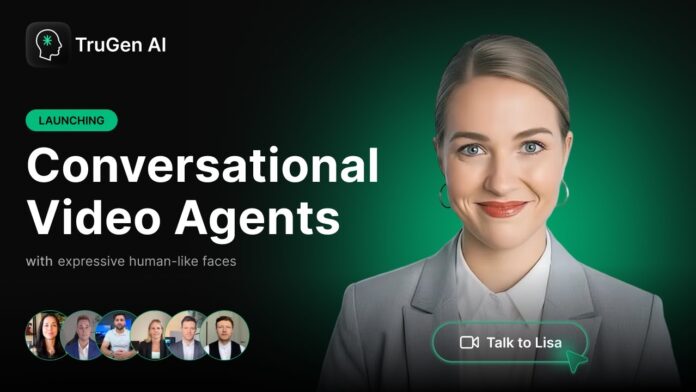

A new chapter in enterprise technology is unfolding as TruGen AI unveils a platform designed to fundamentally reshape how organizations operate, collaborate, and scale. Positioned far beyond traditional automation tools, TruGen’s newly launched AI teammates represent a shift toward fully integrated digital collaborators—systems built with face, voice, vision, and persistent memory that function not as tools, but as embedded contributors inside the enterprise ecosystem.
This is not incremental innovation. It is a structural change in how work itself is defined.
Across industries already grappling with fragmented workflows, siloed data, and rising operational complexity, TruGen AI’s platform introduces a unified approach: intelligent agents that retain institutional knowledge, understand context across time, and participate in business processes with a level of continuity previously reserved for human teams.
From Tools to Teammates: The Evolution of Enterprise AI
For years, enterprise AI has lived in a constrained role—task-based automation, predictive analytics, and isolated chat interfaces that deliver outputs but lack continuity. TruGen AI is pushing beyond that model by introducing systems designed to persist, evolve, and collaborate.
These AI teammates are built to operate with multimodal intelligence. They can see through integrated vision systems, communicate through natural voice interaction, and present a visual identity that enhances human connection in digital environments. More critically, they maintain persistent memory, allowing them to track projects, recall prior interactions, and build context over time.
This shift transforms AI from a reactive tool into a proactive participant.
Inside an organization, that means an AI teammate can onboard alongside human employees, absorb workflows, understand operational nuance, and remain embedded in processes long after initial deployment. Instead of resetting with every query, these systems accumulate knowledge—effectively becoming a living layer of organizational memory.
Persistent Memory as a Strategic Advantage
One of the most consequential aspects of TruGen AI’s platform is its emphasis on long-term memory architecture. In enterprise environments, knowledge fragmentation is one of the most expensive inefficiencies—critical information lives in emails, meetings, documents, and individual expertise that is often lost through turnover or time.
TruGen’s AI teammates are designed to address this directly.
By maintaining persistent memory across interactions, projects, and departments, these systems create a continuous knowledge loop. They can recall decisions made weeks or months earlier, track evolving project requirements, and ensure that institutional knowledge is not only preserved but actively utilized.
This introduces a new operational paradigm where organizations no longer rely solely on human recall or scattered documentation systems. Instead, knowledge becomes dynamic, accessible, and embedded within the workflow itself.
Human-Like Collaboration Without Human Limitations
The defining promise of AI teammates is not just intelligence—it is collaboration.
TruGen AI’s platform is engineered to simulate the dynamics of human teamwork while eliminating many of the constraints that slow organizations down. These systems can participate in meetings, contribute insights in real time, manage workflows, and coordinate across departments without the friction of scheduling, bandwidth limitations, or communication delays.
Voice interaction enables natural dialogue, while visual presence adds a layer of engagement that traditional text-based systems lack. Vision capabilities allow these AI teammates to interpret visual data—documents, dashboards, and even live operational feeds—bringing a level of situational awareness that aligns more closely with how humans process information.
The result is a collaborative model where AI is not an endpoint but an active participant in decision-making processes.
Deep Workflow Integration Across the Enterprise Stack
One of the longstanding challenges in enterprise technology is integration. Organizations operate across a patchwork of platforms—CRM systems, project management tools, communication channels, and data repositories—each with its own structure and limitations.
TruGen AI’s approach centers on deep workflow integration.
Rather than sitting on top of existing systems as a separate interface, AI teammates are designed to embed directly into operational pipelines. They can interact with multiple systems simultaneously, orchestrating workflows that span departments and functions.
For example, an AI teammate can coordinate between sales, marketing, and operations—tracking leads, updating campaign performance, and aligning fulfillment processes without requiring manual intervention at each step. This reduces friction, accelerates execution, and creates a more cohesive operational environment.
In practical terms, organizations gain a layer of intelligence that connects their entire technology stack into a unified system of action.
Organizational Memory Becomes Infrastructure
What TruGen AI is introducing is not just a product—it is an infrastructure layer.
In modern enterprises, data is abundant but often underutilized due to fragmentation and lack of context. By embedding memory directly into AI teammates, TruGen is effectively turning organizational knowledge into a continuously evolving asset.
This has far-reaching implications.
Decision-making becomes more informed as historical context is always available. Onboarding accelerates because new employees can interact with AI teammates that already understand the organization’s processes. Continuity improves because knowledge persists beyond individual roles or teams.
In essence, organizations gain a form of institutional intelligence that compounds over time.
The Technology Context: Where TruGen Fits in a Rapidly Advancing AI Landscape
The launch of TruGen AI’s enterprise teammates arrives at a moment when the technology sector is rapidly redefining the boundaries of artificial intelligence. Across the industry, the focus has shifted from isolated AI capabilities to integrated systems that can operate within complex environments.
The broader trend—reflected across the evolving landscape covered in the technology & tech section—is clear: enterprises are no longer asking what AI can do in isolation, but how it can be embedded into the core of their operations.
TruGen’s approach aligns with this trajectory while pushing it further.
By combining multimodal interaction, persistent memory, and deep workflow integration, the company is positioning its platform as a foundational layer rather than an optional toolset. This places it in direct alignment with the next generation of enterprise systems—those designed to operate continuously, learn over time, and scale alongside organizational growth.
Redefining Scale in the Age of AI
Scale has traditionally been tied to headcount, infrastructure, and capital. TruGen AI introduces a different model—one where scale is driven by intelligent systems capable of expanding operational capacity without proportional increases in human resources.
AI teammates can operate continuously, handle parallel workflows, and adapt to changing conditions in real time. This allows organizations to extend their capabilities without the traditional constraints of workforce expansion.
For high-growth companies, this represents a significant advantage. For established enterprises, it offers a pathway to modernization without the disruption of large-scale restructuring.
Implications for New Jersey’s Innovation and Business Ecosystem
For New Jersey’s diverse business landscape—spanning finance, healthcare, logistics, media, and technology—the introduction of enterprise AI teammates presents both opportunity and competitive pressure.
Organizations across the state are already navigating digital transformation initiatives, seeking ways to streamline operations and remain competitive in a rapidly evolving market. TruGen AI’s platform provides a blueprint for how those transformations can move beyond incremental improvements into structural change.
Companies that adopt this model early position themselves to operate with greater efficiency, stronger knowledge retention, and more agile decision-making frameworks. Those that delay may find themselves competing against organizations that are effectively augmented by continuous, intelligent systems.
A New Standard for Enterprise Collaboration
What ultimately defines TruGen AI’s launch is not just the technology itself, but the shift in expectations it creates.
Enterprise systems are no longer judged solely by their ability to process data or automate tasks. The emerging standard is collaboration—how effectively technology can integrate with human teams, contribute to workflows, and enhance organizational intelligence.
AI teammates represent the next step in that evolution.
They are designed to work alongside humans, not replace them—augmenting capabilities, preserving knowledge, and enabling a level of operational continuity that has historically been difficult to achieve.
The Transition From Adoption to Dependence
As organizations begin to integrate AI teammates into their operations, the relationship between humans and technology will continue to evolve.
What starts as adoption—testing capabilities, integrating workflows, exploring efficiencies—quickly transitions into dependence as these systems become embedded in daily operations. The more they learn, the more valuable they become. The more they integrate, the harder they are to replace.
This creates a feedback loop where AI is not just supporting the organization but becoming a core component of how it functions.
The Road Ahead for Enterprise AI
The introduction of TruGen AI’s platform signals a broader transformation already underway across the enterprise landscape. As AI systems become more capable, more integrated, and more persistent, the line between human and digital collaboration continues to blur.
Organizations are entering a phase where intelligence is no longer confined to individuals or teams—it is distributed, continuous, and embedded within the infrastructure itself.
TruGen AI’s enterprise teammates are an early expression of that future, offering a glimpse into a world where organizations operate with a level of cohesion, memory, and scalability that was previously unattainable.
For businesses across New Jersey and beyond, the message is clear: the next era of work is not just automated—it is collaborative, intelligent, and always on.