



New Jersey has quietly made one of the most significant statewide cybersecurity investments in the country, committing approximately $795,000 annually to provide comprehensive, enterprise-level digital protection to public institutions across the state. The initiative, centered around a statewide membership in the Multi-State Information Sharing and Analysis Center, represents a forward-looking strategy designed to shield critical infrastructure, school systems, municipalities, and public utilities from the rapidly evolving landscape of cyber threats. Yet as of March 2026, the program is confronting a fundamental challenge that could determine its long-term effectiveness: the overwhelming majority of eligible organizations are not using it.
At a time when ransomware attacks, data breaches, and infrastructure intrusions are accelerating in both frequency and sophistication, the state has effectively prepaid access to one of the most robust cybersecurity support systems available to public sector organizations. Managed through a national nonprofit framework and aligned with federal best practices, the program delivers continuous monitoring, threat intelligence, and incident response capabilities that would otherwise be financially out of reach for many local entities. The strategic logic is clear—centralize access, remove cost barriers, and create a unified defensive posture across all levels of government.
However, the execution gap is becoming increasingly difficult to ignore. Out of 1,354 eligible organizations across New Jersey, fewer than 200 have enrolled in the program. That translates to roughly 13 percent participation, leaving the vast majority of municipalities, school districts, and public agencies outside a system specifically designed to protect them. In practical terms, the state has built a cybersecurity shield that most of its intended beneficiaries have yet to pick up.
This underutilization is not being driven by resistance, but by awareness and operational disconnects. Many eligible organizations reportedly do not realize that access has already been secured on their behalf. Others may lack the internal technical capacity to onboard new systems or may not fully understand how the services integrate with their existing infrastructure. In smaller municipalities or under-resourced school districts, where IT responsibilities are often stretched across limited personnel, even a no-cost solution can remain out of reach without targeted implementation support.
The implications of this gap are significant. Cyber threats are no longer abstract risks confined to large corporations or federal agencies. Local governments and school systems have increasingly become primary targets, often precisely because they are perceived as having weaker defenses. A successful ransomware attack on a municipality can disrupt essential services, compromise sensitive data, and impose substantial financial costs. For school districts, the stakes include not only operational disruption but also the exposure of student and staff information, creating long-term consequences that extend far beyond the initial breach.
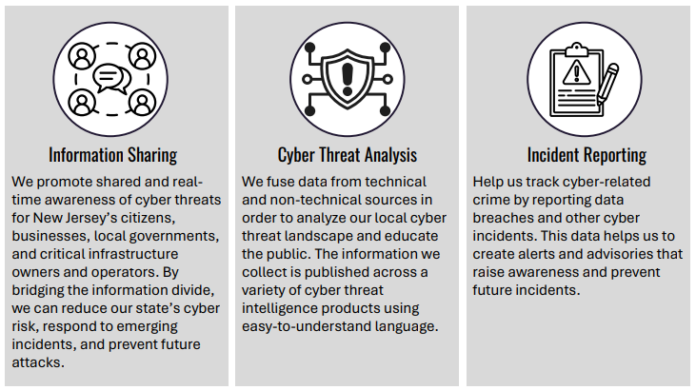
New Jersey’s approach, anchored by the New Jersey Cybersecurity and Communications Integration Cell, reflects a broader shift toward what officials describe as a “whole-of-state” defense model. Rather than relying on fragmented, organization-by-organization security measures, the state is attempting to build an interconnected network where threat intelligence is shared in real time, vulnerabilities are identified proactively, and responses are coordinated across jurisdictions. This model is increasingly viewed as essential in a threat environment where attackers operate with speed, scale, and coordination that individual entities cannot match on their own.
The services available through the statewide program are designed to meet that challenge head-on. Continuous 24/7 monitoring provides early detection of suspicious activity, allowing potential threats to be identified before they escalate into full-scale incidents. Incident response support ensures that when breaches do occur, organizations have access to expertise that can contain and mitigate damage quickly. Real-time threat intelligence sharing creates a feedback loop where information about emerging threats is disseminated across the network, strengthening defenses collectively rather than in isolation.
From a policy perspective, the investment positions New Jersey as a leader in proactive cybersecurity governance. The decision to fund access at the state level removes one of the most persistent barriers to adoption—cost—while signaling a recognition that cybersecurity is no longer a discretionary expense but a core component of public safety and infrastructure resilience. In an era where digital systems underpin everything from emergency services to education and utilities, the ability to defend those systems is inseparable from the ability to govern effectively.
Yet leadership at the policy level must be matched by execution at the operational level. The current participation rate highlights a critical disconnect between availability and adoption, raising questions about how information is communicated, how onboarding is facilitated, and how accountability is structured. If the program is to achieve its intended impact, closing that gap will require a coordinated effort that extends beyond funding to include outreach, education, and hands-on support for implementation.
For local leaders, the calculus is shifting rapidly. The cost of inaction is becoming increasingly visible as cyber incidents make headlines across the country, often involving organizations similar in size and scope to those in New Jersey. The availability of a state-funded solution changes the equation, removing financial constraints and placing the focus squarely on awareness and engagement. The challenge is no longer whether protection is affordable, but whether it is being utilized.
Within the broader technology and infrastructure landscape, this moment represents a defining opportunity. New Jersey has already laid the groundwork for a comprehensive, scalable cybersecurity framework that could serve as a model for other states. The infrastructure is in place, the funding is secured, and the services are operational. What remains is the activation of that framework at scale, transforming a largely untapped resource into a fully realized defense system capable of protecting every corner of the state.
As cyber threats continue to evolve, the window for achieving that transformation is narrowing. The difference between a proactive and reactive posture is often measured in minutes, not months, and the consequences of delayed adoption can be severe. For New Jersey, the path forward is clear: bridge the gap between investment and utilization, ensure that every eligible organization is aware of and equipped to access the protections available, and solidify a statewide defense that reflects both the scale of the threat and the ambition of the solution already in place.



