


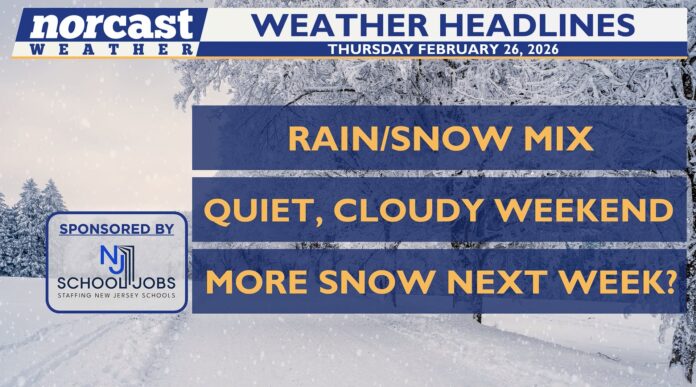

Winter is entering its sunset phase across New Jersey — but not before delivering a few more atmospheric curveballs.
An overnight clipper system slid through the Garden State, dropping a coating to roughly an inch of snow in spots before temperatures rose and erased most evidence by mid-morning. Impacts were minimal. Roads remained largely wet, natural surfaces briefly whitened, and by late morning the event was more visual than consequential.
That theme — marginal setups, fast movers, and temperature battles — will define the next several days across North Jersey (NNJ), Central Jersey (CNJ), and South Jersey (SNJ).
Here’s where things stand as we track the evolving forecast.
Overnight Clipper: A Quick Hit With Little Staying Power
The clipper that moved through overnight behaved as expected: light snow accumulation under favorable pre-dawn surface temperatures, followed by rapid melting once readings climbed.
These Alberta-style clippers are moisture-starved systems that rely heavily on timing. When they arrive during peak cold, they can produce nuisance coatings. When they arrive near or after sunrise, solar influence and rising boundary layer temperatures typically limit impact.
That’s exactly what happened.
Accumulation remained confined mostly to grassy and untreated natural surfaces. Paved roads stayed primarily wet, with only isolated slick spots early.
This event sets the tone for a week defined by marginal thermal profiles and conditional snow potential.
Thursday Afternoon–Evening: A “Conversational Snow” Setup
Attention now turns to a possible slider wave Thursday afternoon into early evening.
If this system tracks far enough north, snow showers — or even a more organized band of snow — could sweep across portions of Southern New Jersey, particularly along and south of the extended Mason-Dixon line.
But here’s the problem: surface temperatures.
Forecast highs are expected in the 38–44°F range during peak precipitation timing (roughly noon to 2 PM onset). Even if moderate snowfall rates briefly cool natural surfaces toward 32°F by late afternoon (around 4–5 PM), paved surfaces would lag significantly behind.
The practical outcome?
A scenario commonly referred to as “white rain.”
Snow may fall steadily. It may look wintry. But accumulation would be limited primarily to colder natural surfaces. Roadways would likely remain wet, potentially turning slushy only at the very end — and only in isolated spots.
Worst-case modeling from the GFS suggests:
• 2–4 inches of snow falling from the sky
• A coating to 2 inches sticking on natural surfaces
• Roads largely wet, possibly briefly slushy late
The European model (Euro) is less enthusiastic, showing lighter totals and a more suppressed track. Meanwhile, mesoscale guidance pushes the bulk of precipitation south into Delmarva with rain dominating there.
So the range for New Jersey Thursday spans:
• A complete southern miss
• Scattered snow showers
• A brief moderate band producing mainly cosmetic accumulation
This may not warrant a formal accumulation map. It could simply be categorized as passing snow showers with minimal impact.
For commuters and school administrators, this appears to be a low-risk event at this time.
Sunday Night Into Monday: Another Fast-Moving Coating?
A subtle secondary wave may ride along a cold front Sunday night into Monday morning.
This setup resembles the recent clipper — quick, limited moisture, marginal but colder air filtering in behind the boundary.
Current thinking:
• A coating to perhaps an inch overnight
• Minimal travel impact
• Mostly confined to grassy surfaces
This would wrap up what can best be described as a “meh snow” stretch — visually wintry but operationally quiet.
The more compelling signal lies just beyond.
March 2–3 (Monday–Tuesday): A More Organized Snow Signal
The Monday–Tuesday period presents a stronger synoptic setup and a more legitimate opportunity for accumulating snow across New Jersey.
Unlike the marginal Thursday wave, this system benefits from a preceding cold front Sunday night, which should lower boundary layer temperatures more effectively.
Model spread remains, but current guidance suggests:
GFS:
• Snow-dominant event Monday
• 1–3 inches for NNJ
• 2–4 inches for SNJ
Canadian:
• Front-end snow thump Tuesday
• Transition to rain Tuesday night
• Statewide 3–6 inches, possibly 4–8 in stronger bands
European:
• 1–3 inches NNJ
• 3–6 inches SNJ
• Changeover to rain late
This is not signaling a blockbuster nor a major nor’easter. However, it could represent a meaningful light-to-moderate snowfall event before winter begins to lose climatological leverage.
Key factors to monitor:
• Thermal profiles at onset
• Precipitation intensity (rate-dependent cooling)
• Timing of any rain transition
• Ground temperature retention
This system will shift from casual monitoring to serious tracking if model consistency strengthens by Friday.
For now, it is the most credible accumulation opportunity in the near term.
Late Next Week: Rain and a Milder Pattern Shift
Beyond the early-week snow potential, a larger-scale rain signal is emerging for the March 5–7 timeframe.
That system may usher in a more sustained mild period across the Mid-Atlantic and Northeast.
Forecast trends indicate:
• Temperatures climbing into the 50s
• Potential for 60°F readings March 7–11
• A 1–2 week milder regime
Warmups this time of year tend to trend warmer as lead time shortens. Increasing sun angle and expanding daylight hours work against late-season snow.
Climatology becomes an opponent.
Average highs climb through the 50s by mid-March across much of New Jersey. Snow becomes harder to accumulate without anomalously cold air masses.
Is Winter Over After March 12–15?
The wildcard remains the polar vortex region.
There are signals of additional upper-level disruption that could split or displace cold air into the eastern United States — similar to setups seen in 1993, 2014, or 2017.
If a deep trough were to establish over the Northeast or Mid-Atlantic with sufficient cold air support, late-season snow would remain possible through March 30.
If, however, temperature anomalies trend only slightly below average, that would likely be insufficient for meaningful accumulation.
By March 12–15, we should have a much clearer temperature trajectory for the second half of the month.
That window may ultimately determine whether the snow season quietly fades or makes one last attempt.
In Plain English
This morning’s snow was cute.
Thursday’s system ranges from a southern miss to cosmetic “white rain.”
Sunday night offers another quick coating opportunity.
Monday–Tuesday is the real player — potentially light to moderate accumulation before a possible rain finish.
After that, rain next week may usher in a milder stretch with 50s and possibly 60s entering the picture.
Winter is entering its sunset phase. Possibly even hospice phase.
But until March firmly takes control, New Jersey’s weather remains capable of one or two more late-season surprises.
Sunset Daily News New Jersey will continue monitoring the evolving models and synoptic signals closely. If the Monday–Tuesday system retains support into Friday, expect detailed tracking, refined accumulation zones, and impact-based forecasting as we move into the weekend.
For now, enjoy the brief white backdrops — and keep an eye on early March.



