



New Jersey’s long-standing distinction as the state with the highest property taxes in the country continues to define both its economic identity and its political landscape, as homeowners and policymakers alike confront the realities of rising costs, structural funding challenges, and evolving relief strategies. With average effective property tax rates ranging from approximately 1.77% to as high as 2.23% in recent analyses, the burden on residents routinely translates into annual bills exceeding $10,000—placing sustained pressure on households across every region of the state.
As the conversation unfolds within Trenton and beyond, property taxes are once again at the center of New Jersey’s fiscal narrative, intersecting with broader debates over affordability, public investment, and long-term competitiveness. The issue is not new, but its urgency has intensified amid ongoing budget discussions, shifting economic conditions, and renewed focus on tax relief programs designed to ease the strain on residents.
At its core, New Jersey’s property tax system is fundamentally local. Unlike many other states that rely more heavily on income or sales taxes to fund public services, New Jersey depends significantly on property taxes to support its public school system, municipal operations, and county-level services. This localized structure means that tax rates are not uniform across the state, but instead vary based on property values, school district budgets, and the financial needs of individual municipalities.
The result is a complex patchwork of tax burdens, where neighboring towns can have markedly different rates depending on their economic base, population density, and access to commercial ratables. In areas with limited commercial development, residential property owners often shoulder a larger share of the tax burden, driving rates higher even when property values remain relatively stable.
Recent data underscores the disparity across counties. Camden County currently stands among the highest in the state, with effective rates reaching approximately 2.32%, reflecting both the cost of local services and the dynamics of its tax base. In contrast, Cape May County consistently ranks among the lowest, with rates generally falling between 1.10% and 1.32%, offering a stark illustration of how regional factors shape tax outcomes.
For homeowners, these percentages translate into tangible financial realities. A property assessed at $400,000 in a higher-tax county can generate a significantly larger annual tax bill than a similarly valued home in a lower-rate region. This variability has become a defining feature of New Jersey’s housing market, influencing where people choose to live, invest, and build.
The structure of property tax payments adds another layer of predictability—and pressure. Bills are due quarterly, with payment deadlines set for February 1, May 1, August 1, and November 1. For many households, these recurring obligations require careful financial planning, particularly as costs continue to rise alongside broader economic pressures.
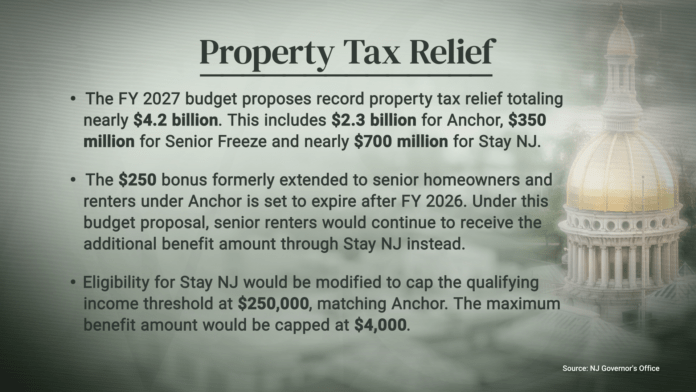
Against this backdrop, state leaders have increasingly turned to relief programs as a way to offset the burden without fundamentally restructuring the system. Among the most prominent is the ANCHOR program, which provides rebates to both homeowners and renters. Typically distributed beginning in September, ANCHOR payments are designed to deliver direct financial relief, helping residents manage the high cost of property taxes in a targeted and immediate way.
For senior residents, the Senior Freeze program offers another layer of support by reimbursing eligible individuals for increases in property taxes over time. Payments, which begin in mid-July, are aimed at stabilizing housing costs for older residents on fixed incomes, ensuring that rising assessments do not force displacement or financial hardship.
Emerging alongside these established programs is the proposed Stay NJ initiative, a policy concept that has quickly become a focal point in ongoing budget discussions. The program is designed to provide a significant reduction—potentially up to 50%—in property tax obligations for qualifying seniors. However, questions surrounding funding mechanisms, eligibility thresholds, and income caps remain central to legislative negotiations. Proposals to adjust income limits, including potential caps around $250,000, highlight the complexity of balancing broad relief with fiscal sustainability.
These programs, while impactful, also reflect a larger truth: New Jersey’s property tax challenge is deeply structural. The reliance on local funding for education and municipal services creates a system where costs are closely tied to community-level decisions and needs. High-performing school districts, comprehensive public services, and robust local infrastructure all contribute to higher budgets—and, by extension, higher property taxes.
This dynamic has placed property taxes at the heart of political discourse, particularly as state leaders weigh competing priorities within the broader budget framework. Investments in education, public safety, transportation, and healthcare all require funding, and property taxes remain one of the primary mechanisms through which those funds are generated.
At the same time, concerns about affordability continue to shape policy discussions. New Jersey’s cost of living is among the highest in the nation, and property taxes play a significant role in that equation. For middle-class families, retirees, and first-time homebuyers, the cumulative impact of high taxes can influence decisions about homeownership, relocation, and long-term financial planning.
The connection between property taxes and economic competitiveness is also becoming increasingly pronounced. Businesses evaluating expansion or relocation consider not only corporate tax structures but also the cost of living for employees, including housing expenses driven by property taxes. As neighboring states seek to attract investment, New Jersey faces ongoing pressure to balance its funding needs with the desire to remain an attractive destination for both businesses and residents.
Within the broader political landscape, coverage in the politics section continues to track how these issues intersect with legislative priorities and budget negotiations. Property tax policy is no longer a standalone issue—it is embedded within conversations about economic growth, infrastructure investment, and the future direction of the state.
For policymakers, the challenge lies in navigating a system that is both deeply entrenched and critically important. Any effort to significantly alter property tax structures must account for the funding of schools, municipalities, and counties, all of which depend on this revenue stream to operate effectively. As a result, reform efforts often focus on relief and adjustment rather than wholesale change.
For residents, the reality is more immediate. Quarterly payments, rising assessments, and the ongoing search for relief programs define the lived experience of property ownership in New Jersey. While initiatives like ANCHOR, Senior Freeze, and Stay NJ provide meaningful support, they also underscore the scale of the challenge.
As the state moves forward, the conversation around property taxes is unlikely to diminish. Instead, it will continue to evolve, shaped by economic conditions, policy decisions, and the needs of communities across New Jersey. What remains constant is the central role property taxes play in funding the services that define the state—from its schools and public safety systems to the infrastructure that supports daily life.
In this environment, understanding the mechanics, impacts, and policy responses surrounding property taxes is essential for anyone engaged in New Jersey’s economic and political landscape. The numbers tell part of the story, but the broader narrative is one of balance—between investment and affordability, between local control and statewide impact, and between the demands of today and the vision for the state’s future.



